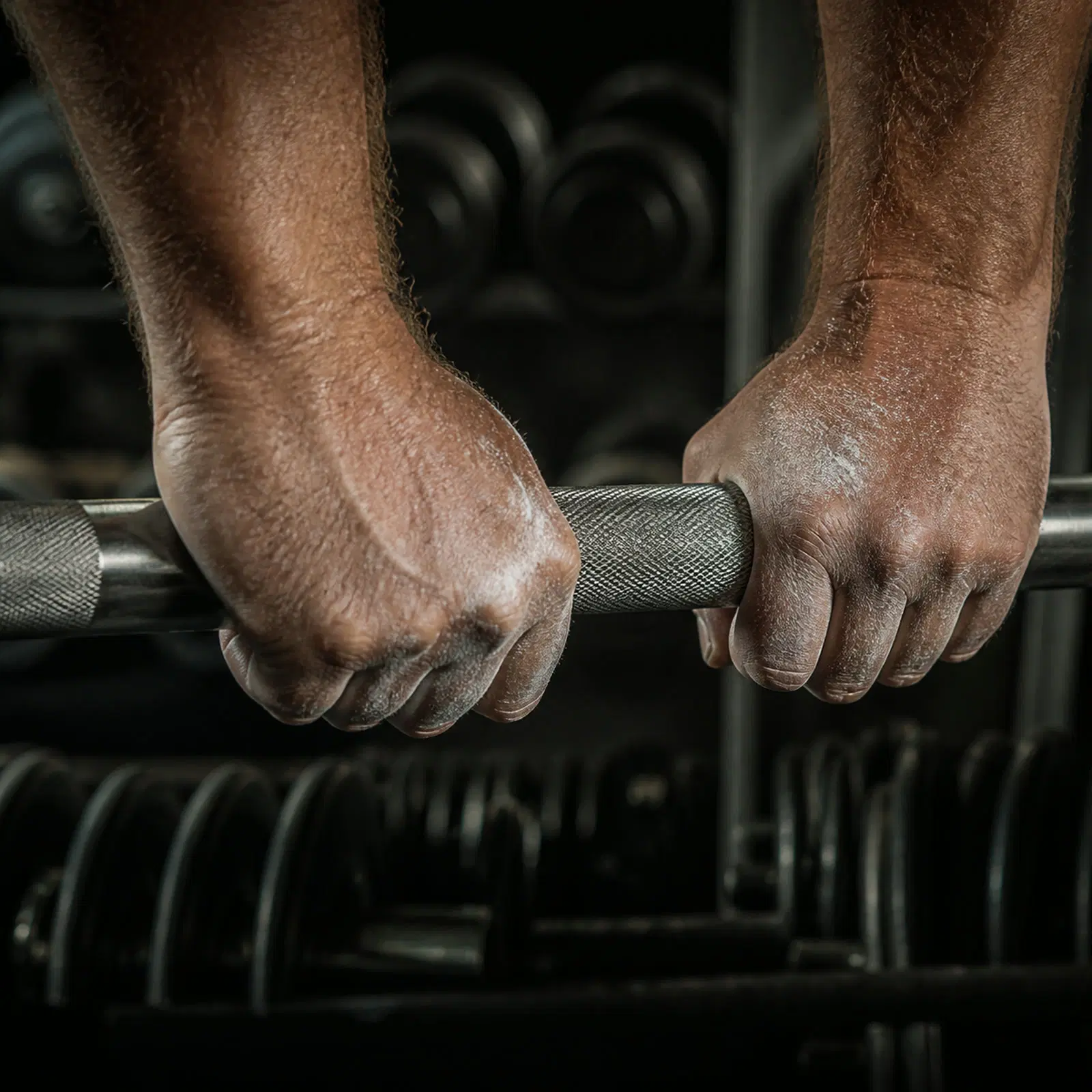
Plate-Loaded Machines
Sources and review status
Review pending — this text hasn’t been signed off by a reviewer yet.
See this lesson’s sources0% read · 1 min left
Leverage machines you load with barbell plates rather than a pin stack — guided like a machine but with a free-weight feel and often independent (unilateral) arms.
Detail
Plate-loaded (a.k.a. leverage) machines guide the movement like a selectorized machine but are loaded with Weight Plates (Iron & Bumper) on pegs instead of a pin-selected stack. Brands like Hammer Strength popularized them.
Pros
- Free-weight-like resistance — loaded with iron, they "feel" heavier and more natural than a cable stack; resistance can rise near the top via leverage/cam geometry (see Variable Resistance Training (Machines, Cams)).
- Often independent arms — each side moves separately, exposing left-right imbalances like a dumbbell while keeping a guided path.
- Heavy loading with the safety of a fixed path and easy entry/exit (e.g., leg press, chest press, rows).
- More durable and serviceable than cable mechanisms.
Cons
- Slower to change — you must load/strip plates each set.
- Footprint and cost — large, expensive; commercial-gym staple.
- Still a guided, largely single-plane path with limited stabilizer demand vs. true free weights (see Free Weights vs. Resistance Machines).
These bridge the gap between machines and free weights — guided and safe, yet heavy and natural-feeling.
Key facts
- Loaded with barbell plates on pegs; leverage/cam guides the path.
- Feel more like free weights than pin stacks; often have independent arms.
- Allow heavy, fixed-path loading; safe entry/exit.
- Slower to change than pin machines; large and costly.
Connections
- Selectorized (Pin) Machines — pin-stack counterpart.
- Weight Plates (Iron & Bumper) — what loads them.
- Leg Press Machine — a common plate-loaded machine.
- Free Weights vs. Resistance Machines / Variable Resistance Training (Machines, Cams) — comparison and cam mechanics.
Sources
Keep this lesson, or ask how it applies to you.
Educational content only — not medical advice. Always consult a qualified professional for individualized guidance, especially around injury, pregnancy, or medical conditions.