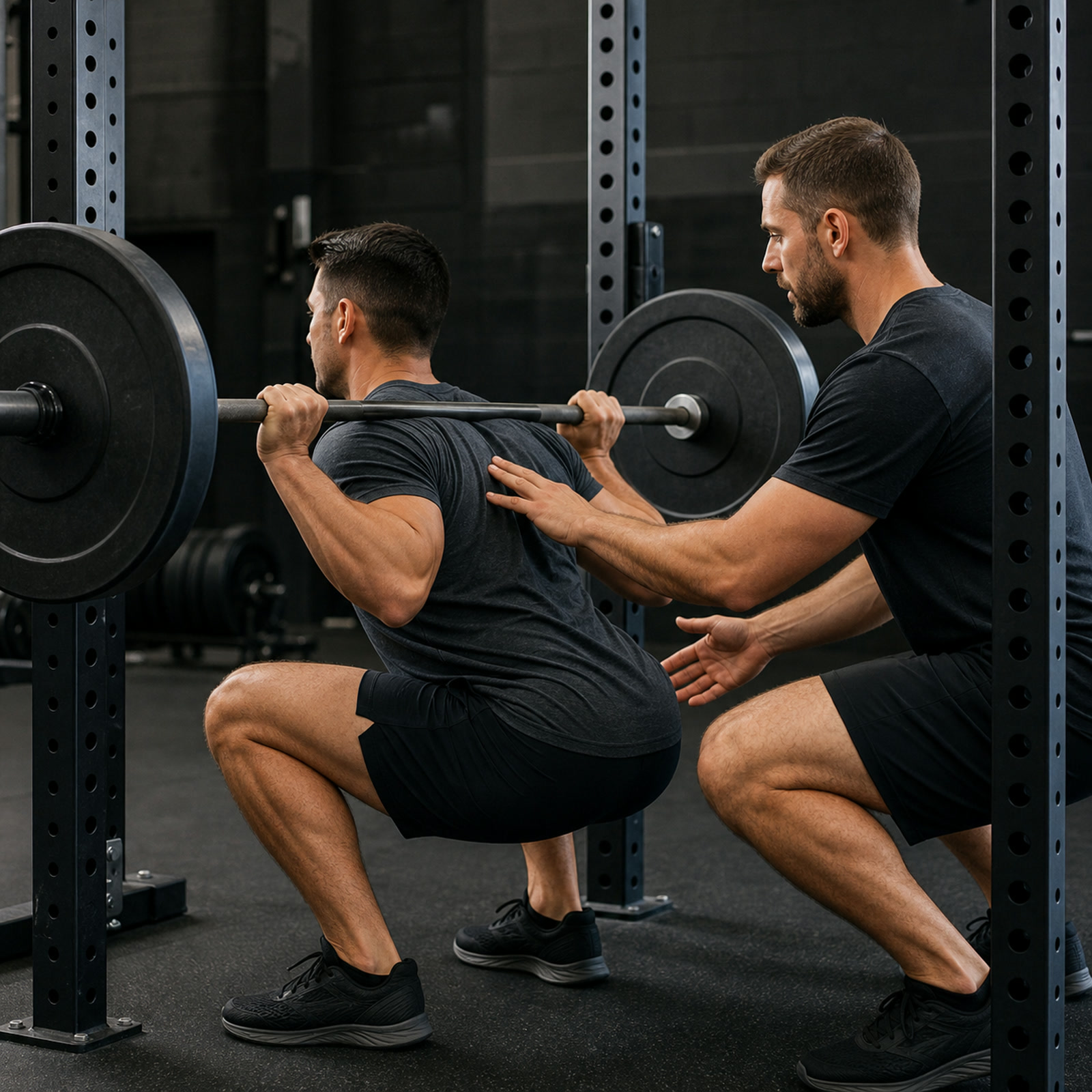
Movement Speed as a Safety Factor (Slow, Controlled Lifting)
0% read · 2 min left
With safety as the number-one concern, resistance exercises should be performed slowly and controlled — fast movements stress muscle, connective tissue, and joints, and rely on momentum rather than muscle.
Detail
With safety as the number one concern, it is important to perform resistance-training exercises in a slow, controlled manner (Westcott, 1987). Fast movements place considerable stress on the muscles, connective tissue, and joint structures and should be avoided. Many people prefer fast resistance training because they can use heavier weight-loads — but it is momentum rather than muscle that permits this. Fast strength training is actually more dangerous and less effective than slow training.
A good guideline is 60 degrees of movement per second. Because many exercises traverse about 120 degrees, this corresponds to about 2 seconds for each phase of the lift. Pause momentarily in the fully contracted position, then lower under control; the lowering (eccentric) phase should be at least as long as the lifting (concentric) phase, because muscles produce more force eccentrically.
Among the five reasons supporting the slow technique, the safety-relevant factors are "Less Tissue Trauma" — power events with heavy resistance (e.g., the clean and jerk) place great stress on joint structures; the faster you accelerate an object, the greater the initial stress on the involved tendons, ligaments, and muscle fascia — and "Less Momentum."
Key facts
- Safety is the number-one reason to lift slowly and controlled.
- Fast lifting relies on momentum, not muscle, and is more dangerous and less effective.
- Guideline: ~60° of movement per second (~2 seconds per phase over a ~120° range).
- Eccentric (lowering) phase should be at least as long as the concentric phase.
- Faster acceleration = greater initial stress on tendons, ligaments, and muscle fascia.
Connections
- movement-speed — the movement-speed principle.
- momentum-injury-risk — momentum's injury and stress effects.
- eccentric-action — eccentric force production.
- rep-tempo-safety — repetition-tempo safety guidance.
Educational content only — not medical advice. Always consult a qualified professional for individualized guidance, especially around injury, pregnancy, or medical conditions.