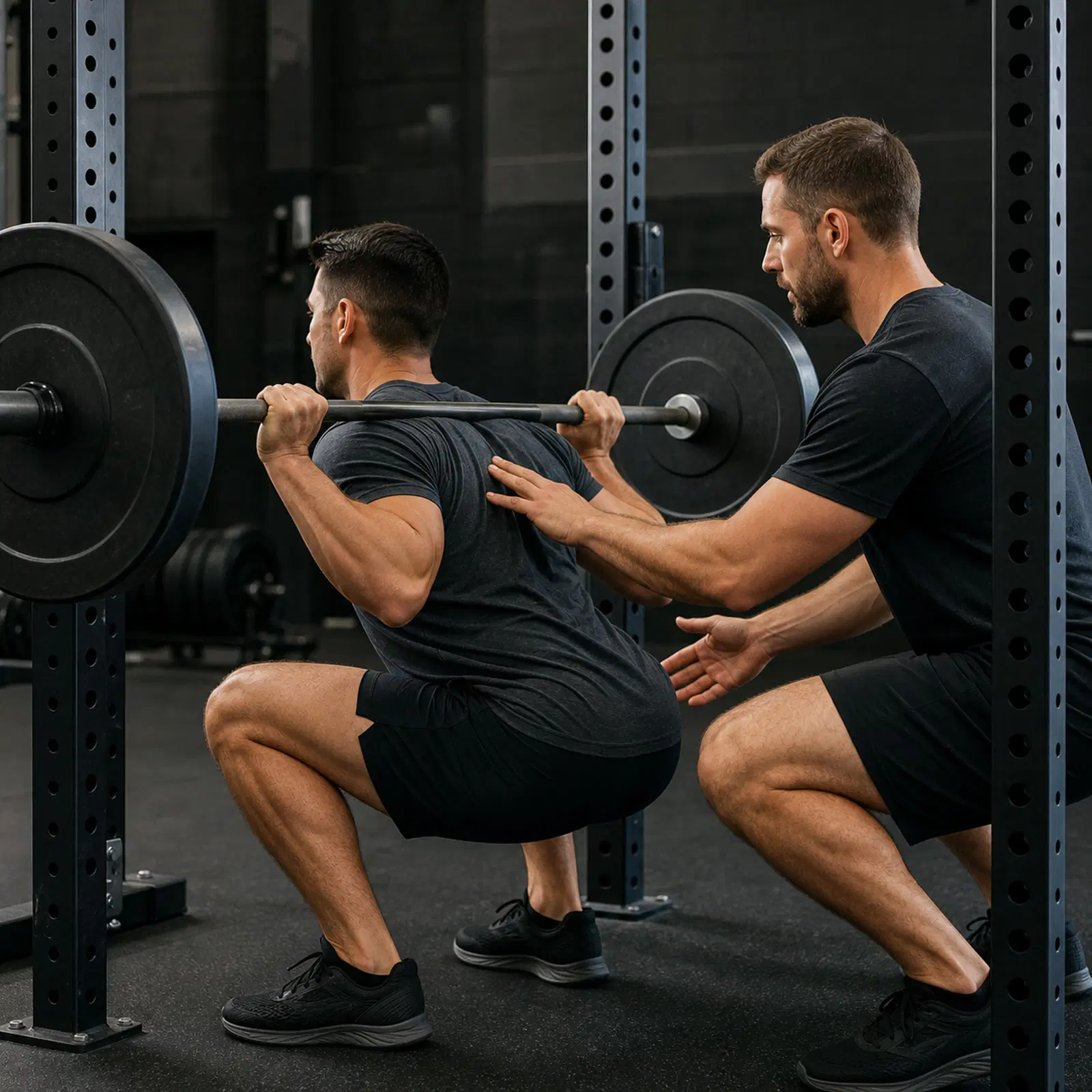
Most lifting injuries come from load, fatigue and form drifting together. Learn the mechanics that keep heavy work repeatable.
What do you want to do?
Start here
4 lessons · ~5 min · in this order- 1Proper Form as Injury PreventionProper form is an injury-prevention measure — especially in squats, deadlifts, and the bench press — and form-breaking advanced systems are not recommended for beginners.Begin →
- 2Safe Lifting MechanicsFour rules for lifting heavy objects in the weight room and at home — keep the back's natural curves, lift with the legs, hold loads close, and avoid twisting/jerking.1 min
- 3Breathing Technique & the Valsalva EffectNever hold your breath while lifting — breath-holding during heavy exertion produces a Valsalva effect that spikes blood pressure and cuts blood flow to the heart, causing fainting.1 min
- 4Soreness vs. Injury (Sharp Pain Distinction)Ordinary post-exercise soreness/stiffness is an expected adaptation, but a sharp, acute pain with joint movement or muscle elongation signals a problem — stop, don't push through it.2 min
More reading routes through Safety
Squat without wrecking your knees · Get the mechanics right
Lift heavy safely · Breathing, spotting, lockout
Stretch without the risky stuff · Skip the contraindicated moves
Every Safety topic
51 topics
- "X-Rated" Exercises (Contraindicated Stretches) — Overview2 minSafety Rule · A set of stretches rated "X" because they are too advanced or dangerous for the average fitness participant — and sometimes even for advanced athletes.
- Back (Behind-Neck) Lat Pulldown — Rotation Danger3 minSafety Rule · Front and behind-neck lat pulldown are not fundamentally different movements — they train the same muscle from a different angle. The behind-neck version is riskier because of the external rotation it imposes on the shoulder, the same core mechanism that makes behind-neck pressing risky.
- Back Pain Prevalence (80–90% of Population)1 minSafety Fact · 80 to 90 percent of the general population will experience back pain at some point in their lifetime.
- Bar Placement in the Squat (High / Low / Front)2 minSafety Rule · Three squat bar positions — high bar (Back Squat), low bar (called "Power Back Squat" in the source; known today as the low-bar squat), and bar-in-front (Front Squat) — each set a different line of force and require proper alignment.
- Behind-the-Neck Press Not Recommended1 minSafety Rule · The behind-the-neck (press behind neck) shoulder press is not recommended because it involves too much external rotation of the shoulder — the same core risk mechanism as behind-neck lat pulldown, since both are the same underlying press/pull pattern taken to a riskier angle, not a separate hazard each.
- Bench Press — Arching the Back (Improper Technique)1 minSafety Rule · Arching the back during the bench press creates dangerous pressure on the spinal discs and adjoining vertebrae, which could cause herniated discs.
- Breathing Technique & the Valsalva Effect1 minSafety Rule · Never hold your breath while lifting — breath-holding during heavy exertion produces a Valsalva effect that spikes blood pressure and cuts blood flow to the heart, causing fainting.
- Calf-Raise Knee & Technique Cautions1 minSafety Rule · On the standing calf raise, don't bend the knees to assist and don't lock them out; on the donkey calf, move vertically (don't pivot around the axis) with the balls of the feet on the plate.
- Causes of Back (Erector Spinae) Disorders1 minSafety Fact · Back (ES) disorders usually result from poor posture, faulty body mechanics, loss of flexibility, decline of physical fitness, and stressful living/working conditions.
- Consult a Fitness Instructor Before Starting1 minSafety Rule · A standing instruction repeated on every program template — please consult a Fitness Instructor before starting an exercise program.
- Deep Knee Bend / Lunge / Squat — Contraindicated Ballistic Stretch2 minContraindicated Exercise · Bouncing or forcing into deep knee bends, lunges, or squats as a stretch is marked "X" in the source (said to strain the knee's lateral ligaments, compress the kneecap, and pinch cartilage). This is about ballistic end-range stretching, not controlled deep squats, which are safe for healthy knees.
- Deltoid Training Cautions (Subluxation & Rotation)1 minSafety Rule · Positioning the upper arm 45° away from the torso prevents shoulder subluxation; beware internal/external rotations; the press-behind-neck is not recommended (too much external rotation).
- Dips — Extreme Shoulder Hyperextension (ROM 45°)1 minSafety Rule · Dips cause extreme shoulder hyperextension — be safe; the shoulder hyperextension ROM is only 45 degrees.
- Dumbbell Press — Ending With a Wrist-Rotation Twist Reduces Pec Contraction2 minSafety Fact · Twisting the dumbbells to a supinated, pinkies-together position at lockout produces LESS pectoral contraction (EMG), not more — because the twist diverts force into humeral rotation, off the pec's actual line of pull.
- Femur Length vs. Torso Length in the Squat1 minSafety Rule · Body proportions change squat mechanics — a long femur forces more forward lean and shifts emphasis to the glutes and erector spinae; lifters must adapt their technique accordingly.
- Five-Step Evaluation of Proper Resistance Exercise1 minSafety Rule · A five-step framework for evaluating safe, proper exercise — joint movement, muscle involvement, direction of resistance, body positioning (alignment/stabilization), and range of movement — and don't combine two movements in one exercise.
- Free Weights vs. Machines — Safety Considerations1 minSafety Fact · Advocates consider machines safer than free weights and usually spotter-free, while free weights demand more sophisticated technique — but free weights have a long accident-free track record.
- Iliopsoas, Lumbar Lordosis & Sit-Up Lower-Back Caution2 minSafety Rule · Tight hip flexors increase lumbar lordosis and low-back strain; straight-leg sit-ups and leg raises work the hip flexors and, with too much upward movement, can cause lower-back problems instead of abdominal tone.
- Initiate Pressing/Fly Movements With Pectoral Contraction, Not Deltoid or Arm3 minSafety Fact · Start pec presses and flyes by contracting the chest first — not the
- Inversion (Inverted Hanging) — Contraindicated Stretch1 minContraindicated Exercise · Hanging upside down raises blood pressure, may rupture blood vessels (especially in the eyes), and may injure those with spinal instability — marked "X".
- Knee Safety in the Leg Extension2 minSafety Rule · Because the knee is a hinge joint, the leg extension requires aligning the patella with the cam's axis of rotation and a slight inward rotation of the quads so extension stays in a vertical plane; locking out is not very dangerous here.
- Knee Safety in the Squat3 minSafety Rule · Safe squatting protects the knee by not locking out, keeping proper spinal alignment, squatting as deep as your mobility allows with control, and managing patellar tracking — knee pressure jumps ~8× from standing to a 90° bend, which is why stopping at parallel isn't the low-stress option it seems.
- Knee Wraps — Effects, Limits & Detrimental Side Effects2 minSafety Fact · Heavy knee wraps boost squat performance through mechanical and other effects, but there is no evidence they prevent injury — and they can damage the patella and cause chondromalacia.
- Knee–Toe Relationship Rule1 minSafety Rule · In the squat, manage where the knees travel relative to the toes — keeping the knees from passing the toes versus keeping the spine vertical — and find the "happy medium."
- Locking Out — When It Is and Isn't Risky1 minSafety Rule · Locking out joints under load is generally avoided in the squat and calf raises, but in the leg extension it is "not very dangerous" because the resistance pushes the shins down.
- Momentum as an Injury Risk1 minSafety Rule · Momentum-assisted lifting increases stress on joint structures and injury potential while decreasing the demand on the target muscles.
- Movement Speed as a Safety Factor (Slow, Controlled Lifting)2 minSafety Rule · With safety as the number-one concern, resistance exercises should be performed slowly and controlled — fast movements stress muscle, connective tissue, and joints, and rely on momentum rather than muscle.
- Muscle Balance (Agonist/Antagonist) as Injury Prevention1 minSafety Rule · Whenever a muscle group is disproportionately stronger than its antagonist, the weaker one is predisposed to injury — so opposing muscle groups should both be trained.
- Pectoral Training — Internal/External Rotation & Bar-Placement Cautions1 minSafety Rule · "Be safe" in chest training — determine the user's ROM beforehand, beware internal/external rotations from improper bar placement, and note that dips cause extreme shoulder hyperextension (ROM 45°).
- Proper Alignment & Stabilization1 minSafety Rule · Set the body up to oppose the resistance, align the joint's axis of rotation with the machine's, and start and end each rep in the same stabilized position.
- Proper Form as Injury Prevention1 minSafety Rule · Proper form is an injury-prevention measure — especially in squats, deadlifts, and the bench press — and form-breaking advanced systems are not recommended for beginners.
- Repetition Tempo & Ballistic-Movement Caution1 minSafety Rule · Within each repetition: refrain from momentum on the way up, pause at mid-range, lower deliberately, and stimulate throughout the ROM — ballistic-type movements compromise safety and effectiveness.
- RM-Loading Caution (Hamstring Curl & Stiff-Leg Deadlift)1 minSafety Rule · Some exercises require care in using RM (repetition-maximum) loading because of possible injury — for example the hamstring curl and stiff-leg deadlift.
- ROM Is Not How Far the Weight Moves1 minSafety Rule · Range of motion is not measured by how far the weight moves — determine the user's true joint ROM before the exercise, for safety.
- Rotator Cuff — Use Only Low Resistance1 minSafety Rule · When training the rotator cuff muscles (SITS), ensure that only low resistances are used.
- Safe Lifting Mechanics1 minSafety Rule · Four rules for lifting heavy objects in the weight room and at home — keep the back's natural curves, lift with the legs, hold loads close, and avoid twisting/jerking.
- Soreness vs. Injury (Sharp Pain Distinction)2 minSafety Fact · Ordinary post-exercise soreness/stiffness is an expected adaptation, but a sharp, acute pain with joint movement or muscle elongation signals a problem — stop, don't push through it.
- Spine Positioning — "S" Shape, Never "C"2 minSafety Rule · Stabilize the spine by holding it in a semi-isometric contraction so it keeps its natural "S" shape — never allow a "C"-shaped spine during exercise. This is a coaching cue for loaded lifting, not a literal, universal rule — see "Current nuance" below.
- Spotting Requirements2 minSafety Rule · Proper spotting ensures lifter safety — spotters must know the lift's technique, be strong/tall enough to assist, support the right body parts, and be present in adequate number (e.g., a heavy 1-RM squat).
- Squat Depth and Knee Safety (Deep Squats Are Not Inherently Dangerous)5 minSafety Rule · For people without knee pathology, squatting deep with good technique and appropriate load is not inherently dangerous to the knee, and it builds more glute and adductor muscle than half squats. Depth should match the individual's mobility, not an arbitrary "parallel only" ceiling.
- Straight-Leg Standing Floor/Toe Touch — Contraindicated Stretch1 minContraindicated Exercise · Bending fully forward with straight legs to touch the toes forces knee hyperextension and loads the lower (lumbar) vertebrae — marked "X".
- Straight-Leg Straddle Stand and Floor/Toe Touch — Contraindicated Stretch1 minContraindicated Exercise · Bending over to the floor from a wide straight-leg straddle stresses the medial knees, can cause permanent deformity, hyperextends the knees, and loads the lumbar vertebrae — marked "X".
- Stretching Precautions & Contraindications2 minSafety Rule · Stretching is not a panacea — for some it can increase the risk of ligament injury and joint dislocation; do not stretch under several specific conditions, and avoid too much ROM.
- The Bridge — Contraindicated Stretch1 minContraindicated Exercise · The back-bridge (wrestler's bridge) squeezes the spinal discs and pinches the nerve fibers — marked "X".
- The Hurdler's Stretch (Inverted) — Contraindicated Stretch1 minContraindicated Exercise · The single- or double-leg inverted hurdler's stretch endangers the knee — stretching its medial ligaments, crushing the meniscus, and side-slipping the kneecap.
- The Plough — Contraindicated Stretch1 minContraindicated Exercise · A folded-over inversion (legs brought over the head while lying on the back) that overloads the lower back and discs and compresses the chest — marked with an "X" as not-to-be-performed.
- The Standing Torso Twist — Contraindicated Stretch1 minContraindicated Exercise · The standing torso twist (with or without weights) strains the knee ligaments and relies on momentum that can exceed the tissues' absorbing capacity — marked "X".
- Tight Hamstrings as a Cause of Back Problems1 minSafety Fact · Tight hamstrings are a recognized cause of back problems — one reason flexibility work emphasizes the low-back and hamstring area.
- Training the 12 Major Muscle Groups to Reduce Injury Risk1 minSafety Rule · For balanced muscle development and to reduce injury risk, strengthen all 12 major muscle groups — training some while excluding others can lead to muscle injuries.
- Warm-Up's Injury-Reduction Role2 minSafety Rule · A warm-up raises muscle temperature, increases blood flow and elasticity, and reduces the risk of injury — stretch only after warming up; stretching a cold muscle can be dangerous.
- Weightlifting Belt — Proper Use & Safety Concerns2 minSafety Rule · A weight belt raises intra-abdominal pressure to support the lumbar spine during heavy/near-maximal lifts, but it can elevate blood pressure, impede venous return, and weaken the body's own trunk musculature if overused.
Explore connections
How Safety links to other categories — line thickness is link density in the graph, not an editorial rating.