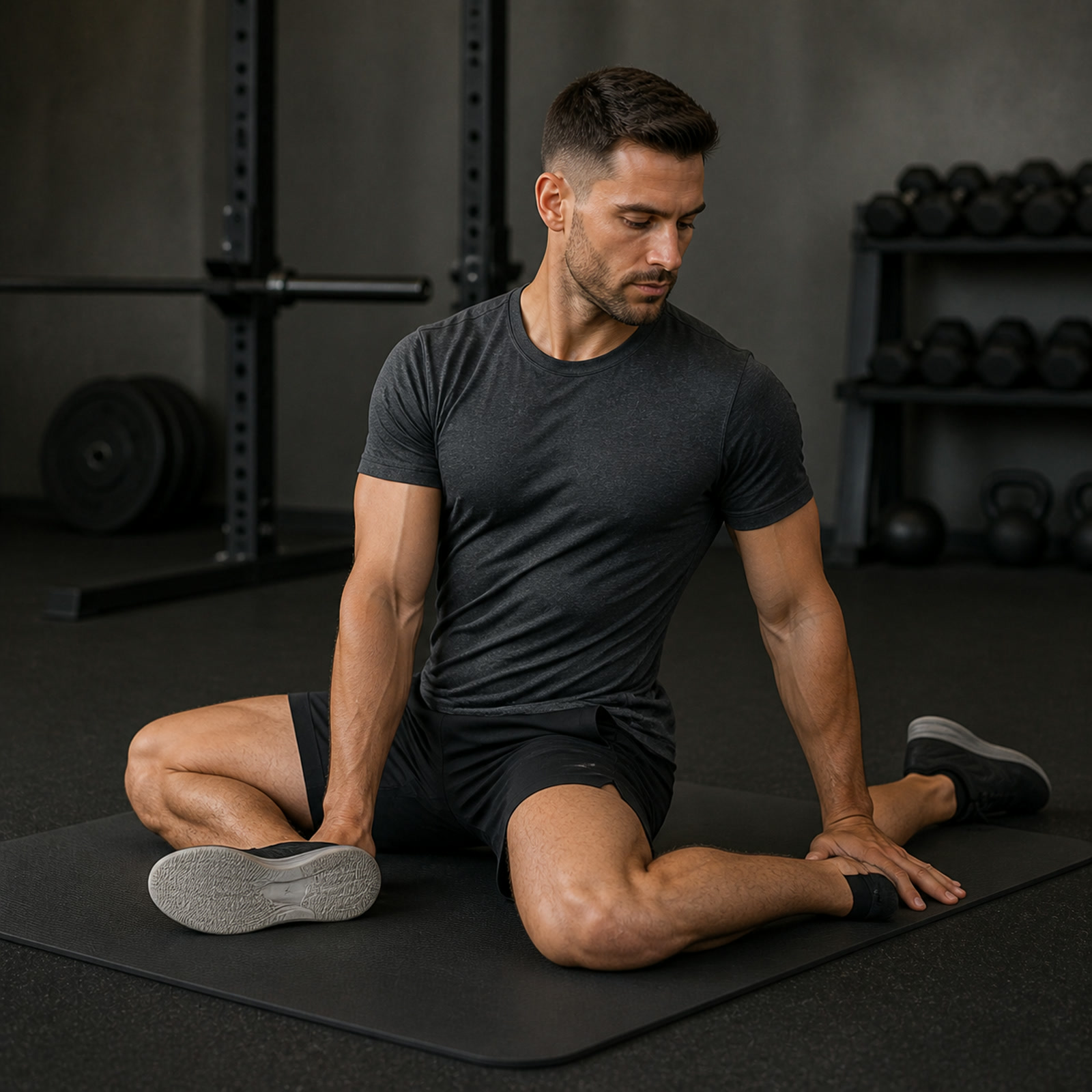
Visual System for Balance
0% read · 2 min left
Vision stabilizes posture by reporting the body's position and motion relative to the environment — which is why balance gets dramatically harder with eyes closed.
Detail
Vision is the third of the three sensory systems for balance (with the somatosensory-system and vestibular-system). It contributes in two ways:
- A reference frame: stable vertical and horizontal cues in the surroundings (door frames, horizon, walls) let the brain judge body orientation and detect sway.
- Optic flow: the pattern of motion across the retina as the body moves signals self-motion and helps the system make anticipatory corrections.
Because vision supplies a large share of postural information, removing or degrading it sharply increases the balance challenge. Closing the eyes is a standard progression step (see eyes-closed-progression) precisely because it forces the somatosensory and vestibular systems to carry the task. Conversely, a moving or misleading visual field (a passing bus, a busy patterned floor) can destabilize balance even on firm ground.
Vision-related fall risk rises in older adults through reduced acuity, cataracts, poor depth perception, multifocal-lens distortion of the lower visual field, and poor lighting (see fall-risk-factors). Gaze fixation on a stable point is a common cueing aid in balance drills.
Key facts
- One of three balance senses (somatosensory, vestibular, visual).
- Provides a visual reference frame plus optic-flow self-motion cues.
- Removing vision (eyes closed) markedly degrades balance — used as a deliberate progression.
- A moving/misleading visual field can destabilize even on stable ground.
- Vision deficits (acuity, depth, lighting, multifocal lenses) are modifiable fall risk factors.
Connections
- somatosensory-system, vestibular-system — the other two balance senses.
- eyes-closed-progression — removing vision to advance difficulty.
- sensory-reweighting — shifting away from vision when it is removed/unreliable.
- fall-risk-factors — vision deficits as fall risk.
Educational content only — not medical advice. Always consult a qualified professional for individualized guidance, especially around injury, pregnancy, or medical conditions.