Balance and core stability are trainable skills, and for older adults they are a fall-prevention priority.
What do you want to do?
Start here
4 lessons · ~11 min · in this order- 1Balance (Static vs Dynamic)The ability to keep the body's center of mass over its base of support — held still (static) or while moving (dynamic) — through continuous coordination of the somatosensory, vestibular, and visual systems.Begin →
- 2Mobility vs FlexibilityFlexibility is how far a joint can be moved, often with outside help. Mobility is how much of that range you can reach and control with your own muscles. Build both by stretching and by strengthening through full range.5 min
- 3Core Stability vs Core StrengthCore strength is how much force the trunk muscles can produce; core stability is the trunk's ability to resist unwanted motion and keep the spine controlled — and for back health and force transfer, stability usually matters more.2 min
- 4Balance Training ProgressionMake balance harder by shrinking or destabilizing the base of support and removing sensory inputs — a staircase from two-feet stable to single-leg, eyes-closed, unstable-surface, and perturbation work.2 min
Every Balance topic
56 topics
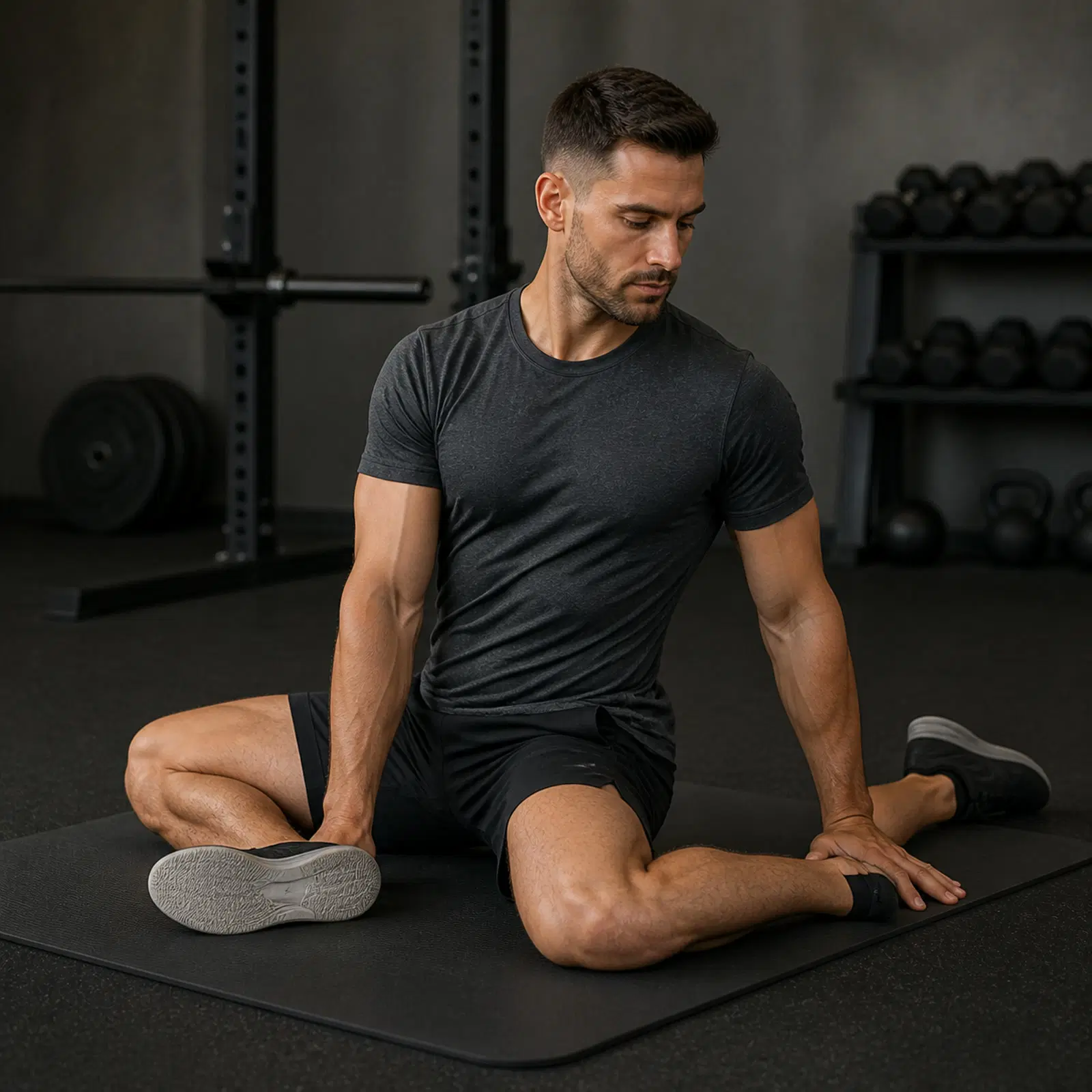
- 90/90 Hip Switch2 minExercise · Sit with both knees bent to 90° (one in front, one to the side) and rotate side to side between positions — a focused drill for hip internal and external rotation.
- Abdominal Bracing (vs Hollowing)2 minConcept · Stiffening the whole trunk wall — like bracing for a punch — to lock the spine in neutral and create a rigid base for the limbs to work from; the foundational core-stability skill.
- ACSM Neuromotor Exercise Recommendation2 minPrinciple · ACSM's 2011 position stand recommends neuromotor exercise — balance, agility, coordination, gait, and proprioceptive work — on 2–3 days per week for 20–30 minutes or more, especially for older adults, as the fourth pillar alongside aerobic, resistance, and flexibility training.
- Ankle Mobility Drills (Knee-to-Wall Dorsiflexion)3 minExercise · Drive the knee forward over the toes with the heel pinned down to mobilize ankle dorsiflexion — the joint-by-joint "mobility" target most often limiting squats and gait.
- Anti-Movement Core Training (Anti-Extension, Anti-Rotation, Anti-Lateral-Flexion)3 minConcept · Train the core by resisting motion the limbs or a load try to impose — anti-extension, anti-rotation, and anti-lateral-flexion — rather than by repeatedly flexing the spine.
- Arm Circles1 minExercise · Circle the arms forward and backward through a growing range to warm and mobilize the shoulders — a quick, equipment-free dynamic warm-up drill.
- Balance (Static vs Dynamic)2 minConcept · The ability to keep the body's center of mass over its base of support — held still (static) or while moving (dynamic) — through continuous coordination of the somatosensory, vestibular, and visual systems.
- Balance Training Progression2 minPrinciple · Make balance harder by shrinking or destabilizing the base of support and removing sensory inputs — a staircase from two-feet stable to single-leg, eyes-closed, unstable-surface, and perturbation work.
- Balance Training Tools (Pad, BOSU, Wobble Board, Stability Ball)2 minConcept · A graded toolkit of unstable surfaces — from a mildly compliant foam pad to a tilting wobble board — each adding a known amount of instability to balance and core drills.
- Bird-Dog2 minExercise · From hands-and-knees, extend the opposite arm and leg while keeping the spine perfectly still — a contralateral coordination and anti-rotation core-stability staple.
- BOSU Squat2 minExercise · A bodyweight squat performed standing on a BOSU dome, adding constant ankle/hip/trunk stabilizer demand — a balance-and-proprioception drill, not a place to load heavy.
- Cat-Cow1 minExercise · From hands and knees, alternately round the spine (cat) and arch it (cow), moving with the breath — a gentle dynamic drill that mobilizes the whole spine into flexion and extension.
- Controlled Articular Rotations (CARs)2 minPrinciple · Slow, deliberate circles taking a single joint through its full active range under maximum muscular control — a daily method to map, maintain, and expand usable joint range.
- Coordination1 minConcept · The ability to combine movements of several body parts smoothly, accurately, and in the right sequence and timing — the quality that makes a complex motion look effortless.
- Core Stability vs Core Strength2 minConcept · Core strength is how much force the trunk muscles can produce; core stability is the trunk's ability to resist unwanted motion and keep the spine controlled — and for back health and force transfer, stability usually matters more.
- Dead Bug2 minExercise · Lie on your back and lower an opposite arm and leg while pinning the low back to the floor — a beginner-friendly anti-extension core-stability drill and the supine partner to the bird-dog.
- Deep Squat Hold2 minExercise · Sink into the bottom of a full squat and relax into the position — a loaded end-range hold that builds and maintains hip, ankle, and knee mobility for squatting and sitting.
- Dynamic Balance Drills2 minPrinciple · Balance challenges performed while the body or base of support is moving — walking heel-to-toe, reaching beyond the base, turning, stepping over obstacles — the form of balance most relevant to real life and falls.
- Dynamic Warm-Up (Mobility-as-Training)2 minPrinciple · A pre-activity routine of active, moving drills that take joints through increasing range while raising temperature and priming the nervous system — building usable mobility, unlike a static hold-and-relax stretch.
- Eyes-Closed Balance Progression2 minPrinciple · Closing the eyes removes a major balance input, forcing reliance on proprioception and the vestibular system — a simple, equipment-free way to make any balance position substantially harder.
- Fall Prevention for Older Adults (Overview)2 minPrinciple · Falls are a leading cause of injury in older adults, and the single most effective intervention is exercise that challenges balance and builds leg strength — done regularly, at sufficient dose, for the long term.
- Fall Risk Factors (Older Adults)2 minConcept · Falls are usually multifactorial — a mix of modifiable factors (weak legs, poor balance, medications, vision, hazards) and non-modifiable ones (age, prior falls) — and the modifiable ones are where exercise and screening intervene.
- Front Plank2 minExercise · Hold a straight-body position on forearms and toes, bracing so the spine does not sag — the archetypal isometric anti-extension core-stability hold.
- Hip CARs (Controlled Articular Rotations)2 minExercise · Standing tall and braced, trace the largest controlled circle one hip can make — lifting the knee, opening it out, rotating, and reversing — for active hip mobility and joint health.
- Hip Circles1 minExercise · Circle the knee/thigh to draw circles with a lifted leg, or circle the pelvis itself — a dynamic warm-up drill that mobilizes the hip through all directions.
- Inchworm1 minExercise · Fold forward, walk the hands out to a plank, then walk the feet back in — a dynamic warm-up drill that mobilizes the hamstrings and posterior chain while bracing the core.
- Leg Swings1 minExercise · Holding support, swing one leg front-to-back and side-to-side through a progressively larger range — a staple dynamic warm-up drill for hip mobility.
- Mobility vs Flexibility5 minApplied lesson · Flexibility is how far a joint can be moved, often with outside help. Mobility is how much of that range you can reach and control with your own muscles. Build both by stretching and by strengthening through full range.
- Motor Control and Motor Learning2 minConcept · How the nervous system organizes muscles into smooth, accurate movement (motor control) and how practice makes that organization permanent (motor learning) — the engine behind balance and mobility gains.
- Neuromotor Fitness2 minConcept · The "fourth pillar" of fitness alongside cardio, strength, and flexibility — training balance, agility, coordination, and gait so the nervous system controls movement well, not just the muscles producing it.
- Otago Exercise Programme2 minSystem · A home-based set of 17 progressive leg-strength and balance exercises plus a walking plan, done three times a week — the most validated exercise program for cutting falls in frail older adults (~35% reduction).
- Pallof Press2 minExercise · Hold a band or cable at the chest and press it straight out while resisting its pull to twist you — the flagship anti-rotation core-stability exercise.
- Perturbation Training2 minPrinciple · Deliberately disturbing balance with pushes, pulls, or moving surfaces so the body practices the rapid, reactive corrections — especially protective steps — that actually prevent falls.
- Plank Hip Dips4 minExercise · From a forearm plank, dip the hips a few inches toward the floor on one side and pull them back to level, alternating sides — a dynamic oblique/quadratus-lumborum drill that turns the static plank hold into controlled lateral-plane motion.
- Postural Control (Ankle, Hip, Stepping Strategies)2 minConcept · The motor side of balance — how the body actually corrects sway, using graded strategies at the ankle, then the hip, then a protective step as disturbances grow.
- Programming Neuromotor Work into a Session2 minProgram Design · Do balance/mobility skill work when fresh — mobility in the warm-up, balance and coordination early in the session before fatigue degrades quality — and treat it as a low-fatigue add-on you can run 2–3 days a week.
- Proprioception2 minConcept · The body's internal sense of joint position and movement, fed by receptors in muscles, tendons, joints, and skin — the foundation of balance and coordinated movement without looking.
- Proprioceptive Training2 minPrinciple · Drills that sharpen the body's joint-position sense and the speed of its reflexive corrections — heavily used in ankle/knee rehab and ACL injury-prevention, and overlapping closely with balance training.
- Sensory Reweighting1 minConcept · The nervous system's trick of trusting whichever balance senses are currently reliable and down-weighting the rest — the principle that makes balance progressions work.
- Shoulder CARs (Controlled Articular Rotations)2 minExercise · Slowly trace the largest circle your shoulder can actively make, body braced and the rest of you still — a daily joint-health and active-mobility drill.
- Shoulder Dislocates (Pass-Throughs)2 minExercise · Hold a dowel or band wide and sweep it overhead from front to back and return — a dynamic drill that opens up overhead shoulder mobility. (The name is figurative — nothing actually dislocates.)
- Shoulder Taps4 minExercise · From a high plank, alternately tap the opposite shoulder while keeping the hips dead still — a bodyweight anti-rotation core drill that turns a static plank into a dynamic stability challenge.
- Side Plank2 minExercise · Hold the body in a straight line on one forearm and the side of the feet, resisting the hips dropping — the key anti-lateral-flexion core-stability hold and a strong lateral-hip/oblique drill.
- Single-Leg Balance Reach (Star/Y Reach)2 minExercise · Balance on one leg and reach the other foot as far as you can in several directions without touching down — a dynamic single-leg drill that pushes the limits of stability.
- Single-Leg Stand2 minExercise · Stand on one leg and hold — the foundational static-balance drill and a key fall-prevention exercise; harder than it looks and easily progressed.
- Somatosensory System for Balance2 minConcept · One of the three sensory systems for balance — it tells the brain where the body and limbs are and how the feet press the ground, via proprioception and skin/pressure receptors.
- Stability vs Mobility (Joint-by-Joint Approach)2 minConcept · Joints alternate in their primary need — some want mobility (move freely), some want stability (resist unwanted motion) — and dysfunction at one tends to show up as pain or compensation at its neighbors.
- Stability-Ball Dead Bug2 minExercise · A dead bug performed pressing a stability ball between the opposite hand and knee — the ball adds an active "press" and instability that raises the anti-extension core demand.
- Tai Chi for Balance and Fall Prevention2 minSystem · A slow, flowing weight-shifting practice that trains dynamic balance, controlled stepping, and confidence — with strong randomized-trial evidence for reducing falls and the fear of falling in older adults.
- Tandem Stance (Heel-to-Toe Stand)2 minExercise · Stand with one foot directly in front of the other, heel touching toe, narrowing the base side-to-side — a gentle balance step between feet-together and single-leg, and a standard balance test.
- Tandem Walking (Heel-to-Toe Walk)2 minExercise · Walk forward placing each foot heel-to-toe along a line — a dynamic-balance and gait drill central to fall-prevention programs.
- Thoracic Rotations (Open-Book / Quadruped)2 minExercise · Drills that isolate rotation to the mid-back (thoracic spine) — the joint-by-joint "mobility" segment — while keeping the lumbar spine stable.
- Unstable-Surface Training2 minPrinciple · Standing or moving on a compliant or tilting surface makes foot/ankle proprioceptive input unreliable, ramping up the balance and ankle-stabilizer demand — valuable for balance and rehab, but a poor place to chase maximal strength.
- Vestibular System for Balance2 minConcept · The inner-ear balance organ that senses head rotation and gravity/linear acceleration — the reference of "true up" that the brain trusts when vision and the feet give conflicting information.
- Visual System for Balance2 minConcept · Vision stabilizes posture by reporting the body's position and motion relative to the environment — which is why balance gets dramatically harder with eyes closed.
- World's Greatest Stretch2 minExercise · A flowing lunge-and-rotate sequence that mobilizes hip flexors, hamstrings, and the thoracic spine in one movement — a high-value dynamic warm-up drill.
Explore connections
How Balance links to other categories — line thickness is link density in the graph, not an editorial rating.