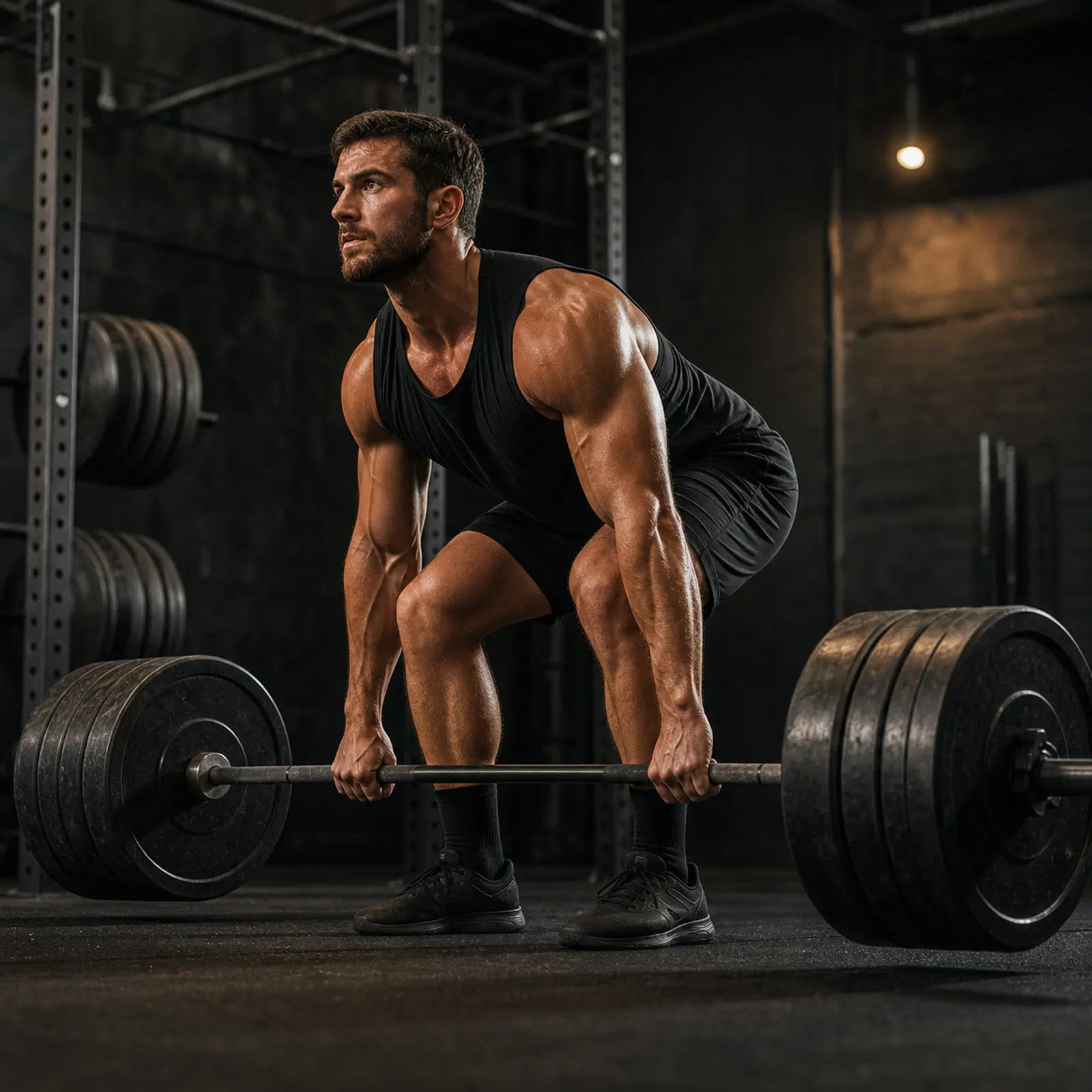
Deadlifts (bent knee)
Sources and review status
Review pending — this text hasn’t been signed off by a reviewer yet.
Health-sensitive topic: not used for AI answers until reviewed.
See this lesson’s sources0% read · 7 min left
Lift a bar from the floor to standing by pushing the floor away and driving your hips forward, with straight arms and a braced back that holds its natural curve. Hips, knees and back all work hard. Start with a trap bar or a light load from blocks, and add weight only while your back position holds.
The explanation
What it is. The bent-knee (conventional) deadlift starts with the bar on the floor. You grip it with straight arms, then stand up until you're upright with the bar hanging at arm's length, around mid-thigh. It is one of the three powerlifts, with the squat and bench press.
Which muscles work.
- Moments (what the joints must overcome). Escamilla et al. (2000) filmed national-level powerlifters. Conventional lifters generated hip extensor, knee extensor, knee flexor and ankle plantar-flexor moments. Compared with sumo, conventional lifters moved the bar 25–40% farther vertically, with correspondingly more mechanical work.
- Activation (EMG). Martín-Fuentes et al.'s 2020 systematic review found erector spinae and quadriceps activation was higher than gluteus maximus and biceps femoris across deadlift variants. Within the hamstrings, semitendinosus was slightly more active than biceps femoris. In the Romanian deadlift, the pattern flips: erector activity is lower than the hamstrings'.
- How to read that. EMG shows how hard a muscle is working, not which muscle moves the joint. The joint actions are hip extension and knee extension; the spine is held neutral, not extended. The erector spinae work hard, but isometrically, to stop the back rounding.
- How the muscles are classed here. Primary: gluteus maximus, hamstrings and adductor magnus (the hip extensors) and the erector spinae (isometric). Secondary: the quadriceps. This follows the joint demands rather than EMG amplitude: in Escamilla 2000, conventional lifters generated only an extensor moment at the hip, while the knee generated both extensor and flexor moments over the lift. Note the tension with the EMG review, where the quadriceps showed higher activation than gluteus maximus and biceps femoris; neither study measured adductor magnus, which is included for its hip-extensor fibres. The source manual had listed the erector spinae as the only primary muscle, with glutes, upper hamstrings and quads as secondary.
Technique cues (coaching standards; see Safe Lifting Mechanics):
- Set-up: mid-foot under the bar, feet about hip width, hands just outside the legs.
- Brace: take a breath into your belly and brace before the bar leaves the floor. Keep your back in its natural curves throughout.
- Lift: push the floor away. The bar stays close to the shins and thighs, and the hips and shoulders rise together.
- Finish: stand tall with the hips through. Don't lean back.
- Lower: under control, hips back first, then bend the knees once the bar passes them.
Form breaks down most often when the weight is beyond what you can hold in position. Add load only while your back position holds.
The trap-bar option. With a hexagonal (trap) bar you stand inside the frame. Swinton et al. (2011) compared it with a straight bar in 19 powerlifters:
- Lower peak moments at the lumbar spine, hips and ankles; a higher moment at the knee.
- A heavier 1RM (265 vs 245 kg) and more peak power.
This makes the trap bar a sensible way to learn the lift and to train hard pulls with less low-back demand.
Belts. A belt is optional for heavy sets; it raises intra-abdominal pressure. Learn to brace without one first (see Weightlifting Belt — Proper Use & Safety Concerns).
See it. Demo clips in the Fysiqal media library: Conventional Deadlift, Trap Bar Deadlift, Sumo Deadlift, Romanian Deadlift, Dumbbell Deadlift, Rack Pull, Deficit Deadlift.
Who it’s for
- Lifters wanting whole-body strength, especially in the hips, back and grip.
- Beginners, via the trap bar, dumbbells or a bar raised on blocks, before moving to the floor.
- Anyone who lifts heavy things in daily life or work and wants a trained hinge pattern.
Limits
- Healthy backs. With current back pain, leg pain or numbness, or a recent injury, get individual advice before loading this lift.
- The cues are coaching standards, not trial results. The research here describes muscle activity and joint loads; it doesn't test which cue prevents injury.
- Small, specific samples. Escamilla 2000 had 24 competition lifters; Swinton 2011 had 19 male powerlifters. EMG studies vary in method, as the 2020 review notes.
- Resistance training overall is safe for healthy adults: ACSM 2026 reports no increase in serious adverse events across >38,000 participants. That's a general finding, not specific to heavy deadlifts.
Show me
Tom, 6 months into training, wants to start deadlifting.
- Weeks 1–3: Trap Bar Deadlift, 3 × 6 at a load where every rep looks the same. He films the first set each session from the side.
- Check: his back holds its natural curve on every rep at 80 kg. At 95 kg, his lower back starts to round on rep 5, so 80–90 kg is his working range for now.
- Weeks 4–8: he adds 2.5–5 kg a week while the video still looks clean. At week 6 he adds a straight-bar Conventional Deadlift from the floor on a second day, starting at 60 kg.
- Weeks 9+: he keeps the trap bar as his heavy pull and uses the straight bar for technique practice at moderate loads.
Try it
Your turn. Film one set of your deadlift (or a light trap-bar or dumbbell version) from the side.
- Does your back keep its natural curve from floor to lockout, on every rep?
- Does the bar stay close to your legs?
- Do your hips and shoulders rise together off the floor, rather than hips shooting up first?
- At the top, do you stand tall without leaning back?
Answer check: if your back rounds or your hips shoot up first, drop the weight until all four checks pass, or pull from blocks. If you feel pain (not just effort) in your back or down a leg, stop and get it assessed.
What next
Next lesson: Principle of Progressive Overload. Learn how to keep adding challenge to lifts like this one safely over months.
Key facts
- Bent-knee deadlift: floor to standing, bar finishing around mid-thigh; one of the three powerlifts.
- Primary: gluteus maximus, hamstrings, adductor magnus (hip extension) and erector spinae (isometric, holding the spine neutral). Secondary: quadriceps. Joint actions: hip extension and knee extension; no spinal extension.
- Erector spinae and quadriceps show higher EMG than gluteus maximus and biceps femoris (Martín-Fuentes 2020); the erectors work isometrically.
- Conventional style moves the bar 25–40% farther than sumo (Escamilla 2000).
- Trap bar: lower lumbar, hip and ankle moments, higher knee moment, heavier 1RM (Swinton 2011).
- Brace, keep the natural curves, bar close, hips and shoulders rise together; add load only while form holds.
- A belt is optional for heavy sets; learn to brace without one first.
Research trail
- Historical: listed under hamstrings with the erector spinae as the primary muscle and classed as an advanced low-back exercise, with a belt "indicated" for heavy deadlifts.
Connections
- Erector Spinae (Sacrospinalis): the spinal stabilisers (isometric here).
- Gluteus Maximus / Hamstrings / Quadriceps: the hip and knee extensors.
- Safe Lifting Mechanics: natural-curve, use-your-legs technique.
- Weightlifting Belt — Proper Use & Safety Concerns: belts for heavy lifts.
- Stiff-Legged Deadlift: the straight-leg hamstring variation.
Sources
- ReviewMartín-Fuentes I, Oliva-Lozano JM, Muyor JM. Electromyographic activity in deadlift exercise and its variants. A systematic review. PLoS One 2020;15(2):e0229507 Published 2020 · DOI 10.1371/journal.pone.0229507 · Accessed 2026-10-13
- SourceEscamilla RF et al. A three-dimensional biomechanical analysis of sumo and conventional style deadlifts. Med Sci Sports Exerc 2000;32(7):1265–1275 Published 2000 · DOI 10.1097/00005768-200007000-00013 · Accessed 2026-10-13
- SourceSwinton PA et al. A biomechanical analysis of straight and hexagonal barbell deadlifts using submaximal loads. J Strength Cond Res 2011;25(7):2000–2009 Published 2011 · DOI 10.1519/JSC.0b013e3181e73f87 · Accessed 2026-10-13
- Position standCurrier BS et al. ACSM Position Stand: Resistance Training Prescription for Muscle Function, Hypertrophy, and Physical Performance in Healthy Adults. Med Sci Sports Exerc 2026;58(4):851–872 Published 2026 · DOI 10.1249/MSS.0000000000003897 · Accessed 2026-10-13
Corrections (2)
- 2026-10-13 — Upgraded to an applied lesson; exercise fields (muscles, joint actions, pattern, difficulty, cautions) unchanged. Muscle roles now cite an EMG systematic review (Martín-Fuentes 2020: erector spinae and quadriceps showed higher activation than gluteus maximus and biceps femoris), with the caveat that EMG amplitude is not the same as which muscle extends the hip. Added joint-moment data (Escamilla 2000) and the trap-bar comparison (Swinton 2011: lower peak lumbar, hip and ankle moments, higher knee moment). 'A weightlifting belt is indicated for heavy deadlifts' softened to 'optional for heavy sets' with a link to the belt module; no new belt evidence was reviewed here.
- 2026-10-13 — Exercise fields changed (founder decision): primary muscles are now gluteus maximus, hamstrings, adductor magnus and erector spinae (isometric, holding the spine neutral; stated in the new rom_notes field and the body); quadriceps are secondary (upper hamstrings folded into hamstrings). Joint actions are hip extension and knee extension; 'spinal extension' removed because the spine is held neutral. Sources: Escamilla et al. 2000 (conventional lifters generated hip extensor, knee extensor, knee flexor and ankle plantar-flexor moments) and Martín-Fuentes et al. 2020 (abstracts re-checked). Caveats stated in the body: the EMG review found quadriceps activation higher than gluteus maximus and biceps femoris, and neither source measured adductor magnus.
Exercise guides
Topics like this depend on your health and history. A qualified coach or clinician can apply it to you safely.
Educational content only — not medical advice. Always consult a qualified professional for individualized guidance, especially around injury, pregnancy, or medical conditions.