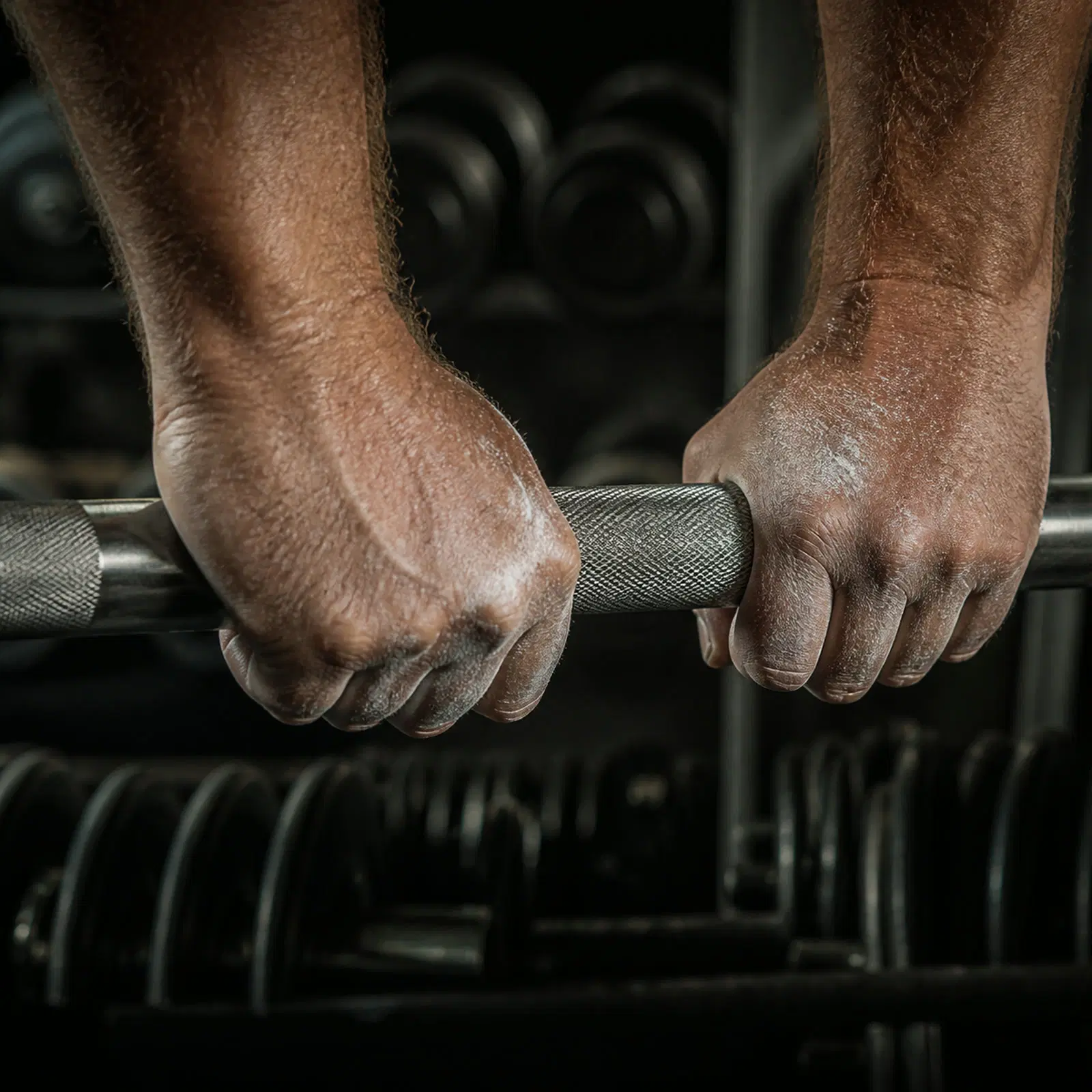
Dumbbells (Fixed & Adjustable)
Sources and review status
Review pending — this text hasn’t been signed off by a reviewer yet.
See this lesson’s sources0% read · 2 min left
Short single-hand free weights that allow a large range of motion, independent (unilateral) loading that exposes side-to-side imbalances, and natural wrist/forearm rotation.
Detail
A dumbbell is a short bar with weight at each end, used in one hand. Compared with a Barbell (Overview & Types), dumbbells offer:
- Greater range of motion (e.g., deeper stretch in presses and flyes).
- Unilateral loading — each arm works independently, so a stronger side cannot compensate for a weaker one; this exposes and corrects imbalances and increases core/stabilizer demand.
- Free wrist rotation — the hands can supinate/pronate naturally (curls, presses), which many find joint-friendly.
- Versatility — a single pair covers presses, rows, curls, flyes, lunges, carries, swings.
Trade-offs: you can load less total weight than a barbell, heavy dumbbells are awkward to get into position alone, and a full fixed set takes a lot of space and money.
Fixed dumbbells are a single welded weight (common in gyms as racked sets from ~2.5 lb up in 2.5–5 lb jumps). They are durable, fast to grab, and balanced, but require an entire rack to cover the range. Adjustable dumbbells use add-on plates with collars, or a selector/dial mechanism (e.g., spin-lock, PowerBlock, Bowflex SelectTech style) that swaps one pair across a wide range — ideal for home gyms where space and budget are limited (see Adjustable vs. Fixed Free Weights, Home Gym (Budget Tiers & What to Buy First)). Selector dumbbells change weight in seconds but cost more per pair and can be bulkier at low settings.
Key facts
- Used one per hand; allow larger ROM than a barbell.
- Unilateral → exposes/corrects left-right imbalances, higher stabilizer demand.
- Permit natural wrist rotation (supination/pronation).
- Fixed: durable, balanced, fast — but need a full rack and space.
- Adjustable (plate-loaded or selector): one pair, wide range — space/budget efficient.
Connections
- Barbell (Overview & Types) — bilateral counterpart that loads heavier.
- Kettlebell — alternative single-hand implement with offset load.
- Adjustable vs. Fixed Free Weights — fixed vs adjustable trade-offs.
- Home Gym (Budget Tiers & What to Buy First) — adjustable dumbbells are a home-gym cornerstone.
- Free Weights vs. Resistance Machines — dumbbells are free weights.
Sources
Exercise guides
Keep this lesson, or ask how it applies to you.
Educational content only — not medical advice. Always consult a qualified professional for individualized guidance, especially around injury, pregnancy, or medical conditions.