Spotting Requirements
0% read · 2 min left
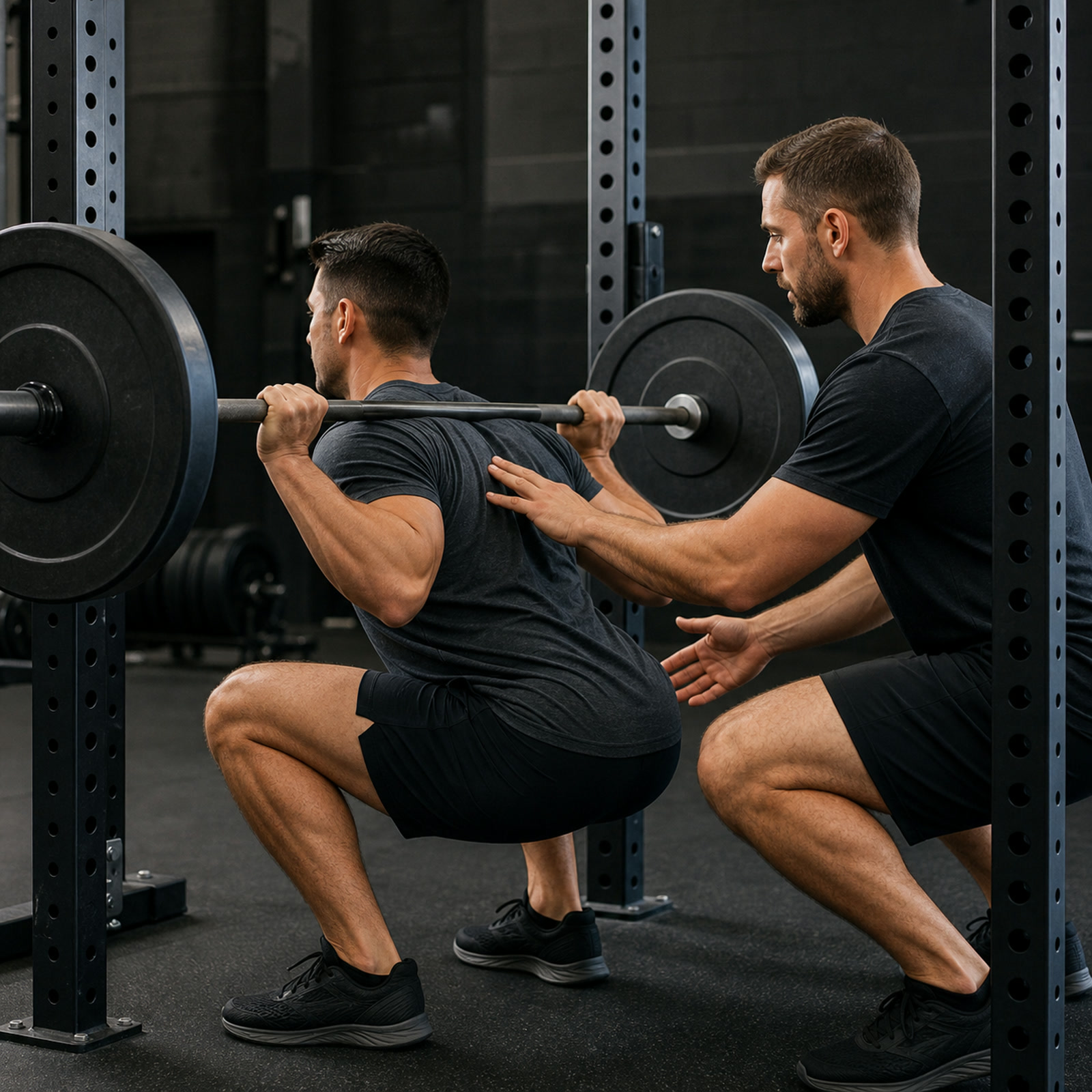
Proper spotting ensures lifter safety — spotters must know the lift's technique, be strong/tall enough to assist, support the right body parts, and be present in adequate number (e.g., a heavy 1-RM squat).
Detail
Proper spotting is necessary to ensure the safety of participants in a resistance training program. Spotters serve two important functions: to assist and to encourage the trainee. Several factors should be considered when spotting:
(i) Spotters should know the proper technique of the lift they are spotting and must be attentive to the lifter and his/her performance. (ii) The spotter must be strong and/or tall enough to assist the trainee if needed. (iii) Understanding the concept of leading and trailing movements is essential. (iv) Proper technique for holding and supporting the appropriate body parts and the barbell/dumbbell should be discussed before the exercise. (v) The appropriate number of spotters should be considered (e.g., a heavy 1-RM squat) to ensure the lifter's safety. (vi) The predetermined total number of reps should also be known.
Spotting is especially tied to advanced systems that take a set past normal limits: forced repetitions require training partners to assist the trainee to force out 3 to 4 additional repetitions after a set to exhaustion, and breakdown ("multi-poundage") training requires 1 or 2 spotters. For dumbbell work, spot beginners by the elbow. Most machines do not require spotters, whereas free weights may.
Key facts
- Spotters assist and encourage; must know the lift and stay attentive.
- Spotter must be strong/tall enough; know leading vs. trailing movements; hold the correct body parts.
- Use an adequate number of spotters (e.g., heavy 1-RM squat); know the predetermined rep total.
- Forced reps add 3–4 assisted reps after exhaustion; breakdown training needs 1–2 spotters.
- Spot dumbbell beginners by the elbow.
Connections
- forced-repetition — partner-assisted reps after exhaustion.
- breakdown-training — requires 1–2 spotters.
- proper-form — spotters watch and correct form.
- rm-loading-caution — spotting heavy RM/failure work.
- free-weights-vs-machines-safety — free weights may need spotters; machines usually do not.
- resistance-training-safety-guidelines — the "training partner for feedback/support/motivation" guideline this module details.
Educational content only — not medical advice. Always consult a qualified professional for individualized guidance, especially around injury, pregnancy, or medical conditions.