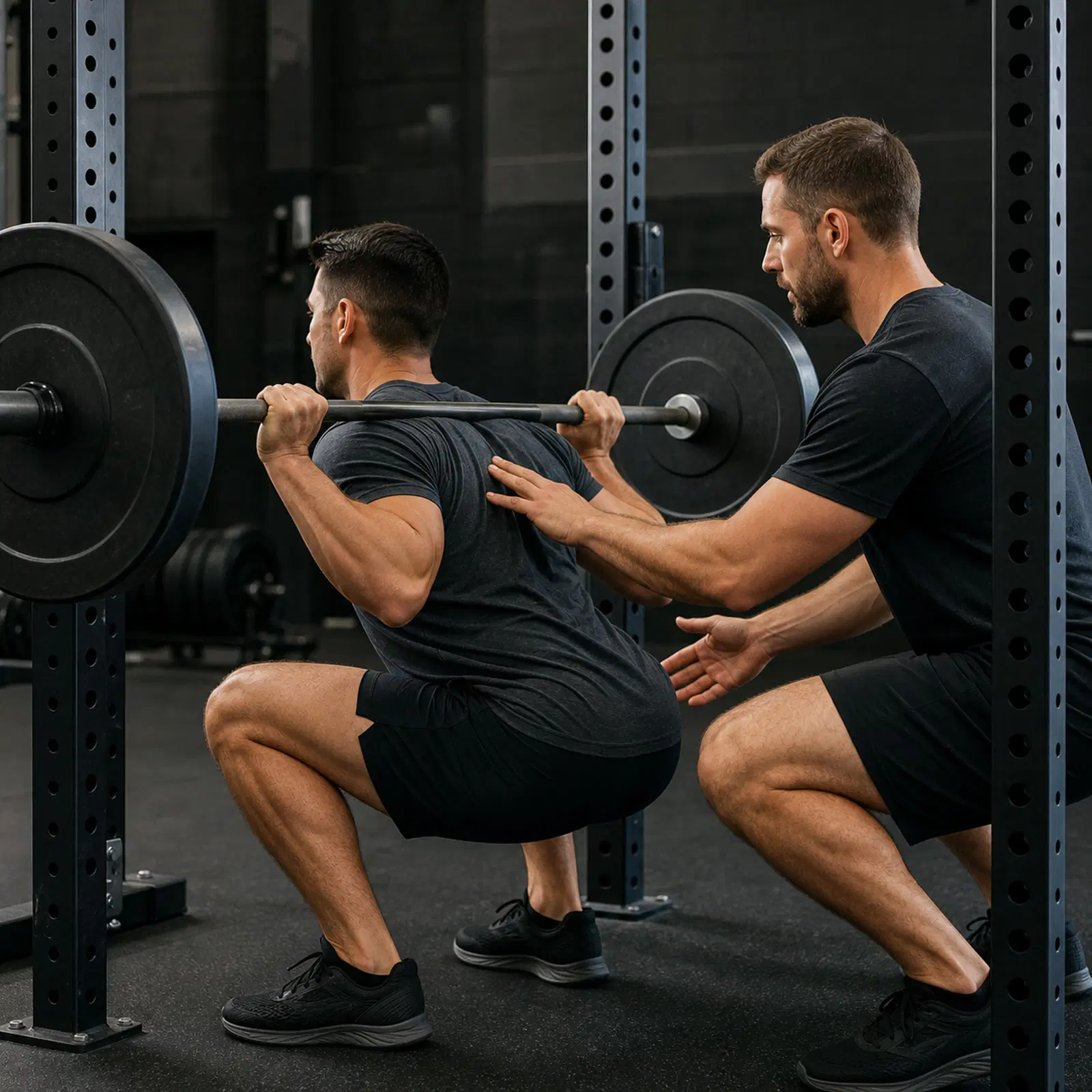
The Standing Torso Twist — Contraindicated Stretch
Sources and review status
Review pending — this text hasn’t been signed off by a reviewer yet.
Historical reference: its only source is the original reference manual, and some of it may be out of date. Not used for AI answers until re-sourced.
See this lesson’s sources0% read · 1 min left
The standing torso twist (with or without weights) strains the knee ligaments and relies on momentum that can exceed the tissues' absorbing capacity — marked "X".
Detail
The Standing Torso Twist (with or without weights) is one of the contraindicated ("X-Rated") movements, illustrated in the source crossed out with a large "X" (a standing figure holding a barbell across the shoulders, twisting the torso). Its specific risks are:
- Can strain the ligaments of the knee
- Uses momentum that often exceeds the absorbing capacity of the tissues being stretched
Note that in the FSU exercise checklist, machine trunk/torso twists are permitted (e.g., Cybex / Paramount Rotary Torso) but free bars are explicitly "No Bars Allowed!" for trunk twists — consistent with this caution about loaded standing twisting.
Key facts
- Can strain the knee ligaments.
- Relies on momentum that often exceeds the tissues' absorbing capacity.
- Free bars are not allowed for trunk twists in the facility guidance.
Connections
- "X-Rated" Exercises (Contraindicated Stretches) — Overview — one of the eight "X-Rated" stretches.
- Momentum in Resistance Training — momentum increases injury risk and reduces target-muscle stimulus.
- Spine Range of Motion — spinal rotation is very limited in the lumbar region.
- Knee Joint Range of Motion — knee ligaments strained by the twist.
Sources
Topics like this depend on your health and history. A qualified coach or clinician can apply it to you safely.
Educational content only — not medical advice. Always consult a qualified professional for individualized guidance, especially around injury, pregnancy, or medical conditions.