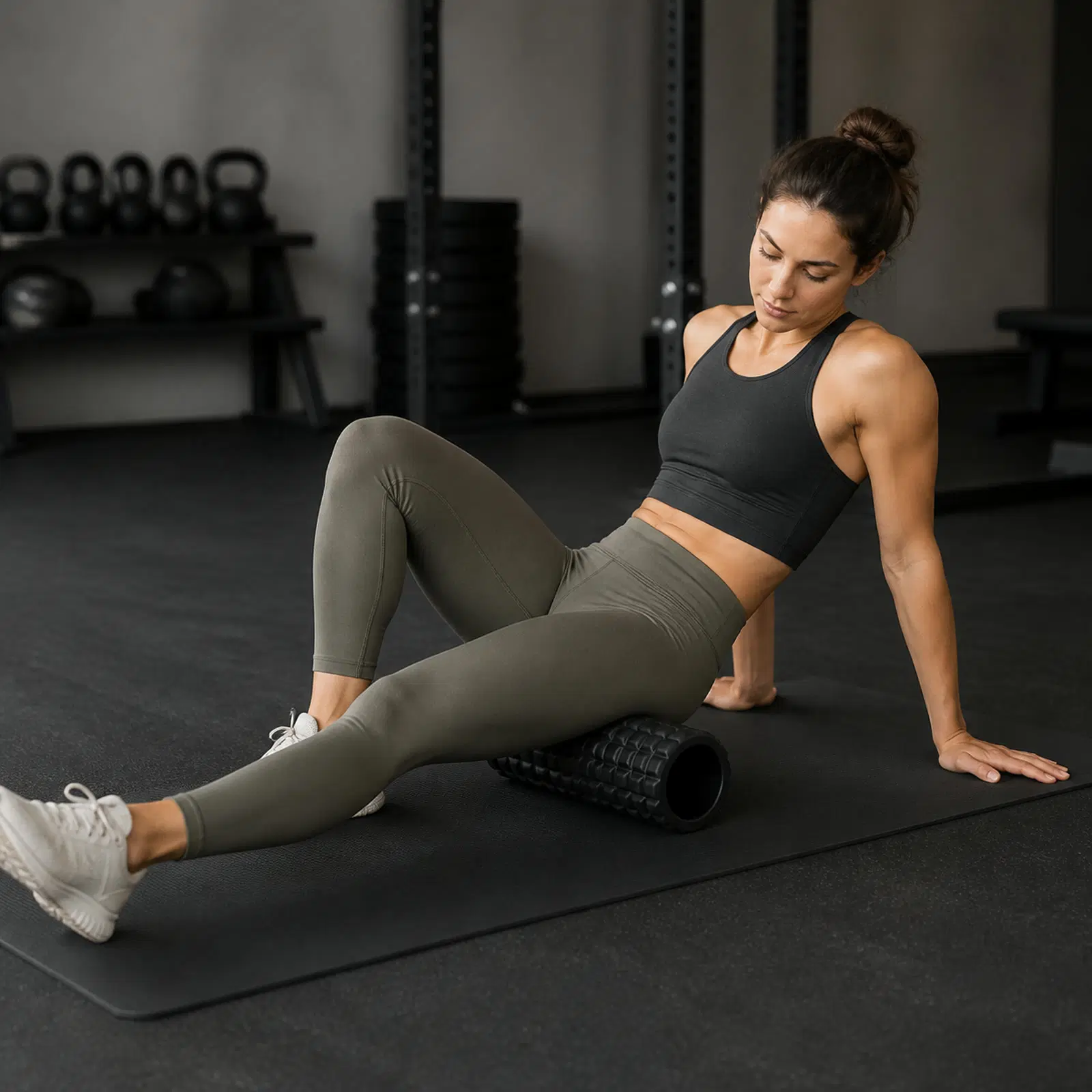
Foam Rolling & Self-Myofascial Release (SMR)
Sources and review status
Review pending — this text hasn’t been signed off by a reviewer yet.
See this lesson’s sources0% read · 2 min left
Rolling a muscle over a foam roller or ball briefly improves range of motion and reduces the feeling of soreness without lasting tissue change — useful in warm-ups and for comfort, not a true "release" of fascia.
Detail
Self-myofascial release (SMR) — foam rolling, roller balls, massage guns — applies pressure to soft tissue. The evidence is modest but real for acute, short-lived effects:
- ↑ Range of motion (short-term): rolling a muscle before training transiently increases joint ROM, without the strength/power loss that long static stretching can cause — making it a good warm-up tool (see Specific (Exercise Movement) Warm-Up).
- ↓ Perceived soreness/DOMS: rolling after exercise reduces the sensation of soreness and may modestly aid perceived recovery (see Muscle Soreness — Acute vs. DOMS).
- No lasting structural change: despite the name, foam rolling does not permanently lengthen or "break up" fascia or adhesions; mechanisms are largely neural (altered pain perception, reduced muscle tone) rather than mechanical remodeling.
Practical use:
- Warm-up: 30–60 s per muscle group to boost ROM before training.
- Post-session / off-day: for comfort and a mobility routine (pairs with Mobility Flows & Movement Practice (Overview)).
Like massage, SMR sits in the comfort/perception tier of Recovery Modalities — Overview & Evidence: helpful for how you feel and move acutely, not a driver of long-term adaptation.
Key facts
- Acute ↑ ROM without strength loss → good warm-up tool.
- ↓ perceived soreness; no lasting fascial/structural change (mechanism mostly neural).
- Typical dose: ~30–60 s per muscle group.
Connections
- Specific (Exercise Movement) Warm-Up — SMR as a warm-up component.
- Massage for Recovery — therapist-applied analog.
- Muscle Soreness — Acute vs. DOMS — DOMS target.
- Mobility Flows & Movement Practice (Overview) — pairing with mobility work.
Sources
Keep this lesson, or ask how it applies to you.
Educational content only — not medical advice. Always consult a qualified professional for individualized guidance, especially around injury, pregnancy, or medical conditions.