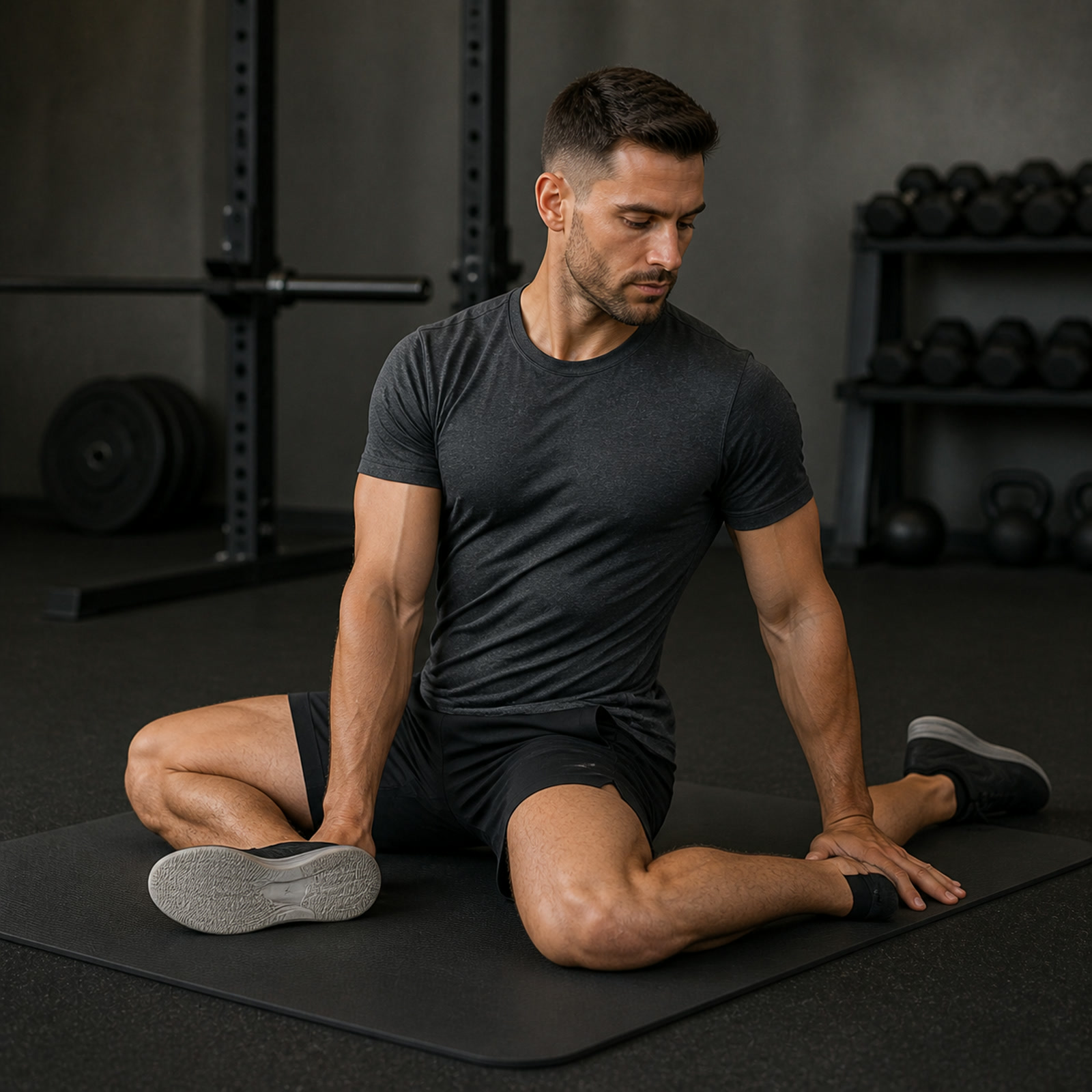
Controlled Articular Rotations (CARs)
0% read · 2 min left
Slow, deliberate circles taking a single joint through its full active range under maximum muscular control — a daily method to map, maintain, and expand usable joint range.
Detail
Controlled Articular Rotations (CARs) are active, rotational movements that move one joint through the largest range it can produce under its own muscular control, with the rest of the body braced and still. CARs are the foundational practice of Functional Range Conditioning (FRC), a system developed by Dr. Andreo Spina. The intent is to build and preserve active, controllable mobility (see mobility-vs-flexibility) rather than passive flexibility.
Execution principles:
- Isolate one joint — keep adjacent segments still (e.g., during shoulder CARs the spine and other arm stay fixed) so the target joint does the work.
- Maximal tension / irradiation — brace the whole body and keep the working limb under tension throughout, not relaxed.
- Slow and deliberate — typically taking several seconds per circle; speed is not the point, control at end ranges is.
- Full circle, outer limits — trace the largest pain-free circle the joint can actively make, in both directions.
- Commonly programmed daily, low volume (often 1–3 reps per direction per joint) as a joint-health and assessment practice; it also reveals where active range is limited.
CARs differ from dynamic warm-up swings (see dynamic-warmup-overview): swings use momentum and aim to prime tissues quickly before activity, whereas CARs are slow, momentum-free, maximally controlled, and aim at the active end range. The most common are shoulder CARs (exercise-shoulder-cars) and hip CARs (exercise-hip-cars), but every major joint can be trained this way (neck, spine segments, wrist, ankle).
Key facts
- CARs = active full-range rotational movement of one joint under maximal muscular control.
- Foundation of Functional Range Conditioning (FRC; Dr. Andreo Spina).
- Principles: isolate one joint, full-body tension, slow/momentum-free, trace largest pain-free circle both directions.
- Typical dose: ~1–3 reps per direction per joint, often daily.
- Builds active/controllable mobility and assesses end-range limits; differs from momentum-based dynamic swings.
Connections
- mobility-vs-flexibility — CARs build the "active control" side of mobility.
- exercise-shoulder-cars, exercise-hip-cars — specific drills.
- dynamic-warmup-overview — contrasted method (momentum-based swings).
- stability-vs-mobility — CARs serve the mobility joints especially.
- range-of-motion — the range CARs explore.
Educational content only — not medical advice. Always consult a qualified professional for individualized guidance, especially around injury, pregnancy, or medical conditions.