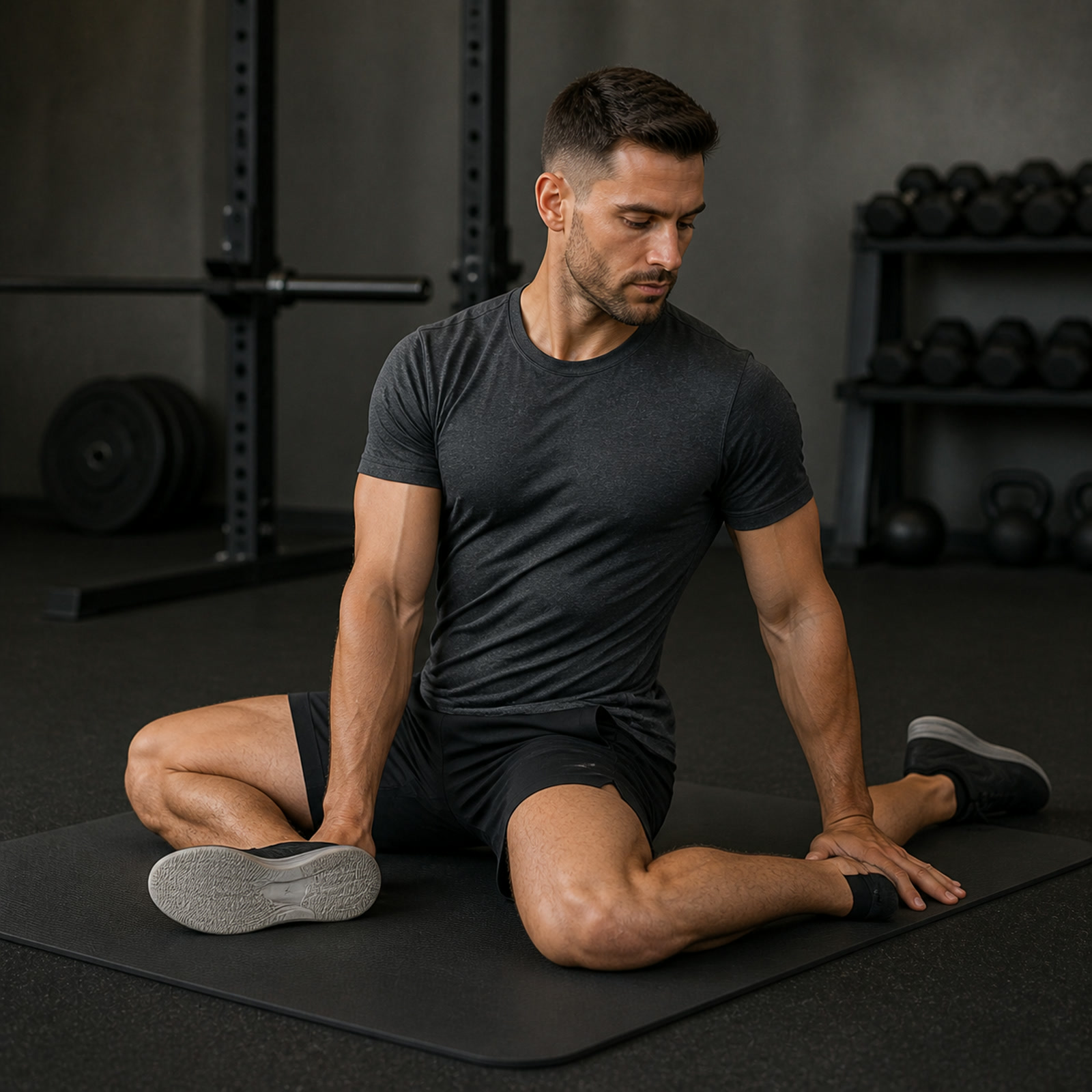
Hip CARs (Controlled Articular Rotations)
0% read · 2 min left
Standing tall and braced, trace the largest controlled circle one hip can make — lifting the knee, opening it out, rotating, and reversing — for active hip mobility and joint health.
Detail
A Controlled Articular Rotation for the hip (see the principle controlled-articular-rotations): stand tall (hold light support for balance), brace the trunk and keep the spine and pelvis as still as possible, and move one hip through the largest circle it can produce under control (hip-complex, hip-lateral-rotators).
A typical path: lift the knee toward the chest (hip flexion); open the knee out to the side (abduction/external rotation); carry the leg back and behind (extension); then rotate inward and return — then reverse the circle. The key is keeping the rest of the body still and the working leg under tension throughout, so the hip does the rotating rather than the spine swaying or the pelvis tilting to "borrow" range.
This builds and assesses active, controllable hip mobility (mobility-vs-flexibility) — valuable because the hip is a mobility joint whose stiffness gets compensated at the lumbar spine and knees. The shoulder equivalent is shoulder CARs (exercise-shoulder-cars); the 90/90 switch (exercise-90-90-hip-switch) is a related seated hip-rotation drill.
Coaching:
- Move slowly (several seconds per circle); control at the end ranges is the goal.
- Keep the standing leg stable and the pelvis quiet; use a wall/rail so balance does not limit the drill.
- Pain-free range only; this also reveals where active range is restricted.
- Typical dose: ~1–3 reps per direction, per hip.
Key facts
- One hip traces its largest active circle (flex → abduct/ER → extend → IR → return), spine/pelvis still.
- Builds/assesses active hip mobility (FRC principle); often daily.
- Slow, full-body tension, pain-free; use support so balance doesn't limit it.
- Typical dose: ~1–3 reps per direction per hip.
Connections
- controlled-articular-rotations — the governing principle.
- mobility-vs-flexibility — develops active, controllable range.
- hip-complex, hip-lateral-rotators — joint/muscles trained.
- exercise-shoulder-cars — shoulder equivalent.
- exercise-90-90-hip-switch — related seated hip-rotation drill.
Educational content only — not medical advice. Always consult a qualified professional for individualized guidance, especially around injury, pregnancy, or medical conditions.