Fysiqal
Balance
Balance

Dynamic Warm-Up (Mobility-as-Training)

Evidence-grounded — sourced from Fysiqal's fitness knowledge graph· 2 min read
dynamic-warm-upmobilitymovement-prepdynamic-stretchingneuromotorramp

0% read · 2 min left

In one line

A pre-activity routine of active, moving drills that take joints through increasing range while raising temperature and priming the nervous system — building usable mobility, unlike a static hold-and-relax stretch.

Detail

A dynamic warm-up uses active, controlled movements that progressively increase range of motion and movement speed to prepare the body for activity. It belongs to the BALANCE/neuromotor domain because it develops and expresses active mobility (see mobility-vs-flexibility) and movement quality, in contrast to the passive, hold-and-relax static stretching of the * domain (see warm-up-types).

Functions:

  • Raise muscle/core temperature and blood flow (the general warm-up; see warm-up-aerobic-general).
  • Take joints actively through progressively larger ranges (mobility).
  • Prime the nervous system, rehearsing the movement patterns of the session (the specific warm-up; see warm-up-specific).
  • Activate stabilizers and rehearse coordination.

A common structure ("RAMP"-style): raise temperature → activate/mobilize → potentiate with movement-specific drills. Typical drill menu (each is its own module):

  • exercise-leg-swings (front-back, lateral)
  • exercise-arm-circles and shoulder swings
  • exercise-hip-circles
  • exercise-worlds-greatest-stretch
  • exercise-inchworm
  • exercise-cat-cow
  • exercise-thoracic-rotations
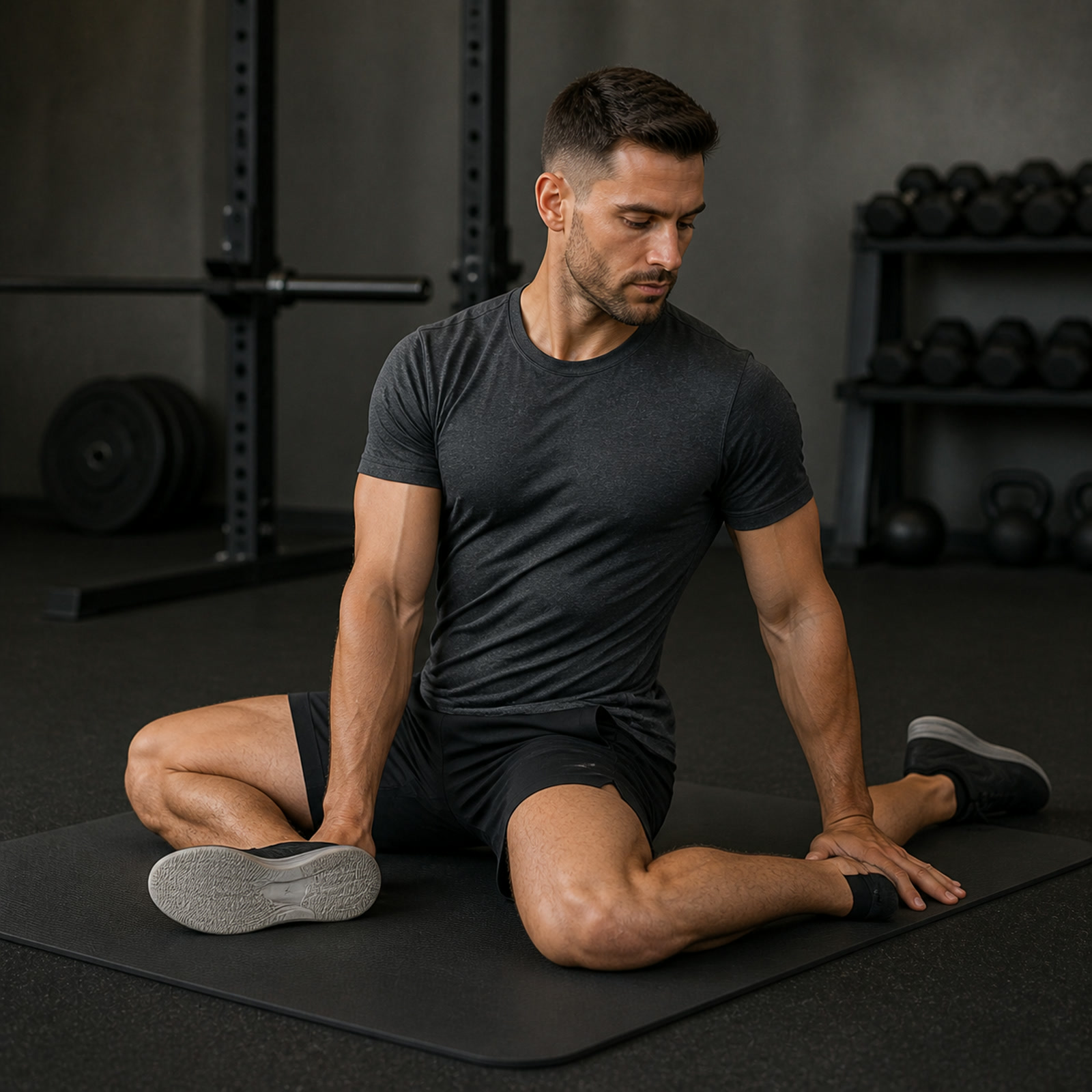
  • exercise-90-90-hip-switch
  • exercise-deep-squat-hold
  • exercise-ankle-mobility-drills
  • exercise-shoulder-dislocates
  • exercise-shoulder-cars / exercise-hip-cars

Note vs ballistic stretching: dynamic warm-up movements are controlled and progressively ranged, not the forceful bouncing/end-range bobbing of true ballistic stretching (ballistic-stretching); the latter carries higher injury risk and is not the same thing. Dynamic warm-up is now the preferred pre-exercise approach, with static stretching de-emphasized immediately before power/strength performance (see warm-up-types).

Key facts

  • Dynamic warm-up = active, progressively-ranged movements that warm tissues and prime the nervous system.
  • Develops active mobility / movement quality (neuromotor domain), not passive flexibility.
  • Structure: raise temperature → activate/mobilize → movement-specific potentiation.
  • Controlled progressive movement ≠ forceful ballistic bouncing.
  • Preferred pre-activity; static stretching de-emphasized right before power/strength work.

Connections

  • mobility-vs-flexibility — why this is "mobility," not flexibility.
  • warm-up-types, warm-up-specific, warm-up-aerobic-general — the warm-up framework it sits in.
  • ballistic-stretching — contrasted (controlled vs bouncing).
  • exercise-leg-swings and the other listed drills — the menu.
SourceCurrent guideline bodies
Authored from established warm-up and movement-prep consensus (links to flex.* warm-up modules).
Get your own push/pull and knee/hip balance tracked for real.Build my free plan

Educational content only — not medical advice. Always consult a qualified professional for individualized guidance, especially around injury, pregnancy, or medical conditions.

Explore related topics

Atlas Connections

Controlled Articular Rotations (CARs)Closely related
Slow, deliberate circles taking a single joint through its full active range under maximum muscular control — a daily method to map, maintain, and expand usable joint range.
90/90 Hip SwitchClosely related
Sit with both knees bent to 90° (one in front, one to the side) and rotate side to side between positions — a focused drill for hip internal and external rotation.
Ankle Mobility Drills (Knee-to-Wall Dorsiflexion)Closely related
Drive the knee forward over the toes with the heel pinned down to mobilize ankle dorsiflexion — the joint-by-joint "mobility" target most often limiting squats and gait.
Arm CirclesClosely related
Circle the arms forward and backward through a growing range to warm and mobilize the shoulders — a quick, equipment-free dynamic warm-up drill.
Cat-CowClosely related
From hands and knees, alternately round the spine (cat) and arch it (cow), moving with the breath — a gentle dynamic drill that mobilizes the whole spine into flexion and extension.
Deep Squat HoldClosely related
Sink into the bottom of a full squat and relax into the position — a loaded end-range hold that builds and maintains hip, ankle, and knee mobility for squatting and sitting.
Hip CARs (Controlled Articular Rotations)Closely related
Standing tall and braced, trace the largest controlled circle one hip can make — lifting the knee, opening it out, rotating, and reversing — for active hip mobility and joint health.
Hip CirclesClosely related
Circle the knee/thigh to draw circles with a lifted leg, or circle the pelvis itself — a dynamic warm-up drill that mobilizes the hip through all directions.
InchwormClosely related
Fold forward, walk the hands out to a plank, then walk the feet back in — a dynamic warm-up drill that mobilizes the hamstrings and posterior chain while bracing the core.
Leg SwingsClosely related
Holding support, swing one leg front-to-back and side-to-side through a progressively larger range — a staple dynamic warm-up drill for hip mobility.
Shoulder CARs (Controlled Articular Rotations)Closely related
Slowly trace the largest circle your shoulder can actively make, body braced and the rest of you still — a daily joint-health and active-mobility drill.
Shoulder Dislocates (Pass-Throughs)Closely related
Hold a dowel or band wide and sweep it overhead from front to back and return — a dynamic drill that opens up overhead shoulder mobility. (The name is figurative — nothing actually dislocates.)
Thoracic Rotations (Open-Book / Quadruped)Closely related
Drills that isolate rotation to the mid-back (thoracic spine) — the joint-by-joint "mobility" segment — while keeping the lumbar spine stable.
World's Greatest StretchClosely related
A flowing lunge-and-rotate sequence that mobilizes hip flexors, hamstrings, and the thoracic spine in one movement — a high-value dynamic warm-up drill.
Mobility vs FlexibilityClosely related
Flexibility is how far a joint *can* be moved (often passively); mobility is how far you can *actively control* it — flexibility plus the strength and motor control to own that range.
Ballistic Stretching
Bobbing, bouncing, rebounding movements — the most controversial technique because it causes the most soreness and injury, though it does build the dynamic flexibility some sports require.
General (Aerobic) Warm-Up
Light aerobic activity (bike, treadmill, rower, etc.) that elevates the heart rate 20–30 bpm above rest for 5–10 minutes, to raise muscle temperature, boost blood flow, and reduce injury risk.
Specific (Exercise Movement) Warm-Up
A specific warm-up rehearses the actual activity at reduced intensity — for resistance exercise, one set of 12–15 reps using 50% of 1RM.
Types of Warm-Up (Passive, General, Specific)
Warm-ups fall into three categories — passive (external heat), general (unrelated large-muscle movement), and specific (reduced-intensity versions of the target activity) — with a specific warm-up preferred when possible.