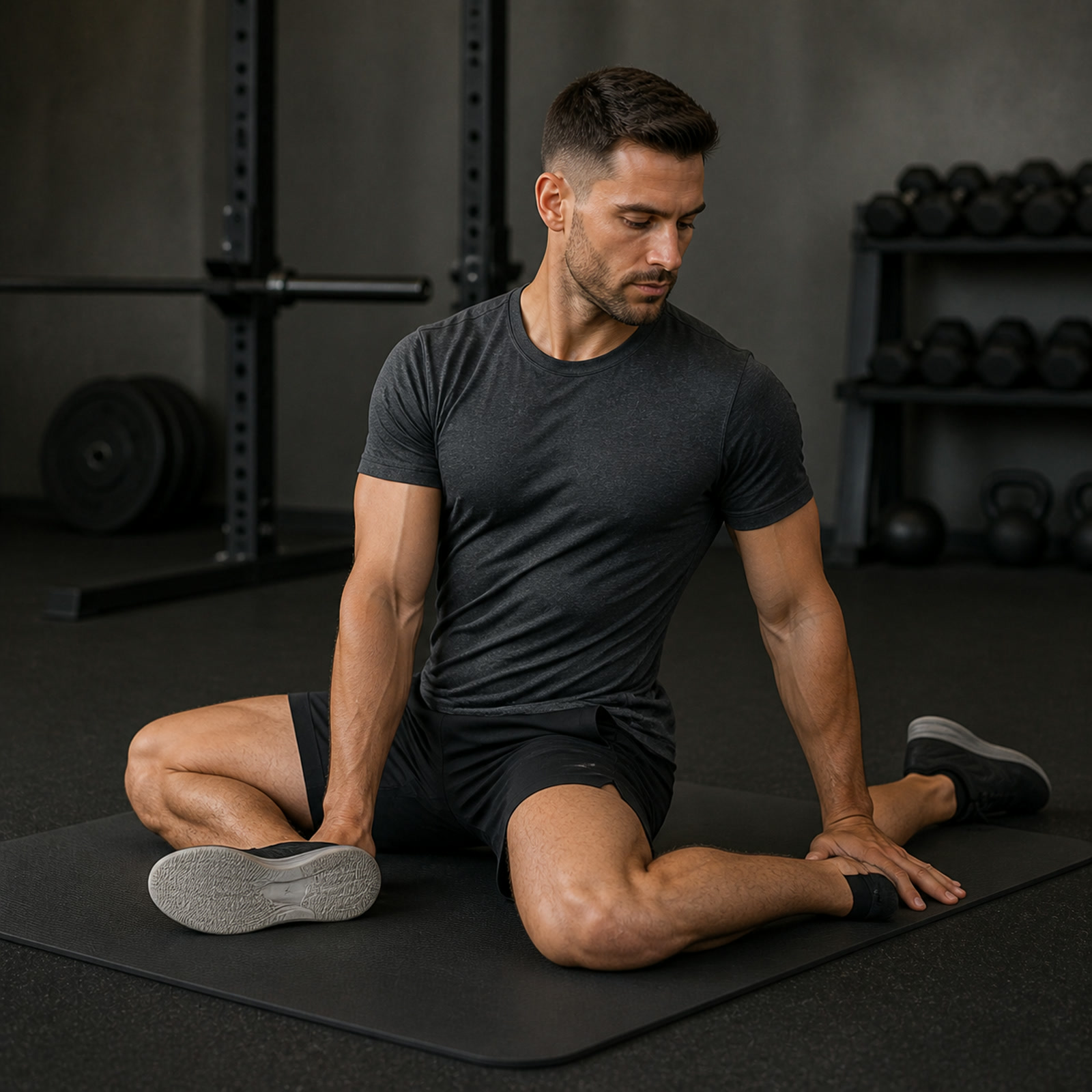
Passive Stretching
0% read · 2 min left
You stay relaxed while an outside agent (a partner or a machine) creates the range of motion — useful when the muscle is too weak to move itself, but riskier if the partner applies force incorrectly.
Detail
Passive stretching is a technique in which you are relaxed and make no contribution to the range of motion. Instead, an external force is created by an outside agent, either manually or mechanically. Advantages associated with passive stretching include:
- It is effective when the agonist (the primary muscle responsible for the movement) is too weak to respond.
- It is effective when attempts to inhibit the tight muscles (i.e., the antagonist) are unsuccessful.
- It allows stretching beyond one's active range of motion.
- Direction, duration, and intensity can be measured when more advanced stretching machines and modalities are used in rehabilitative therapy.
- It can promote team comradery when athletes stretch with partners.
The major disadvantage of passive stretching is its greater risk of resulting in soreness and injury if a partner applies the external force incorrectly. In addition, it may initiate the stretch too rapidly, and the likelihood of injury increases with greater differences between the range of active and passive flexibility. The solution is to also develop your active flexibility (see active-stretching).
Key facts
- Method: the person stays relaxed; an external agent (manual or mechanical) creates the ROM.
- Advantages: works when the agonist is too weak; works when inhibiting tight antagonists fails; allows stretching beyond active ROM; direction/duration/intensity measurable with rehab machines; promotes partner comradery.
- Major disadvantage: greater risk of soreness/injury if a partner applies force incorrectly; may initiate the stretch too rapidly; injury risk rises with a larger gap between active and passive flexibility.
Connections
- static-stretching, ballistic-stretching, active-stretching, pnf-stretching — the other four of the five basic techniques.
- active-stretching — developing active flexibility offsets the passive-stretch injury risk.
Educational content only — not medical advice. Always consult a qualified professional for individualized guidance, especially around injury, pregnancy, or medical conditions.