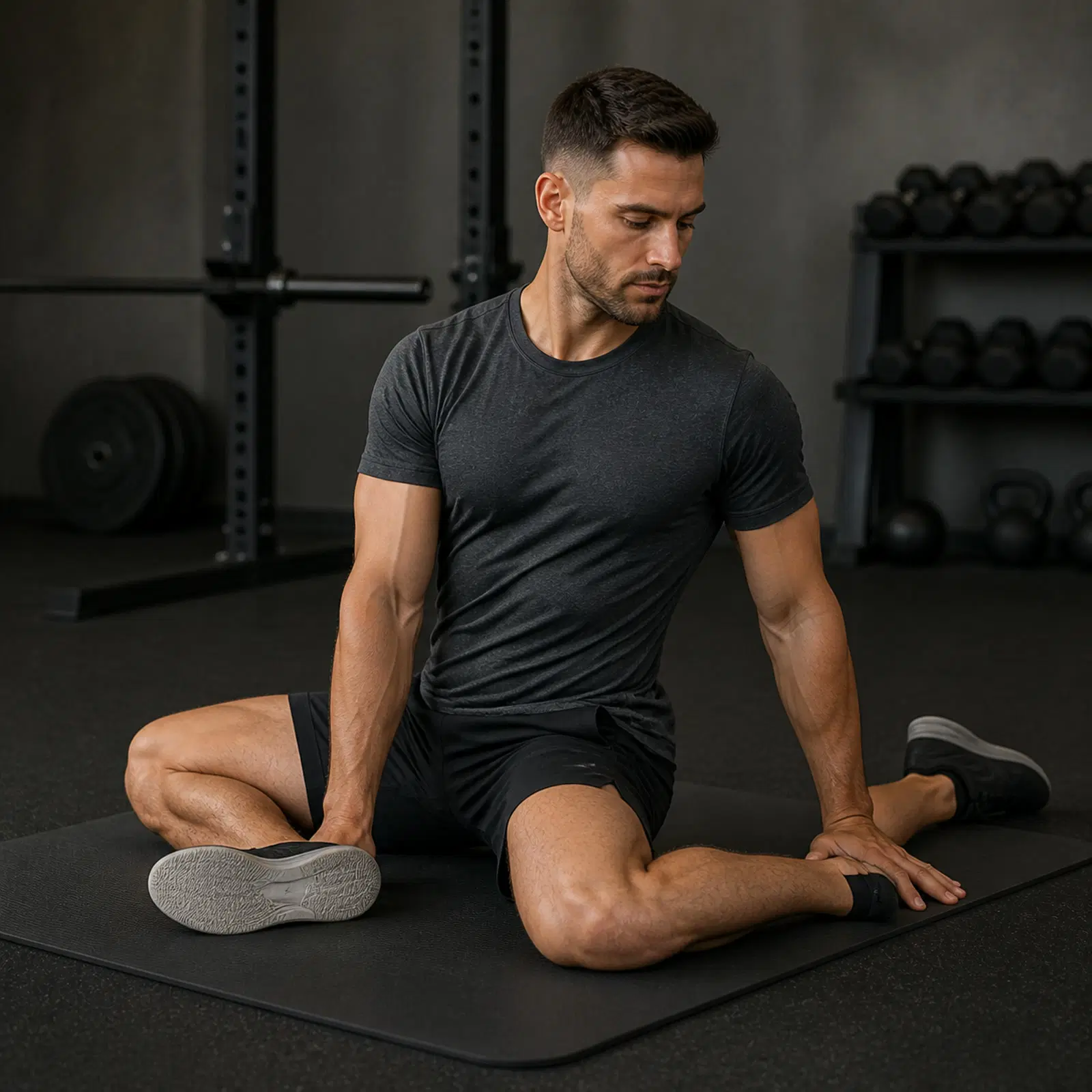
Stretching is useful for some goals and unnecessary for others. Learn when it helps, and which kind to use.
What do you want to do?
Start here
4 lessons · ~6 min · in this order- 1Benefits and Outcomes of Flexibility ExerciseFlexibility (joint ROM) helps in sport, work, and home tasks; its outcomes include improved ROM, contribution to fitness, better motor performance, warm-up assistance, injury reduction, reduced tissue trauma, and relaxation.Begin →
- 2The Five Basic Stretching TechniquesStretching (the process of elongation) can be done five ways — static, ballistic, passive, active, and proprioceptive (PNF) — chosen by goal, ability, and state of training.1 min
- 3Static StretchingStretching to the farthest point and holding the position — the safest technique, requiring the least energy and giving time to reset the stretch reflex, change length, and relax the muscle via the GTOs.1 min
- 4Types of Warm-Up (Passive, General, Specific)Warm-ups fall into three categories — passive (external heat), general (unrelated large-muscle movement), and specific (reduced-intensity versions of the target activity) — with a specific warm-up preferred when possible.2 min
Every Flexibility topic
55 topics
- "X-Rated" (Contraindicated) Stretches — List2 minGuideline · The program standards and Alter (1996) rate eight stretches "X" (too advanced or dangerous for the average participant): Plough, Hurdler's Stretch, Deep Knee Bend/Lunge/Squat, Torso Twist, Straight-Leg Straddle Floor/Toe Touch, Straight-Leg Standing Floor/Toe Touch, Bridge, and Inversion.
- Active Stretching1 minPrinciple · Stretching using only your own muscles, with no external assistance — it builds active flexibility (which correlates more highly with sports achievement) but can trigger the stretch reflex.
- Ballistic Stretching1 minPrinciple · Bobbing, bouncing, rebounding movements — the most controversial technique because it causes the most soreness and injury, though it does build the dynamic flexibility some sports require.
- Benefits and Outcomes of Flexibility Exercise2 minPrinciple · Flexibility (joint ROM) helps in sport, work, and home tasks; its outcomes include improved ROM, contribution to fitness, better motor performance, warm-up assistance, injury reduction, reduced tissue trauma, and relaxation.
- Flexibility Exercise Not Always Needed1 minPrinciple · An individual can have too much ROM — excessive tissue elongation costs joint stability, so loose-jointed people should rely on muscle strengthening and consider reducing flexibility work.
- Flexibility Guidelines (ACSM)2 minGuideline · ACSM's current (2011) guidance is to stretch each major muscle–tendon group at least 2–3 days/week (daily is best), holding 10–30 s for 2–4 reps — about 60 s per stretch; the 1998 version said at least 4 reps of 10–30 s.
- Flexibility Guidelines (Program Standards)3 minGuideline · Per the exercise program standards, flexibility work raises ROM in the major muscle groups; all stretches are static, held 10 seconds, and repeated twice.
- GAGs and Connective Tissue Lubrication1 minPrinciple · Stretching is thought to stimulate gel-like glycosaminoglycans (GAGs) that, with water and hyaluronic acid, lubricate connective tissue fibers and keep them from sticking and forming excessive cross-linkages.
- General (Aerobic) Warm-Up2 minGuideline · Light aerobic activity (bike, treadmill, rower, etc.) that elevates the heart rate 20–30 bpm above rest for 5–10 minutes, to raise muscle temperature, boost blood flow, and reduce injury risk.
- Golgi Tendon Organ (GTO) in Stretching1 minPrinciple · The GTOs are proprioceptors whose firing during a sufficiently long-held stretch induces muscular relaxation — one of the advantages that makes static stretching effective.
- How Much Warm-Up Is Enough2 minGuideline · Ten to fifteen minutes is generally adequate; intensity should raise heart rate to 90–120 bpm depending on age, with longer warm-ups needed on cold days, in early morning, and for older adults.
- Passive Stretching2 minPrinciple · You stay relaxed while an outside agent (a partner or a machine) creates the range of motion — useful when the muscle is too weak to move itself, but riskier if the partner applies force incorrectly.
- Physiological Effects of Warm-Up3 minPrinciple · A warm-up raises tissue temperature (speeding metabolism ~13% per °C), increases oxygen delivery, speeds nerve impulses, improves muscle force and elasticity, opens blood vessels, and shifts hormones toward energy production.
- Proprioceptive Neuromuscular Facilitation (PNF)1 minPrinciple · A range-of-motion strategy (also called a muscle energy technique) originally developed for rehabilitation; its two most common forms are the contract-relax and the contract-relax-contract techniques.
- Semi-Permanent Fascial Sheath Length Change1 minPrinciple · Sustained stretching over time can make the connective sheaths that encase muscle — plus tendons, ligaments, fascia, and scar tissue — undergo a semi-permanent change in length.
- Specific (Exercise Movement) Warm-Up1 minGuideline · A specific warm-up rehearses the actual activity at reduced intensity — for resistance exercise, one set of 12–15 reps using 50% of 1RM.
- Static Stretching1 minPrinciple · Stretching to the farthest point and holding the position — the safest technique, requiring the least energy and giving time to reset the stretch reflex, change length, and relax the muscle via the GTOs.
- Static Stretching Before Lifting — Acute Power/Strength Impairment5 minConcept · Holding a static stretch for 60+ seconds per muscle immediately before a lift measurably reduces force and power output (roughly -1 to -5% on average, more in some jump/vertical-power tests) — but the effect is dose-dependent and mostly disappears under ~30-45 seconds, so a brief static stretch isn't the same risk as a long, sustained hold.
- Stretch Reflex Resetting1 minPrinciple · When a muscle is stretched suddenly the stretch reflex makes it contract, but training can raise the threshold at which the reflex fires, letting the muscle relax further into the stretch.
- Stretch: Achilles Tendon & Calves (Seated, Both Legs)1 minStretch · Sitting with both legs straight, lean forward, grasp the feet (or use a folded towel), and pull on them.
- Stretch: Achilles Tendon & Calves (Seated, Leg Crossed)1 minStretch · Sitting with one leg extended and the other crossed onto the opposing knee, lean forward and pull on the foot of the extended leg.
- Stretch: Achilles Tendon & Calves (Wall, Both Legs Straight)1 minStretch · Standing 4-5 steps from a wall with both legs together and straight, keep both heels flat and lean the chest toward the wall.
- Stretch: Achilles Tendon & Calves (Wall, One Leg Bent)1 minStretch · Standing 4-5 steps from a wall, bend one leg forward with the rear leg straight, keep the rear foot flat, and lean the chest toward the wall.
- Stretch: Anterior Shoulder1 minStretch · Brace on a sturdy chair with arms straight behind and legs extended forward, then bend the arms and lower the buttocks toward the floor.
- Stretch: Biceps (Door Frame)1 minStretch · Standing with your back to a door frame, rest a hand against it with the arm externally rotated and thumb down, then try to roll the biceps to face upward.
- Stretch: Buttocks & Hips (Both Legs Lowered to Side)1 minStretch · Lying on the back with arms out and knees flexed, slowly lower both legs to the floor on one side while keeping elbows, head, and shoulders flat.
- Stretch: Buttocks & Hips (Knee Pulled Across Body)1 minStretch · Lying on the back, raise one flexed knee to the chest, grasp it, and slowly pull it across the body to the floor.
- Stretch: Buttocks & Hips (Seated Spinal Twist)1 minStretch · Seated with one leg crossed over the other, place the opposite elbow outside the bent knee and twist the trunk while looking over the shoulder.
- Stretch: Buttocks & Hips (Seated, Foot to Opposite Shoulder)1 minStretch · Sitting against a wall with one leg flexed, grasp the ankle and hook the knee with the opposite elbow, then pull the foot toward the opposite shoulder.
- Stretch: Buttocks & Hips (Supine, Foot to Opposite Shoulder)1 minStretch · Lying on the floor with one leg flexed, grasp the ankle and knee and slowly pull the foot to the opposite shoulder, keeping the back flat.
- Stretch: Groin (Seated, Soles Together)1 minStretch · Sit with the soles of the feet together pulled toward the buttocks, place the elbows on the inner thighs, and slowly push the legs toward the floor.
- Stretch: Groin (Soles Together, Forward Lean)1 minStretch · From the soles-together groin position, grasp the feet/ankles and lean forward from the hips (without bending the back) to lower the chest toward the floor.
- Stretch: Hamstrings & Lower Back (Both Legs Extended)1 minStretch · Seated with both legs extended, bend forward at the waist with both legs straight and lower the trunk onto the thighs.
- Stretch: Hamstrings & Lower Back (Figure-Four)1 minStretch · Seated with one leg extended and the other bent in a figure-four against the inner thigh, bend at the waist and lower the torso onto the straight thigh.
- Stretch: Lateral Aspect of Neck1 minStretch · A seated/standing neck stretch — pull the head laterally toward one shoulder to stretch the opposite side of the neck.
- Stretch: Lower Back (Cat / All-Fours)1 minStretch · On all fours, round the back while contracting the abdominals, then relax back to a flat-back position.
- Stretch: Lower Back (Knees to Chest)1 minStretch · Lying on the back, grasp behind the thighs, pull the knees toward the chest/shoulders, and elevate the hips — with cautions on knee hyperextension and re-extending the legs slowly.
- Stretch: Posterior Aspect of Neck1 minStretch · Interlock the hands behind the head and pull forward until the chin rests on the chest, stretching the back of the neck.
- Stretch: Posterior Shoulder (Behind Back)1 minStretch · With one arm flexed behind the back, grasp the elbow from behind with the opposite hand and pull it across the mid-line of the back.
- Stretch: Posterior Shoulder (Cross-Body)1 minStretch · Bring one arm across to the opposite shoulder, grasp the raised elbow with the other hand, and pull the elbow backward.
- Stretch: Quadriceps & Hip Flexors (Kneeling Lunge)1 minStretch · From a wide stance, turn one foot 90° sideways, flex that knee and roll the rear foot under so the instep rests on the floor, then force the rear hip toward the floor.
- Stretch: Quadriceps & Hip Flexors (Prone)1 minStretch · Lying face down, reach back to grasp the ankle and pull the heel toward the buttocks — avoid if you have "bad knees."
- Stretch: Quadriceps & Hip Flexors (Side-Lying)1 minStretch · Lying on the side, grasp the ankle and pull the heel toward the buttocks — avoid if you have "bad knees."
- Stretch: Quadriceps & Hip Flexors (Standing)1 minStretch · Standing with one hand on a support, grasp the foot of the flexed leg and pull the heel toward the buttocks — avoid if you have "bad knees."
- Stretch: Triceps (Behind-Back Interlock)1 minStretch · With one arm reaching up the back and the other lifted overhead and bent, interlock the fingers behind the back.
- Stretch: Triceps (Overhead Elbow Pull)1 minStretch · Raise one arm overhead with the hand on the shoulder blade, grasp the elbow with the opposite hand, and pull the elbow behind the head.
- Stretch: Upper Back (Bar Hang)1 minStretch · Hang from an overhead bar with a hollow body, drop the chin to the chest and sink the shoulders to stretch the upper back.
- Stretch: Upper Back (Standing Support Reach)1 minStretch · Standing about three feet from a waist-to-shoulder-height support, bend forward with straight arms and legs, grip the support, and press down to arch the upper back.
- Stretching (Before or After Exercise) Does Not Meaningfully Reduce DOMS6 minConcept · Stretching before exercise, after exercise, or both does not produce
- Stretching Controversy2 minPrinciple · Stretching is not a panacea — for some athletes it may increase the risk of ligament injury and joint separation/dislocation, and excessively loose joints may lead to premature osteoarthritis.
- Stretching Guidelines (Alter)1 minGuideline · Eight how-to rules for safe stretching from Alter (1996): warm up first, isolate the muscle, move in slowly, align properly, breathe out into the stretch, hold ~10 seconds, concentrate, and come out carefully.
- The Five Basic Stretching Techniques1 minPrinciple · Stretching (the process of elongation) can be done five ways — static, ballistic, passive, active, and proprioceptive (PNF) — chosen by goal, ability, and state of training.
- Types of Warm-Up (Passive, General, Specific)2 minPrinciple · Warm-ups fall into three categories — passive (external heat), general (unrelated large-muscle movement), and specific (reduced-intensity versions of the target activity) — with a specific warm-up preferred when possible.
- What Happens When You Stretch1 minPrinciple · Regular, proper stretching produces three adaptations — a reset stretch reflex, a semi-permanent lengthening of the connective sheaths, and increased lubricating gel that keeps connective fibers from sticking together.
- When Not to Stretch (Precautions)1 minGuideline · Do not stretch if a bone blocks motion, after a recent fracture, with suspected joint infection/inflammation, with osteoporosis, with sharp acute pain on movement, or with certain vascular/skin diseases.
Explore connections
How Flexibility links to other categories — line thickness is link density in the graph, not an editorial rating.