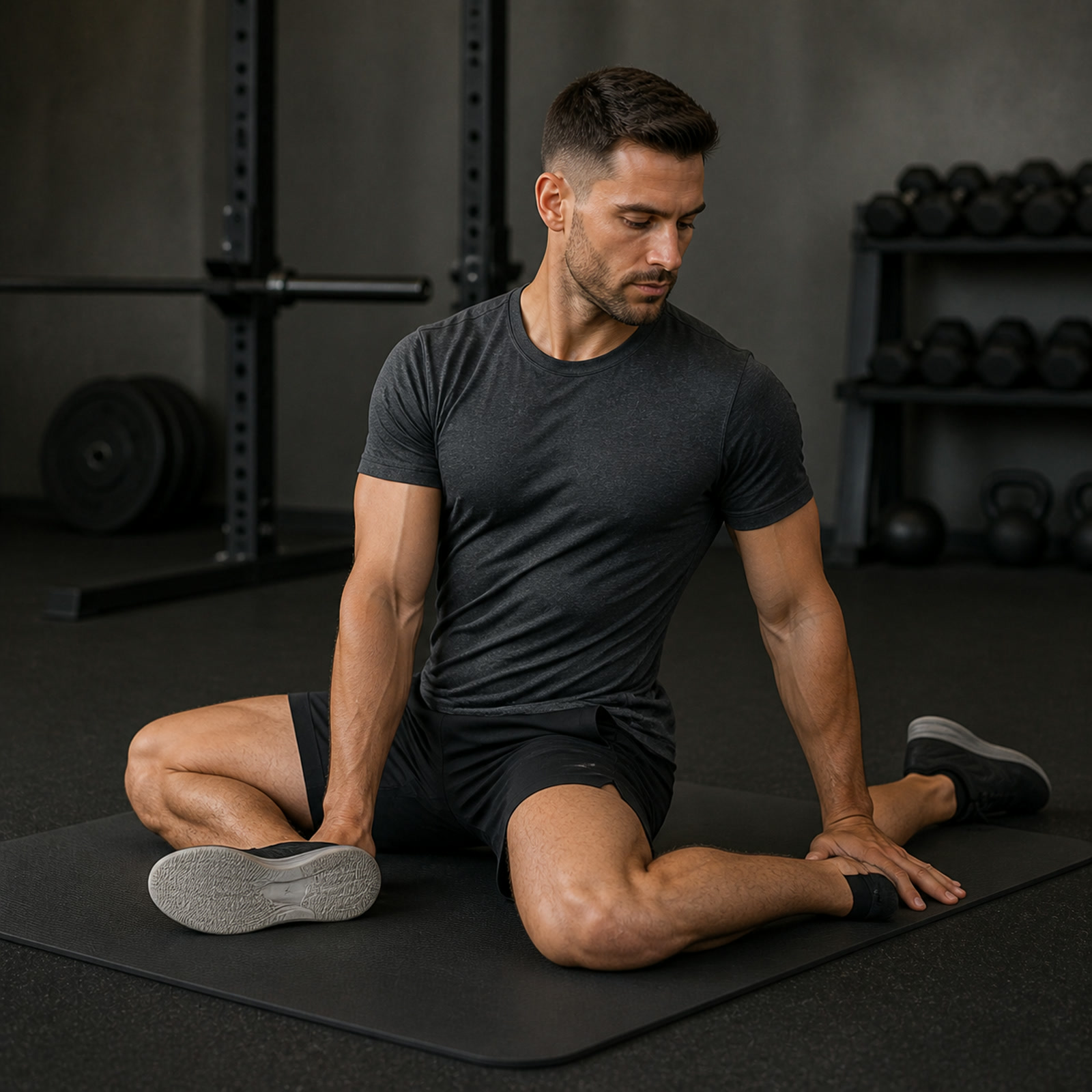
Static Stretching Before Lifting — Acute Power/Strength Impairment
0% read · 5 min left
Holding a static stretch for 60+ seconds per muscle immediately before a lift measurably reduces force and power output (roughly -1 to -5% on average, more in some jump/vertical-power tests) — but the effect is dose-dependent and mostly disappears under ~30-45 seconds, so a brief static stretch isn't the same risk as a long, sustained hold.
Detail
This is real, and the module balance.dynamic-warmup-overview already states the
directional conclusion ("static stretching de-emphasized immediately before power/
strength work") without quantifying it. This module supplies the actual finding: the
size of the effect, and — the part that gets lost in the popular "static stretching
kills your gains" framing — that it is dose-dependent, not a fixed penalty that
applies to any stretch of any length.
The mechanism is a mix of mechanical (reduced musculotendinous stiffness = less efficient force transmission) and neural (reduced motor-unit excitability/reflex sensitivity during and shortly after a sustained stretch) factors; both blunt the muscle-tendon unit's ability to produce force quickly right afterward.
The dose-response relationship (Behm & Chaouachi 2011, synthesizing the prior research base): static stretching held ≥60 seconds per muscle group produced a mean -4.6% reduction in strength/power/speed-dependent performance measures, while stretching held <60 seconds per muscle group produced only a -1.1% reduction — trivial and often not statistically significant. The relationship is curvilinear, not a hard cliff: the percentage of individual studies finding a significant deficit rises with duration (roughly 14% of studies at <30s, 22% at 30-45s, 61% at 1-2 min, 63% at
2 min). The effect also generalizes across strength-, power-, and speed-dependent tasks and across muscle groups — it isn't unique to one test or one muscle.
A representative single study (Pinto, Wilhelm, Tricoli, Pinto & Blazevich 2014, n=16 trained men): a 60-second static stretch of the quadriceps/hamstrings immediately before testing reduced countermovement jump height by -3.4%, average power by -2.7%, and peak power by -2.0%, relative to a no-stretch control — but a 30-second stretch of the same muscles produced no significant difference from the control condition at all.
Contrast with dynamic stretching: the same Behm & Chaouachi synthesis found dynamic stretching does not carry the same downside and can improve subsequent power output when the bout is long enough — >90 seconds of dynamic stretching improved peak force/power by +7.3% on average, versus a trivial +0.5% for <90 seconds. This is the quantitative backing for why dynamic warm-up (see dynamic-warmup-overview) is the preferred pre-lifting choice, not just a directional preference.
Honest complication (2024 currency check): a 2024 multilevel meta-analysis (Nakamura et al., Journal of Sport and Health Science) revisiting the stretch-induced force deficit found the deficit is most consistently observed in isolated, single-joint strength tests (e.g., isokinetic knee extension); evidence for a meaningful negative effect on complex, whole-body athletic performance (sprinting, change-of-direction, multi-joint 1RM lifts) is weaker and less consistent across studies. This doesn't overturn the jump/power findings above, but it means the popular "any static stretch tanks your entire workout" framing overstates how far the effect reliably extends beyond the specific muscle/movement stretched.
How long the impairment lasts: individual studies vary, but deficits from longer-duration stretching have been measured as still present at 5-15 minutes post-stretch in several protocols; the deficit is not necessarily gone by the time a lifter finishes a typical warm-up set. A general warm-up (raising temperature via light cardio/movement) performed after stretching does not reliably reverse the deficit within the same session — the safer sequencing is dynamic warm-up first, save longer static holds for after training, per warm-up-types's existing hierarchy.
Key facts
- Static stretching ≥60s/muscle: mean -4.6% strength/power/speed reduction (Behm & Chaouachi 2011 synthesis). <60s/muscle: mean -1.1%, often not significant.
- Effect is dose-dependent/curvilinear, not a fixed penalty — a brief static stretch is not the same risk as a sustained hold.
- Representative single study (Pinto et al. 2014, n=16): 60s stretch → -3.4% jump height / -2.7% avg power / -2.0% peak power vs. control; 30s stretch → no significant difference.
- Dynamic stretching does not carry the same penalty; >90s of dynamic stretching improved subsequent power by +7.3% on average (vs. +0.5% for <90s).
- The deficit is most consistent for isolated single-joint strength tests; evidence for a reliable effect on complex whole-body athletic performance is weaker (2024 current meta-analysis).
- Deficits have been measured as still present 5-15 minutes post-stretch in some protocols; a subsequent general warm-up doesn't reliably erase it within the session.
- Practical implication: prioritize dynamic warm-up before power/strength work; if static stretching is used pre-lift, keep individual holds under ~30-45s; save longer sustained holds (60s+) for after training or a separate flexibility session.
Connections
- static-stretching — the technique itself, its benefits (safety, ROM, reflex-reset), and where those benefits are best captured (not immediately pre-power).
- dynamic-warmup-overview — states the directional preference for dynamic warm-up pre-activity; this module supplies the quantified "why."
- warm-up-types — general vs. specific warm-up framework this recommendation slots into.
- rate-of-force-development — the neuromuscular quality (fast force production) that a pre-lift stretch deficit is blunting.
- force-velocity-curve — power output as the product being measured in the jump/vertical-power studies cited here.
- stretching-controversy — the existing module's broader caution that stretching isn't a risk-free panacea; this module adds the performance-timing-specific case.
Educational content only — not medical advice. Always consult a qualified professional for individualized guidance, especially around injury, pregnancy, or medical conditions.