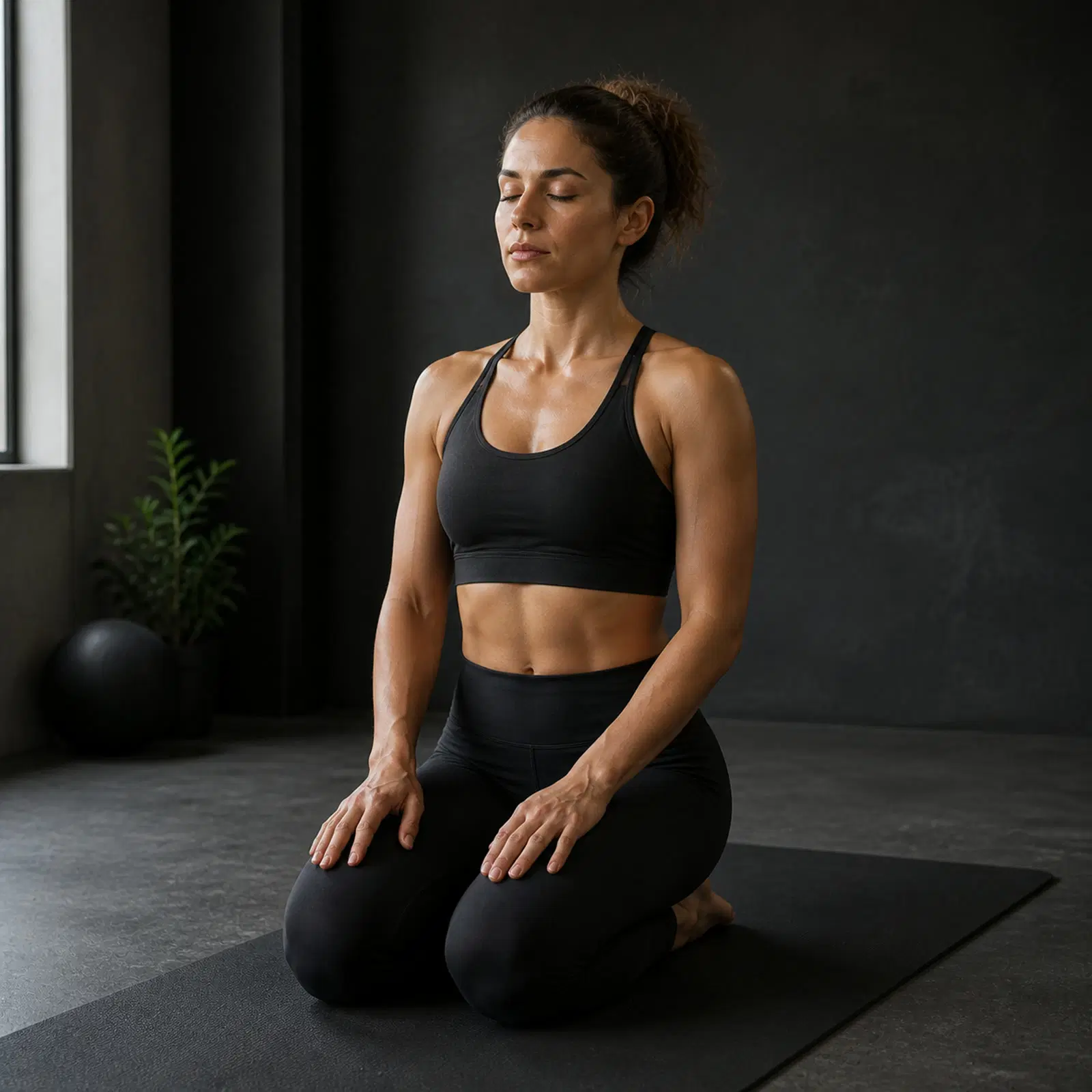
Pilates — The "Powerhouse" (Core Focus)
Sources and review status
Review pending — this text hasn’t been signed off by a reviewer yet.
See this lesson’s sources0% read · 1 min left
Joseph Pilates' term for the deep trunk musculature — abdominals, low back, hips, and pelvic floor — from which all Pilates movement is initiated and stabilized.
Detail
The "powerhouse" is the band of deep trunk musculature spanning roughly from the lower ribs to the line across the hips: the abdominals (notably the deep transverse abdominis — Transverse Abdominis), the obliques, the deep low-back/multifidus, the pelvic floor, and the hip/gluteal muscles. The principle of centering (Pilates — The Principles (Centering, Concentration, Control, Precision, Breath, Flow)) holds that all movement emanates from this center.
Functionally, engaging the powerhouse means co-activating the deep trunk stabilizers to create a stable, controlled spine and pelvis before and during limb movement — a core-stability strategy that protects the spine (Spine Positioning — "S" Shape, Never "C") and underpins the method's documented carryover to core strength, trunk endurance, and low-back-pain outcomes. EMG work shows trunk/core activation is central to Pilates loading, with reformer exercises producing notably high core engagement.
Key facts
- Powerhouse = deep trunk: abdominals (esp. transverse abdominis), obliques, low back/multifidus, pelvic floor, hips/glutes.
- All Pilates movement is initiated from this center (centering).
- Co-activating it stabilizes the spine/pelvis during limb movement.
Connections
- Transverse Abdominis — key deep stabilizer.
- Abdominals (Midsection) / Pelvic-Floor Considerations in Exercise — components.
- Pilates — The Principles (Centering, Concentration, Control, Precision, Breath, Flow) — "centering" principle.
- Spine Positioning — "S" Shape, Never "C" — stability protects the spine.
Sources
Keep this lesson, or ask how it applies to you.
Educational content only — not medical advice. Always consult a qualified professional for individualized guidance, especially around injury, pregnancy, or medical conditions.