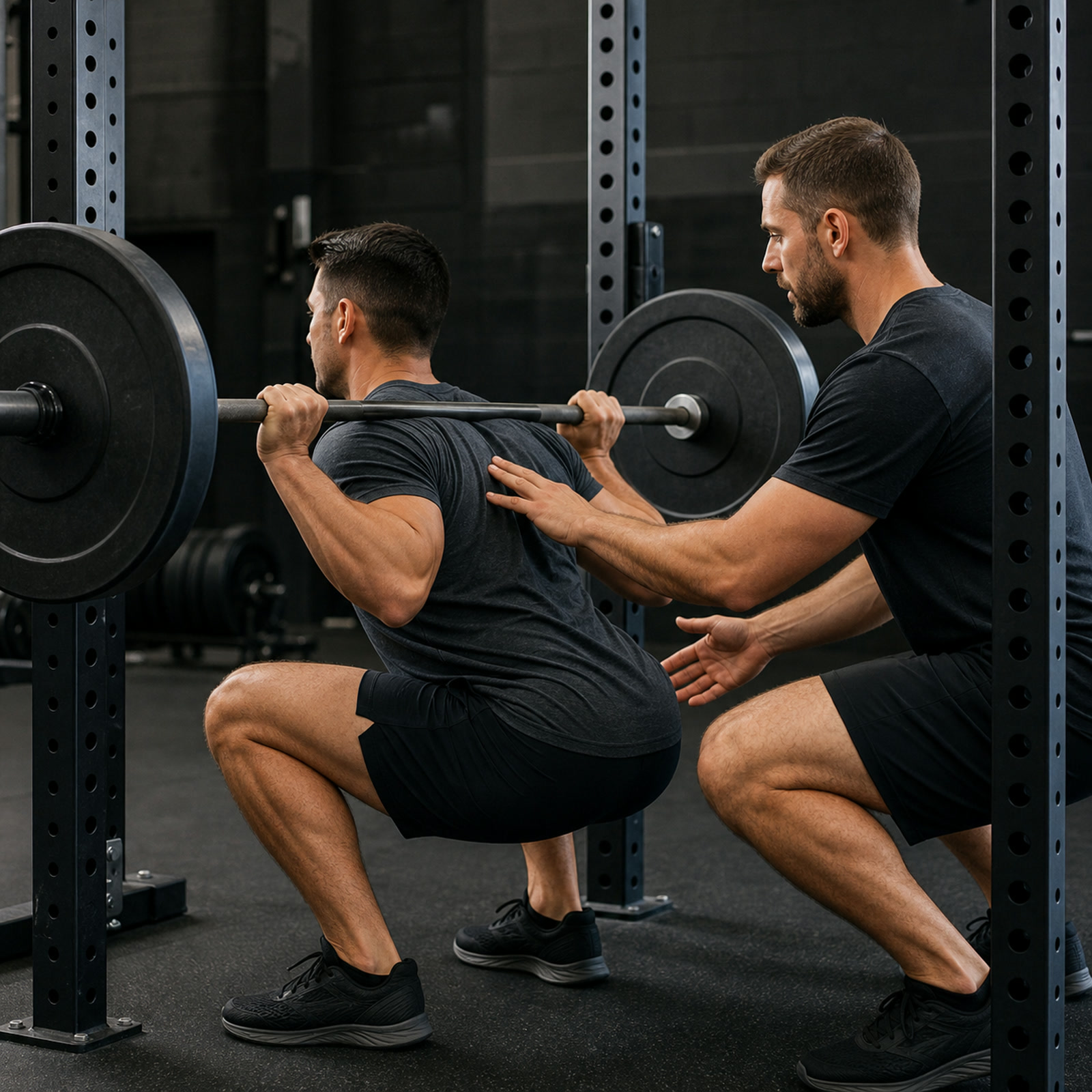
Spine Positioning — "S" Shape, Never "C"
0% read · 1 min left
Stabilize the spine by holding it in a semi-isometric contraction so it keeps its natural "S" shape — never allow a "C"-shaped spine during exercise.
Detail
Positioning and stabilizing the spine requires holding it in a semi-isometric contraction, to keep it in an "S" shape. Never allow a "C"-shape spine during exercise.
This principle reappears in the five-step evaluation of proper resistance exercise, under body positioning: proper spinal alignment is essential — the "S" shape is opposed to the "C." Maintaining the spine's natural curves recruits the erector spinae to protect the discs and vertebrae against compressive and shearing loads.
Key facts
- Hold the spine in a semi-isometric contraction to keep its natural "S" shape.
- Never allow a "C"-shape spine during exercise.
- Proper spinal alignment is essential to the body-positioning step of safe exercise evaluation.
Connections
- safe-lifting-mechanics — maintain the back's natural curves when lifting.
- knee-squat-safety — squats require semi-isometric spinal contraction.
- spinal-column — the four anterior-posterior curves of the spine.
- erector-spinae — the muscles holding the spine upright.
- proper-form — proper form as injury prevention.
- evaluation-5-steps — body-positioning/alignment step.
Educational content only — not medical advice. Always consult a qualified professional for individualized guidance, especially around injury, pregnancy, or medical conditions.