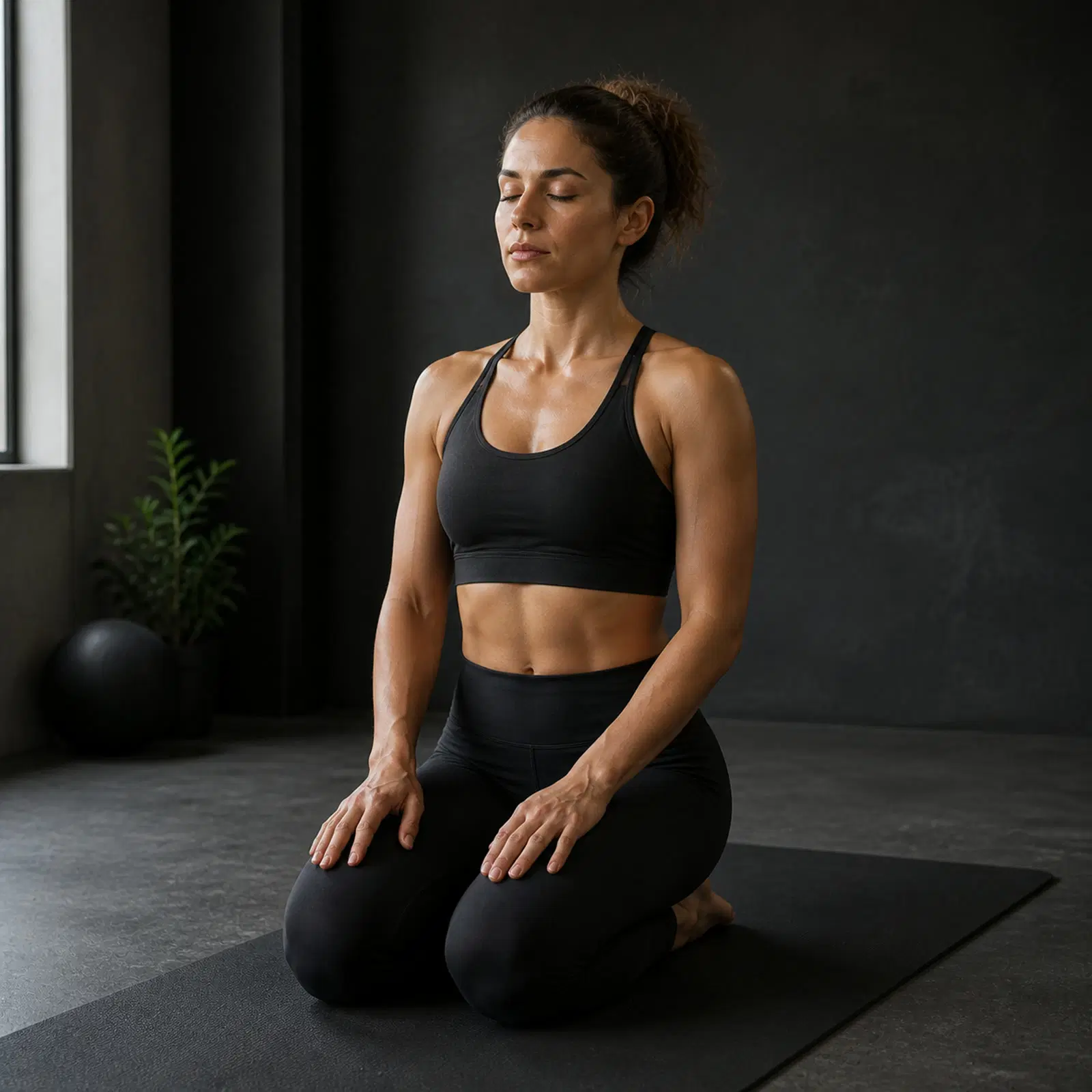
Yoga, Pilates, tai chi and breathwork, judged on what they are good for — mobility, control, calm — not on mystique.
What do you want to do?
Start here
4 lessons · ~6 min · in this order- 1Mind-Body Training — Who Benefits MostMind-body practices help nearly everyone for mobility and stress, but the largest, best-evidenced gains accrue to older adults (balance/falls), the stressed, deconditioned beginners, and people managing chronic low-back pain.Begin →
- 2Yoga (Overview)A mind-body discipline combining physical postures (asanas), breath control, and attentional focus that measurably improves flexibility, balance, strength, and stress regulation.2 min
- 3Pilates (Overview)A low-impact movement system built on core ("powerhouse") control, precise alignment, and breath, shown to improve core strength, flexibility, and low-back pain.1 min
- 4Diaphragmatic (Belly) BreathingSlow breathing driven by the diaphragm (belly rises, chest stays quiet) that raises vagal tone, lowers cortisol, and shifts the body toward the parasympathetic "rest-and-digest" state.1 min
Every Mind & Body topic
53 topics
- 4-7-8 Breathing1 minConcept · An exhale-weighted pattern — inhale 4, hold 7, exhale 8 — that emphasizes a long exhale and breath-hold to amplify vagal output and promote relaxation and sleep onset.
- Animal Flow & Ground-Based Movement (Overview)1 minDiscipline · A bodyweight discipline of crawling, quadrupedal positions, and flowing locomotion patterns that builds mobility, core/shoulder stability, and movement coordination.
- Box Breathing (4-4-4-4)1 minConcept · A simple equal-count pattern — inhale 4, hold 4, exhale 4, hold 4 — used to calm the nervous system and steady focus under stress.
- Breathing During Exercise & Lifting1 minConcept · During endurance exercise, breathe rhythmically to demand; during resistance training, exhale on exertion and avoid breath-holding strain — never hold your breath under heavy load.
- Breathing for Relaxation vs Performance1 minConcept · Slow, long-exhale breathing down-regulates arousal for calm and recovery; faster or held breathing and brisk exhale-equal patterns can prime alertness for performance — the goal sets the pattern.
- Bridge Pose (Setu Bandha Sarvangasana)1 minExercise · A supine hip-extension/backbend that strengthens the glutes and hamstrings and opens the hip flexors and chest.
- Cat-Cow (Marjaryasana-Bitilasana)1 minExercise · A breath-paced spinal flexion/extension cycle on hands and knees that mobilizes the whole spine and is a staple warm-up movement.
- Chaturanga Dandasana (Low Plank)1 minExercise · A controlled half-push-up lowering with elbows hugged to the ribs — the strength-demanding link in Vinyasa flows, easily done wrong at the shoulders.
- Child's Pose (Balasana)1 minExercise · A kneeling forward-fold resting posture that gently lengthens the spine and hips and serves as the default "rest" position during practice.
- Cobra Pose (Bhujangasana)1 minExercise · A prone back-extension that opens the front of the body and strengthens the spinal extensors, using leg/glute engagement to protect the lower back.
- Criss-Cross1 minExercise · A supine rotational core exercise — hands behind the head, rotating one shoulder toward the opposite knee in a slow, controlled bicycle.
- Diaphragmatic (Belly) Breathing1 minConcept · Slow breathing driven by the diaphragm (belly rises, chest stays quiet) that raises vagal tone, lowers cortisol, and shifts the body toward the parasympathetic "rest-and-digest" state.
- Double-Leg Stretch1 minExercise · A supine core exercise reaching both arms and both legs away simultaneously, then circling them back, while the trunk stays curled and braced.
- Downward-Facing Dog (Adho Mukha Svanasana)1 minExercise · An inverted-V posture that simultaneously stretches the hamstrings and calves while loading the shoulders, used as a transitional "home base" in flows.
- Feldenkrais & Somatics (Overview)1 minDiscipline · Gentle, attention-based movement methods that use slow exploratory movement and body awareness to improve movement efficiency, comfort, and self-regulation through motor learning.
- Full-Body Mobility Flow (Sequence)1 minSequence · A sample continuous floor-to-standing flow that mobilizes spine, hips, shoulders, and ankles — usable as a dynamic warm-up or a short standalone mobility session.
- Integrating Mind-Body Mobility into Warm-Up2 minConcept · Mobility flows and dynamic mind-body movements fit best in the warm-up as active, range-rehearsing preparation; long static or restorative work belongs after training.
- Leg Circles (Single-Leg Circles)1 minExercise · A supine exercise circling one extended leg from the hip while the pelvis stays still — training hip mobility against a stable, controlled core.
- Mind-Body Training — Who Benefits Most2 minConcept · Mind-body practices help nearly everyone for mobility and stress, but the largest, best-evidenced gains accrue to older adults (balance/falls), the stressed, deconditioned beginners, and people managing chronic low-back pain.
- Mobility Flows & Movement Practice (Overview)1 minConcept · Continuous, low-load sequences that move joints actively through their range — combining mobility, active flexibility, and control — used to warm up, restore range, and practice movement.
- Mountain Pose (Tadasana)1 minExercise · The foundational standing posture — feet grounded, spine tall and neutral, body stacked — that teaches alignment and postural awareness for all standing poses.
- Nasal Breathing1 minConcept · Breathing through the nose filters, warms, and humidifies air, supports nitric-oxide production, and tends to slow and deepen the breath versus mouth breathing.
- Pigeon Pose (Eka Pada Rajakapotasana, prep)1 minExercise · A deep hip-opener that stretches the glutes and external rotators (piriformis) of the front leg and the hip flexors of the rear leg.
- Pilates — Mat vs Reformer1 minConcept · Mat Pilates uses bodyweight and small props on the floor; the reformer adds spring resistance and a moving carriage for graded load and assistance.
- Pilates — The "Powerhouse" (Core Focus)1 minConcept · Joseph Pilates' term for the deep trunk musculature — abdominals, low back, hips, and pelvic floor — from which all Pilates movement is initiated and stabilized.
- Pilates — The Principles (Centering, Concentration, Control, Precision, Breath, Flow)1 minConcept · Six classical principles — centering, concentration, control, precision, breath, and flow — define how every Pilates movement is performed.
- Pilates (Overview)1 minDiscipline · A low-impact movement system built on core ("powerhouse") control, precise alignment, and breath, shown to improve core strength, flexibility, and low-back pain.
- Plank Pose (Phalakasana)1 minExercise · A high-push-up-position isometric hold that builds whole-body core and shoulder-girdle stability and anchors Vinyasa transitions.
- Pranayama (Yogic Breathing) Overview1 minConcept · The yogic system of breath-regulation techniques — slow, paced, and patterned nasal breathing used to steady the mind and modulate arousal alongside asana practice.
- Programming Mind-Body Work (Frequency & Integration)2 minConcept · Mind-body work can run 2–3+ sessions/week, slotted as standalone sessions, warm-ups/cool-downs, or active-recovery days, and layered onto strength and cardio without conflict when intensity is matched to the day.
- Qigong (Overview)1 minDiscipline · A Chinese system of gentle, repetitive movements, posture, breathing, and focused attention — closely related to tai chi and supported by evidence for balance, mobility, and well-being.
- Seated Forward Fold (Paschimottanasana)1 minExercise · A seated hip-hinge fold over straight legs that stretches the hamstrings and back, performed by leading with the chest rather than rounding the spine.
- Side Kicks1 minExercise · A side-lying series swinging the top leg front-and-back (and other variations) while the trunk stays rigidly stable — targeting the hip abductors and lateral core.
- Single-Leg Stretch1 minExercise · A supine core-stability exercise: head/shoulders curled up, one knee drawn in while the other leg extends, alternating with control.
- Spine Stretch (Forward)1 minExercise · A seated forward articulation — rounding down vertebra by vertebra toward the floor and re-stacking — that mobilizes the spine and stretches the back and hamstrings.
- Sun Salutation (Surya Namaskar)1 minSequence · A flowing, breath-paced sequence of linked postures that warms and mobilizes the whole body and forms the backbone of Vinyasa practice.
- Swan (Swan Dive prep)1 minExercise · A prone Pilates back-extension that strengthens the spinal extensors and counterbalances the method's many flexion exercises, with the powerhouse protecting the lumbar spine.
- Tai Chi — Principles & Basic Forms1 minConcept · Tai chi is built on slow continuous motion, relaxed upright posture, deliberate single-leg weight shifting, and breath-coordinated, mindful movement.
- Tai Chi (Overview)1 minDiscipline · A low-impact Chinese martial-art-derived practice of slow, continuous, weight-shifting movements that has strong evidence for improving balance and preventing falls, especially in older adults.
- Tai Chi & Qigong — Evidence for Balance & Fall Prevention2 minConcept · Across randomized trials and meta-analyses, tai chi (and to a growing degree qigong) significantly improves balance and reduces falls in community-dwelling older adults.
- The Hundred1 minExercise · A foundational warm-up exercise — supine with the head/shoulders curled up, legs raised, arms pulsing while breathing in patterns of five, for 100 counts.
- The Roll-Up1 minExercise · A slow, controlled articulation from lying to a seated forward fold and back, peeling the spine off the mat one vertebra at a time.
- The Teaser1 minExercise · An advanced V-sit balance — torso and legs lifted to form a V, balancing on the sacrum — demanding deep abdominal strength and control.
- Tree Pose (Vrksasana)1 minExercise · A single-leg balance posture — foot placed on the inner ankle, calf, or thigh — that trains proprioception, ankle/hip stability, and focus.
- Triangle Pose (Trikonasana)1 minExercise · A wide-stance standing posture with a long side-bend over a straight front leg, stretching the hamstrings and side body while training balance.
- Ujjayi Breath (Ocean Breath)1 minConcept · A yogic breath made by gently narrowing the throat to produce a soft, audible "ocean" sound, used to pace, steady, and focus flow practice.
- Warrior I (Virabhadrasana I)1 minExercise · A front-facing standing lunge with arms overhead — builds lower-body strength and stretches the rear hip flexor while training stance stability.
- Warrior II (Virabhadrasana II)1 minExercise · A wide, side-facing lunge with arms extended laterally — builds lower-body and shoulder endurance and opens the hips while the torso stays upright over the pelvis.
- Yoga — Contraindications & Safety1 minConcept · Yoga is generally safe but carries injury risk from over-ranging, neck loading in inversions, and unsupervised advanced postures; several conditions require modification.
- Yoga — Core Principles1 minConcept · The operating principles of asana practice — breath-movement coordination, alignment, steadiness-with-ease, non-forcing, and present-moment attention.
- Yoga — Evidence-Based Benefits1 minConcept · Controlled research supports yoga for flexibility, balance, muscular strength, and stress/mood — with adjunct benefit for chronic low back pain.
- Yoga (Overview)2 minDiscipline · A mind-body discipline combining physical postures (asanas), breath control, and attentional focus that measurably improves flexibility, balance, strength, and stress regulation.
- Yoga Styles (Hatha, Vinyasa, Iyengar, Yin, Power, Restorative)1 minConcept · The major asana styles differ mainly by pace, intensity, hold duration, and use of props — from vigorous Vinyasa/power to passive Yin and restorative.
Explore connections
How Mind & Body links to other categories — line thickness is link density in the graph, not an editorial rating.