Deep Squats Not Recommended (Full-ROM Exception)
0% read · 2 min left
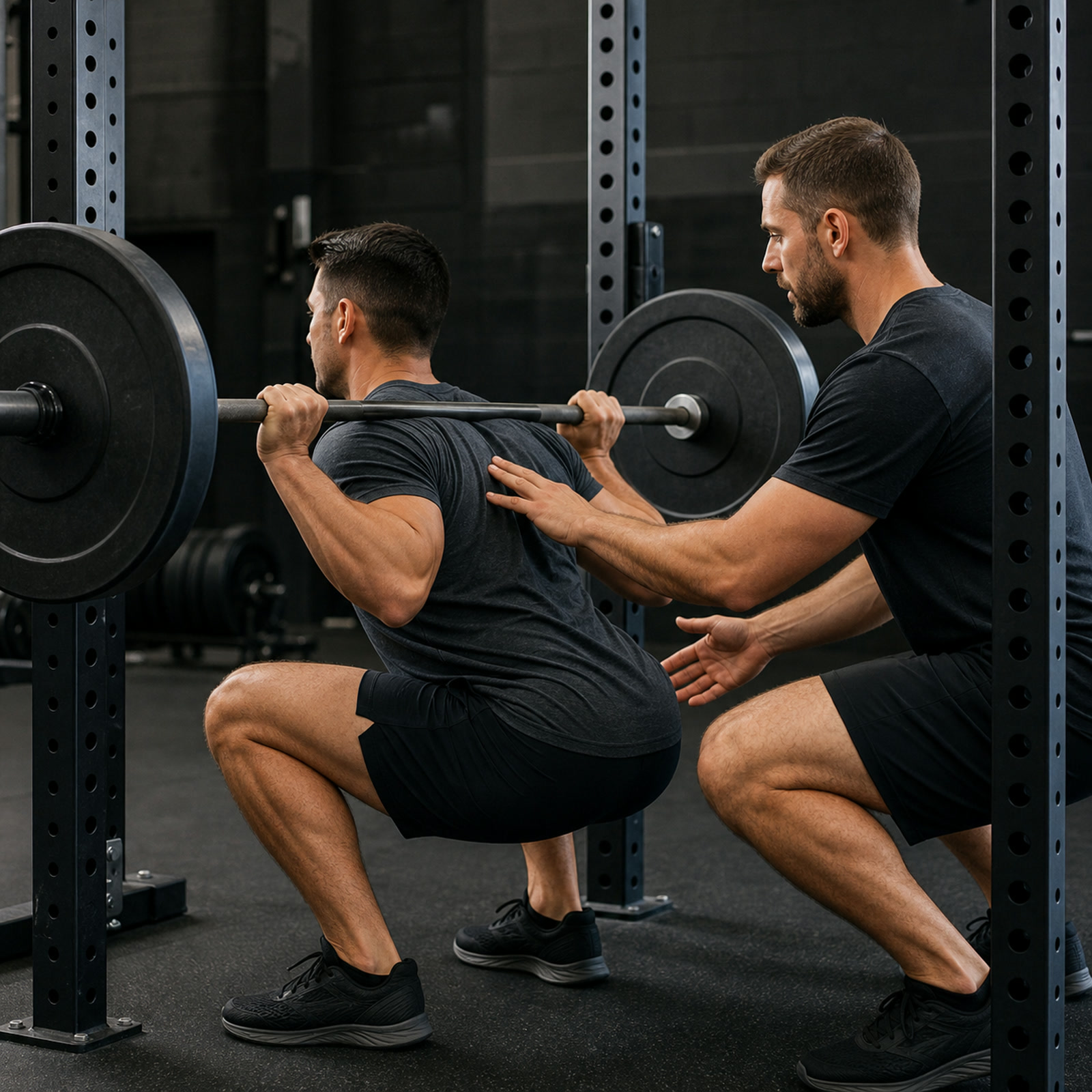
Every exercise should go through the full ROM a joint safely allows — but the squat is the exception: deep squats are not recommended; the safety range is thighs/quads parallel to the floor.
Detail
To ensure proper development of strength, every exercise should be performed through the full range of motion that the joint safely allows — with one noted exception: deep squats are not recommended.
The squat movement is probably the only exercise for which full ROM is not recommended. The safety range is quads parallel to the floor. Although it is assumed that developing strength throughout the full ROM requires training through the full ROM, for the squat the depth is deliberately limited for knee safety.
Current research update (2026)
The blanket "deep squats are dangerous" rule traces back to flawed 1960s research
(Klein) using an unvalidated laxity-measurement method. A 2024 scoping review of
15 high-quality studies found 14 showed no negative impact of deep squats on
knee health in people without pre-existing pathology — the forces at depth are
tolerable and may strengthen stabilizing tissue, and competitive lifters who
squat deep routinely show less knee laxity than non-squatters, not more. The
current understanding is that risk comes from excessive load or poor technique,
not depth itself. This doesn't mean forcing depth past an individual's actual
mobility — that's still a real, individual limiting factor — but "quads
parallel" as a universal safety ceiling isn't supported the way this module
frames it. See verification_note in this module's frontmatter.
Key facts
- General rule: train through the full ROM the joint safely allows.
- Source's original framing: the squat is the exception — deep squats not recommended; safety range is quads/thighs parallel to the floor.
- 2026 update: for individuals without pre-existing knee pathology and with adequate mobility/technique, squat depth itself is not inherently dangerous — risk comes from load and technique, not depth. Depth should still match the individual's actual mobility, not be forced past it.
Connections
- knee-squat-safety — squat technique and knee pressure.
- deep-knee-bend — deep knee bend/lunge/squat as a contraindicated movement.
- full-range-of-motion — the full-ROM training principle this qualifies.
- range-of-motion — ROM definition and the deep-squat caveat.
- knee-joint-rom — knee ROM.
Educational content only — not medical advice. Always consult a qualified professional for individualized guidance, especially around injury, pregnancy, or medical conditions.