Fysiqal
Safety
Safety

Knee Safety in the Squat

Evidence-grounded — sourced from Fysiqal's fitness knowledge graph· 2 min read
squatkneepatellalocking-outspinealignmentptd

0% read · 2 min left

In one line

Safe squatting protects the knee by not locking out, keeping proper spinal alignment, squatting to near-parallel, and managing patellar tracking — knee pressure jumps ~8× from standing to a 90° bend.

Detail

The knee joint ROM is 90 degrees (a hinge joint). From a standing position to a knee-bend at 90 degrees, the knee joint experiences 8 times more pressure. Years of leg workouts and overuse can produce "Patellar Tracking Dysfunction (PTD)," meaning the patella does not "track" straight when the knee is flexed or extended (lateral tracking). The function of the patella is to increase force area and improve the mechanics of the knee joint. The vastus medialis becomes strongest during the last 15 degrees of a knee extension movement.

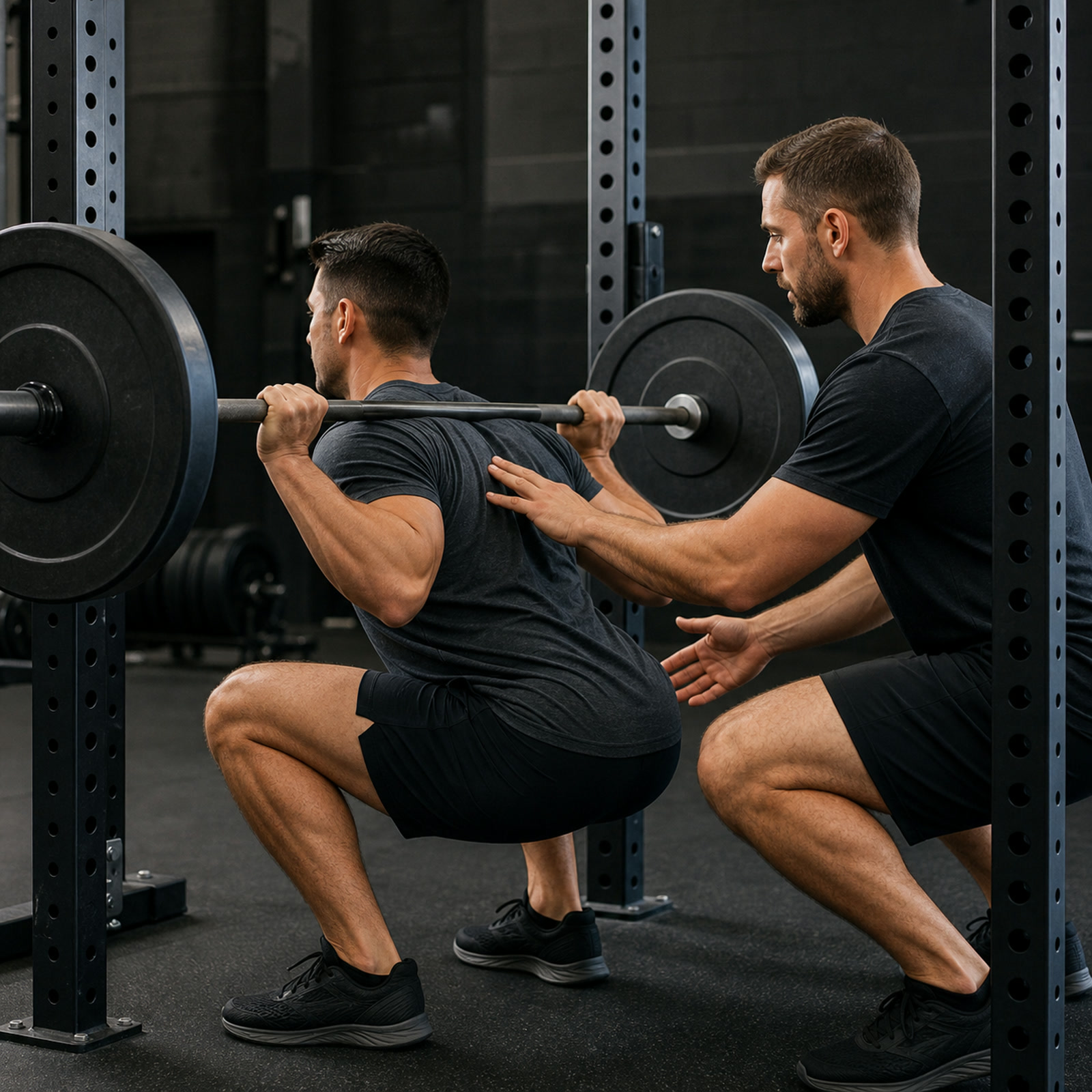
Safe squat technique: a. Do not lock out the knee. b. Ensure proper spinal alignment is observed (muscles in semi-isometric contraction). c. Squat to a position close to parallel to the floor. d. Keep feet at about shoulder width apart. e. Understand the "femur length vs. torso length" relationship. f. Understand the "knee–toe" relationship. g. Understand the "hip–knee" relationship. h. Understand "knee–foot" placement. i. Understand "stance width" of feet. j. Not all people can squat to a parallel position. k. Check position of the bar.

Key facts

  • Knee joint ROM is 90° (hinge joint).
  • Knee pressure increases ~8× going from standing to a 90° knee bend.
  • Vastus medialis is strongest during the last 15° of knee extension.
  • Patellar Tracking Dysfunction (PTD) = patella tracks laterally rather than straight.
  • Do not lock out; keep spine aligned (semi-isometric); squat to near-parallel; feet ~shoulder width.

Connections

  • knee-toe-relationship — knee/toe alignment rule.
  • deep-squats-not-recommended — full-ROM exception for the squat.
  • deep-knee-bend — the contraindicated ballistic/bouncing version of a deep bend.
  • bar-placement — high/low/front bar position.
  • locking-out — locking-out cautions.
  • spine-positioning — "S"-shape spine in semi-isometric contraction.
  • knee-joint-rom — knee ROM (90°).
  • quadriceps — vastus medialis tracking the patella.
  • femur-torso-length-squat — proportions affecting squat depth/lean.
  • exercise-selections-by-training-level — the Sissy Squat (listed there as an advanced quad exercise) carries a similar knee-loading caution: high patellofemoral stress that's fine for healthy knees but should be avoided or modified for patellar tendinopathy, recent ACL reconstruction, or PFPS.
  • knee-wraps — a squat-support accessory with its own patellar-tracking cautions.
SourceReference manual
p.504p.540p.688
Pages: 688, 504, 540.
Concerns like this deserve a real coach’s eyes, not just an article.Browse coaches

Educational content only — not medical advice. Always consult a qualified professional for individualized guidance, especially around injury, pregnancy, or medical conditions.

Explore related topics

Atlas Connections

Knee Joint Range of Motion
The knee is a hinge joint: extension 90°, flexion 120° (hamstring knee-flexion ROM stated as 125°).
Quadriceps
The four knee extensors — rectus femoris, vastus medialis, vastus lateralis, vastus intermedius (rectus femoris also flexes the hip); knee ROM 90°.
Resistance Exercise Selections for Different Training Levels
A 14-muscle-group table mapping novice → intermediate → advanced exercise choices, generally progressing from stable machines to freer, more technically demanding movements as training level rises.
Bar Placement in the Squat (High / Low / Front)Closely related
Three squat bar positions — high bar (Back Squat), low bar (called "Power Back Squat" in the source; known today as the low-bar squat), and bar-in-front (Front Squat) — each set a different line of force and require proper alignment.
Deep Knee Bend / Lunge / Squat — Contraindicated Stretch
Deep knee bends, lunges, and squats (with or without weights) endanger the knee's lateral ligaments, compress the kneecap, and damage cartilage — marked "X".
Deep Squats Not Recommended (Full-ROM Exception)Closely related
Every exercise should go through the full ROM a joint safely allows — but the squat is the exception: deep squats are not recommended; the safety range is thighs/quads parallel to the floor.
Femur Length vs. Torso Length in the Squat
Body proportions change squat mechanics — a long femur forces more forward lean and shifts emphasis to the glutes and erector spinae; lifters must adapt their technique accordingly.
Knee–Toe Relationship RuleClosely related
In the squat, manage where the knees travel relative to the toes — keeping the knees from passing the toes versus keeping the spine vertical — and find the "happy medium."
Knee Wraps — Effects, Limits & Detrimental Side EffectsClosely related
Heavy knee wraps boost squat performance through mechanical and other effects, but there is no evidence they prevent injury — and they can damage the patella and cause chondromalacia.
Locking Out — When It Is and Isn't RiskyClosely related
Locking out joints under load is generally avoided in the squat and calf raises, but in the leg extension it is "not very dangerous" because the resistance pushes the shins down.
Spine Positioning — "S" Shape, Never "C"Closely related
Stabilize the spine by holding it in a semi-isometric contraction so it keeps its natural "S" shape — never allow a "C"-shaped spine during exercise.