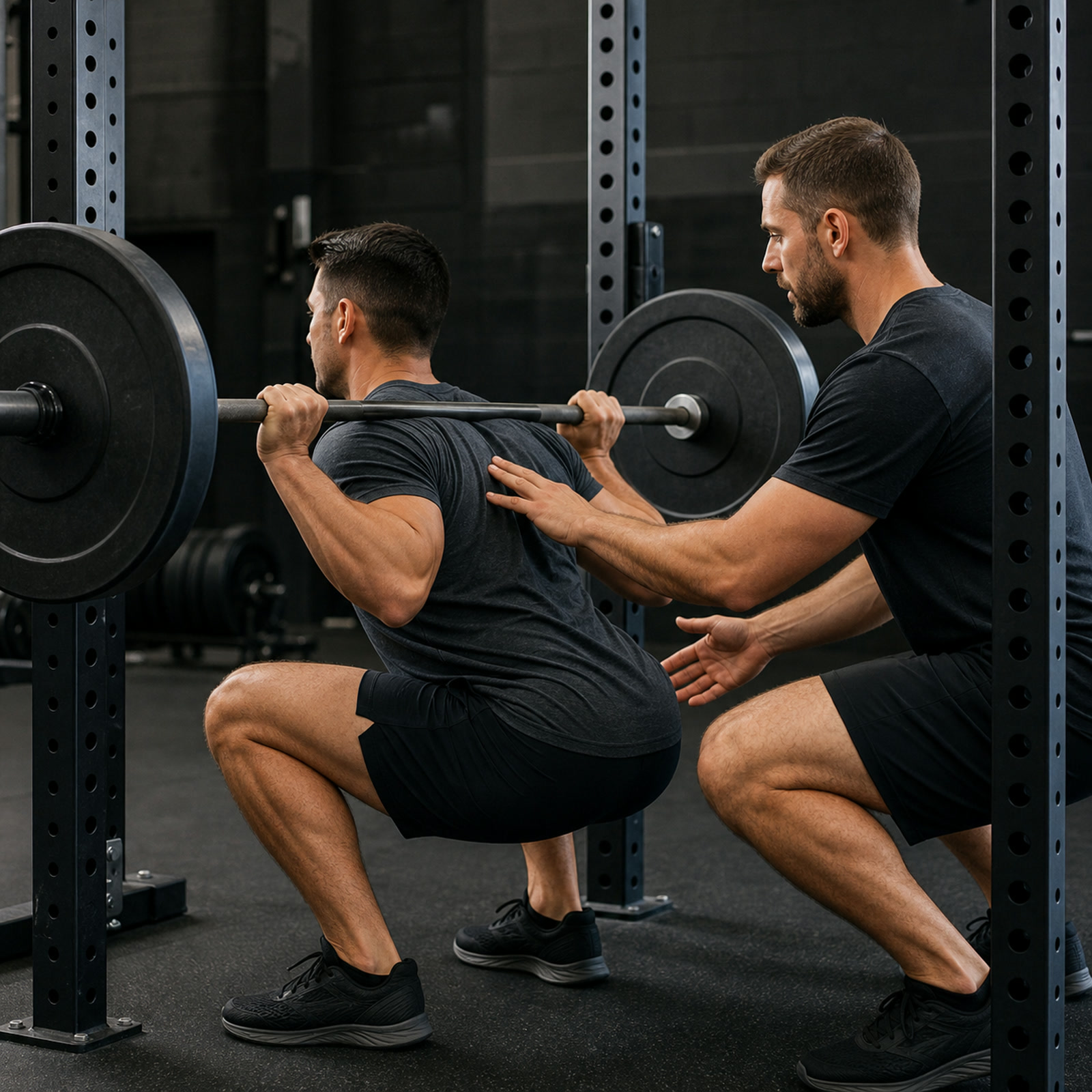
Deep Knee Bend / Lunge / Squat — Contraindicated Stretch
0% read · 1 min left
Deep knee bends, lunges, and squats (with or without weights) endanger the knee's lateral ligaments, compress the kneecap, and damage cartilage — marked "X".
Detail
The Deep Knee Bend/Lunge/Squat (with or without weights) is one of the contraindicated ("X-Rated") movements, illustrated in the source with a large "X" (a figure shown standing and in a deep-squat position with a barbell across the shoulders). Its specific risks are:
- Endangers the lateral ligaments of the knee
- Compresses the kneecap
- Pinches and damages the cartilage
This is the stretching-context counterpart to the resistance-training guidance that deep squats are not recommended and that the squat should go only to a position close to parallel to the floor.
Key facts
- Source's original framing: endangers the lateral ligaments of the knee, compresses the kneecap, pinches and damages the cartilage.
- Applies with or without added weight.
- 2026 update: current research finds squat depth itself is not inherently dangerous for healthy knees with adequate mobility/technique — see deep-squats-not-recommended's currency note. The distinct concern here is more plausibly the ballistic/uncontrolled bouncing this X-Rated context implies, not depth per se.
Connections
- x-rated-exercises-overview — one of the eight "X-Rated" stretches.
- deep-squats-not-recommended — full-ROM exception for the squat.
- knee-squat-safety — squat technique and knee safety.
- knee-joint-rom — knee ROM is 90° (hinge joint).
- knee-toe-relationship — knee alignment rule.
Educational content only — not medical advice. Always consult a qualified professional for individualized guidance, especially around injury, pregnancy, or medical conditions.