Fysiqal
Safety
Safety
Locking Out — When It Is and Isn't Risky
Evidence-grounded — sourced from Fysiqal's fitness knowledge graph· 1 min read
locking-outkneesquatleg-extensioncalvesjoints
0% read · 1 min left
In one line
Locking out joints under load is generally avoided in the squat and calf raises, but in the leg extension it is "not very dangerous" because the resistance pushes the shins down.
Detail
Locking out (fully extending a joint under load) is treated differently by exercise:
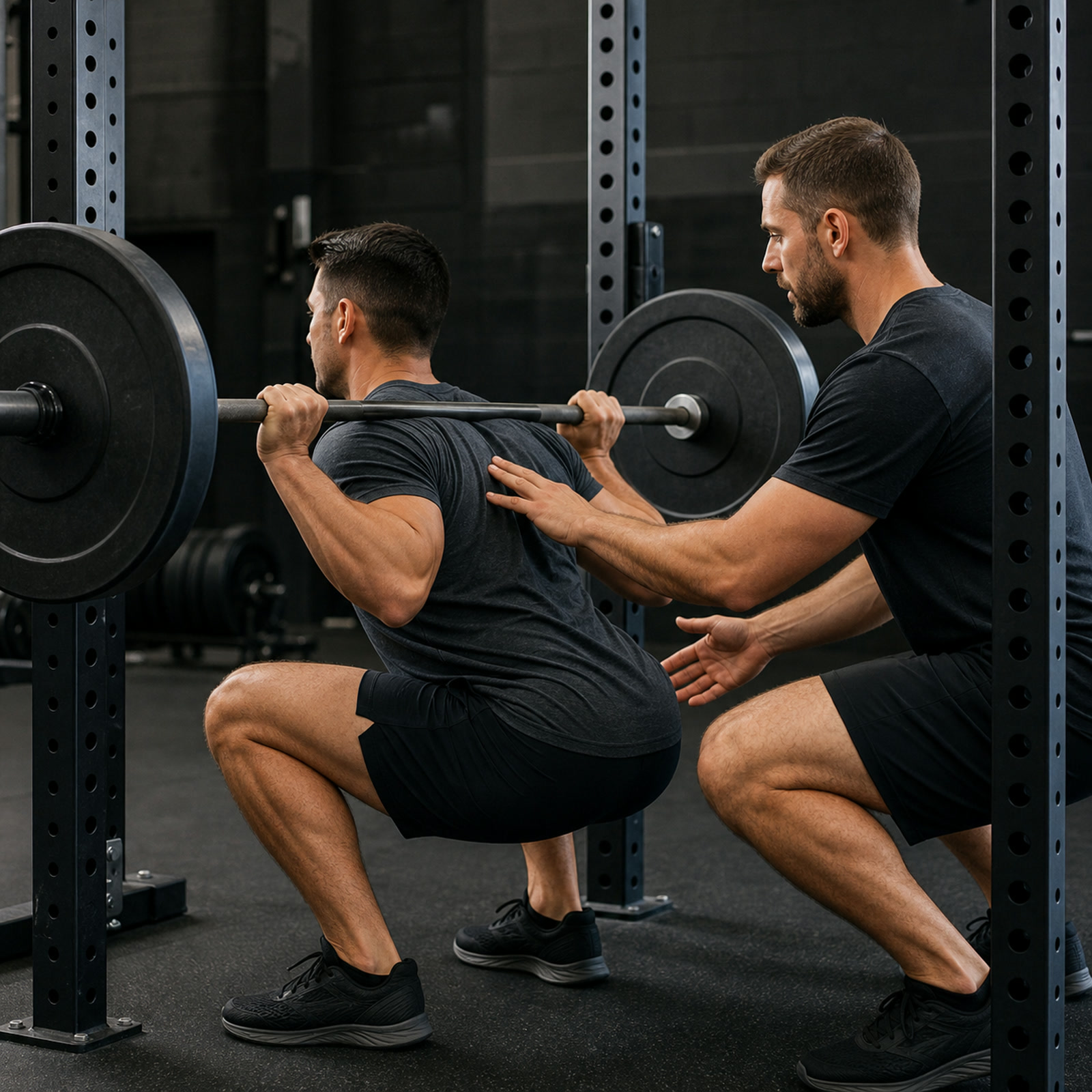
- Squats: Do not lock out the knee.
- Standing calf: Don't lock out the knees (and don't bend the knees to help with the movement).
- Leg extension: Locking out is not very dangerous, because the resistance force is pushing the shins down.
The distinction is the direction of the resistance relative to the joint: when the load would drive a locked joint into hyperextension or bear straight down on it, locking out is avoided; when the load instead acts to keep the joint controlled, locking out is comparatively safe.
Key facts
- Squats: do not lock out the knee.
- Standing calf: do not lock out the knees.
- Leg extension: locking out is not very dangerous (resistance pushes the shins down).
Connections
- knee-squat-safety — "do not lock out the knee" in squats.
- leg-extension-knee-safety — locking out is not very dangerous here.
- knee-joint-rom — the knee joint involved.
- gastrocnemius / soleus — calf raises (don't lock the knees).
SourceReference manual
p.32p.504p.688
Pages: 32, 504, 688.
Educational content only — not medical advice. Always consult a qualified professional for individualized guidance, especially around injury, pregnancy, or medical conditions.
Explore related topics
Locking Out — When It Is and Isn't Risky
GastrocnemiusKnee Joint Range of …SoleusKnee Safety in the S…Knee Safety in the L…Atlas Connections
Gastrocnemius
A 2-joint calf muscle that plantar-flexes the ankle and flexes the knee; origin at the femoral condyles, insertion at the calcaneus.Knee Joint Range of Motion
The knee is a hinge joint: extension 90°, flexion 120° (hamstring knee-flexion ROM stated as 125°).Soleus
A single-joint calf muscle that plantar-flexes the ankle; trained with seated calf raises.Knee Safety in the SquatClosely related
Safe squatting protects the knee by not locking out, keeping proper spinal alignment, squatting to near-parallel, and managing patellar tracking — knee pressure jumps ~8× from standing to a 90° bend.Knee Safety in the Leg ExtensionClosely related
Because the knee is a hinge joint, the leg extension requires aligning the patella with the cam's axis of rotation and a slight inward rotation of the quads so extension stays in a vertical plane; locking out is not very dangerous here.