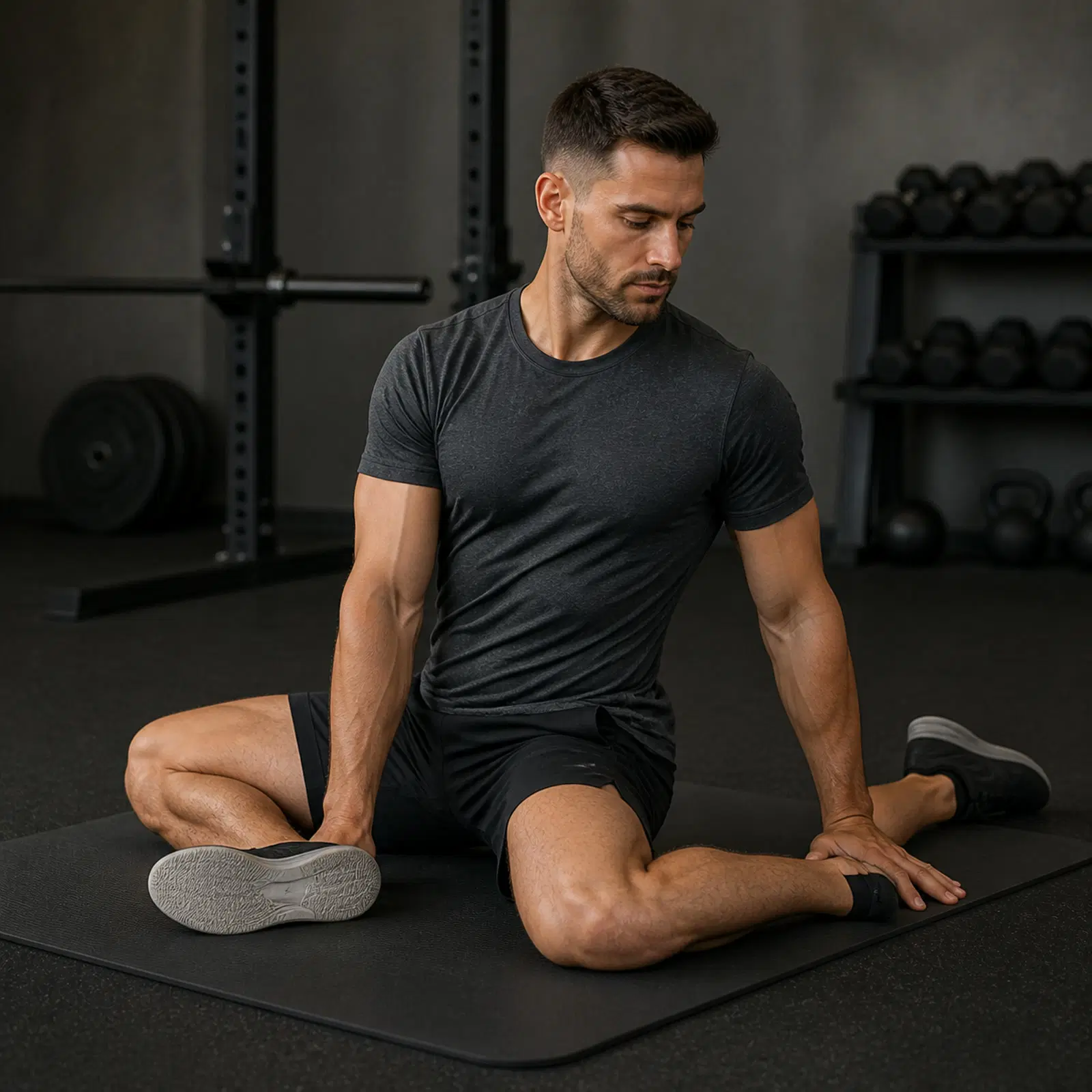
Deep Squat Hold
Sources and review status
Review pending — this text hasn’t been signed off by a reviewer yet.
See this lesson’s sources0% read · 2 min left
Sink into the bottom of a full squat and relax into the position — a loaded end-range hold that builds and maintains hip, ankle, and knee mobility for squatting and sitting.
Detail
From standing, descend into a full (deep/"resting") squat: hips below the knees, feet roughly shoulder-width, toes slightly out, heels staying down, knees tracking over the toes, and the torso as upright as mobility allows. Settle into the bottom and hold, breathing and relaxing into the position. The hold loads end-range hip flexion (The Hip Complex) and ankle dorsiflexion (Foot / Ankle Range of Motion) — often the limiting factors — and develops active, usable bottom-position mobility (Mobility vs Flexibility) for squatting (Back Squats) and floor-sitting.
Verified 2026-08-31: heel-lift/limited depth in the squat bottom tracking back to ankle dorsiflexion specifically is measured, not just a coaching heuristic — see Ankle Mobility Drills (Knee-to-Wall Dorsiflexion)'s verification note (Kim et al. 2015, J Human Kinetics, n=101, R²=0.435 men/0.324 women; Endo et al. 2020, J Phys Ther Sci, n=9).
Coaching:
- If the heels lift or you topple backward, the ankles are usually limiting — hold light support (a rail/door frame) or elevate the heels slightly while you work on ankle mobility (Ankle Mobility Drills (Knee-to-Wall Dorsiflexion)).
- Keep the knees tracking over the toes and the spine long.
- Gently push the knees out with the elbows from inside the thighs to deepen.
- Typical dose: accumulate ~30–120 seconds, in one or several holds; can be done daily.
Use it as a warm-up position (see Dynamic Warm-Up (Mobility-as-Training)), a mobility-maintenance habit, or a mobility assessment (how comfortably you reach and hold the bottom).
Key facts
- Hold the bottom of a full squat (hips below knees, heels down, knees over toes).
- Loads end-range hip flexion and ankle dorsiflexion; builds usable squat-bottom mobility.
- Heels lifting / falling back usually signals limited ankle mobility.
- Typical dose: ~30–120 s accumulated; can be daily.
Connections
- Mobility vs Flexibility — builds active end-range mobility.
- Ankle Mobility Drills (Knee-to-Wall Dorsiflexion) — address the common ankle limiter.
- The Hip Complex, Foot / Ankle Range of Motion — joints loaded.
- Back Squats — the movement this supports.
- Dynamic Warm-Up (Mobility-as-Training) — usable as a warm-up position.
Sources
Exercise guides
Keep this lesson, or ask how it applies to you.
Educational content only — not medical advice. Always consult a qualified professional for individualized guidance, especially around injury, pregnancy, or medical conditions.