Move Better
Free to read. Track it in Studio to save progress and practice each checkpoint.
1EssentialsWhat mobility actually is, and where it fits around a warm-up. · 4 core lessons
- 1Mobility vs FlexibilityFlexibility is how far a joint can be moved, often with outside help. Mobility is how much of that range you can reach and control with your own muscles. Build both by stretching and by strengthening through full range.5 min · Balance5 min · Balance
- 2Dynamic Warm-Up (Mobility-as-Training)A pre-activity routine of active, moving drills that take joints through increasing range while raising temperature and priming the nervous system — building usable mobility, unlike a static hold-and-relax stretch.2 min · Balance2 min · Balance
- 3Stability vs Mobility (Joint-by-Joint Approach)Joints alternate in their primary need — some want mobility (move freely), some want stability (resist unwanted motion) — and dysfunction at one tends to show up as pain or compensation at its neighbors.2 min · Balance2 min · Balance
- 4Controlled Articular Rotations (CARs)Slow, deliberate circles taking a single joint through its full active range under maximum muscular control — a daily method to map, maintain, and expand usable joint range.2 min · Balance2 min · Balance
Explain the difference between mobility and flexibility, and where each fits around your warm-up and training.
Practice it in Studio2ApplicationThe real drills that make up a mobility routine. · 4 core lessons
- 1Hip CARs (Controlled Articular Rotations)Standing tall and braced, trace the largest controlled circle one hip can make — lifting the knee, opening it out, rotating, and reversing — for active hip mobility and joint health.2 min · Balance2 min · Balance
- 2Ankle Mobility Drills (Knee-to-Wall Dorsiflexion)Drive the knee forward over the toes with the heel pinned down to mobilize ankle dorsiflexion — the joint-by-joint "mobility" target most often limiting squats and gait.3 min · Balance3 min · Balance
- 3Thoracic Rotations (Open-Book / Quadruped)Drills that isolate rotation to the mid-back (thoracic spine) — the joint-by-joint "mobility" segment — while keeping the lumbar spine stable.2 min · Balance2 min · Balance
- 4Mobility / Longevity ProgramA sustainable, joint-friendly plan that protects strength, mobility, balance, and aerobic health into later decades — optimizing healthspan rather than peak performance.2 min · Programming2 min · Programming
Go deeper · 12 optional lessons
- 1Shoulder CARs (Controlled Articular Rotations)Slowly trace the largest circle your shoulder can actively make, body braced and the rest of you still — a daily joint-health and active-mobility drill.2 min · Balance2 min · Balance
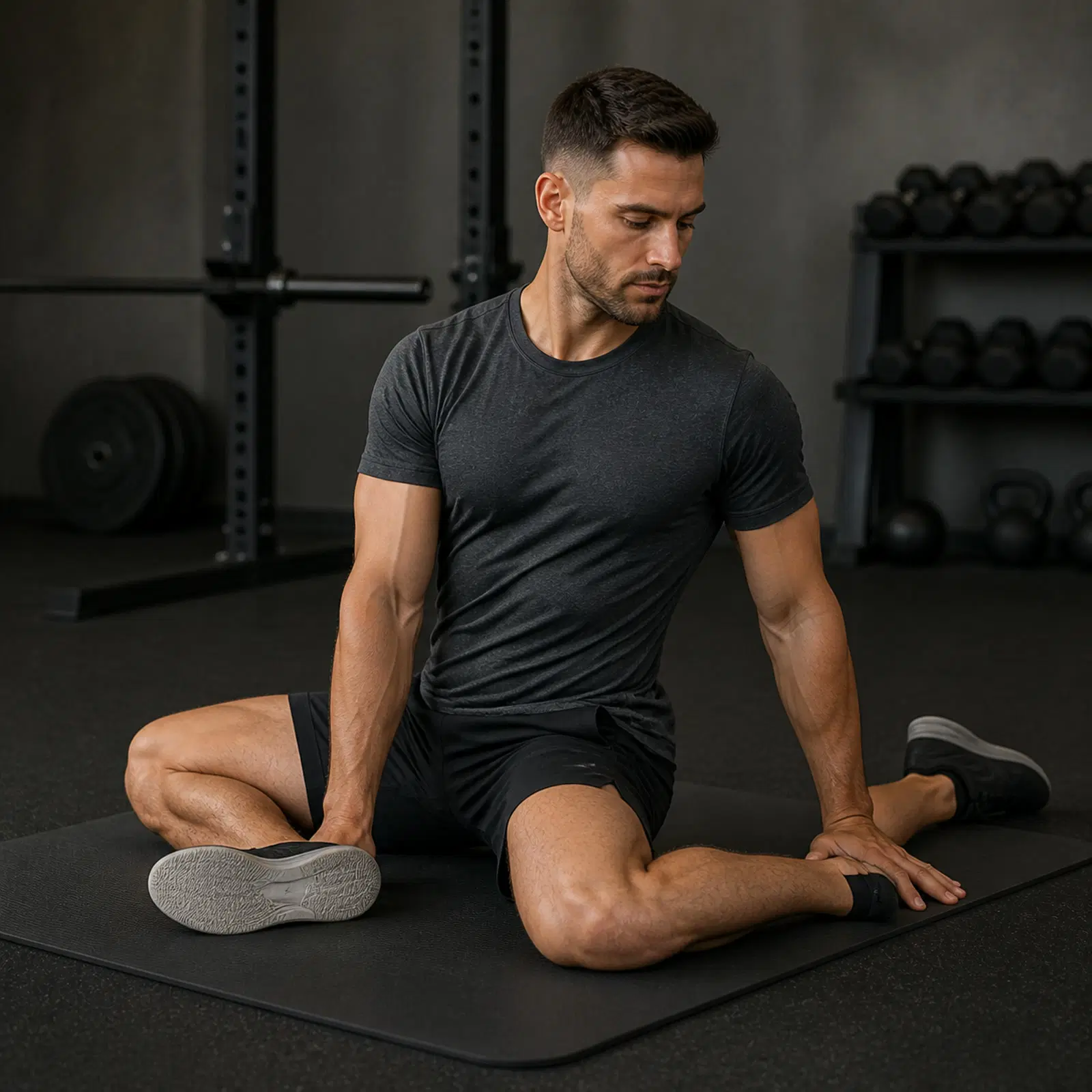
- 290/90 Hip SwitchSit with both knees bent to 90° (one in front, one to the side) and rotate side to side between positions — a focused drill for hip internal and external rotation.2 min · Balance2 min · Balance
- 3Hip CirclesCircle the knee/thigh to draw circles with a lifted leg, or circle the pelvis itself — a dynamic warm-up drill that mobilizes the hip through all directions.1 min · Balance1 min · Balance
- 4Leg SwingsHolding support, swing one leg front-to-back and side-to-side through a progressively larger range — a staple dynamic warm-up drill for hip mobility.1 min · Balance1 min · Balance
- 5Arm CirclesCircle the arms forward and backward through a growing range to warm and mobilize the shoulders — a quick, equipment-free dynamic warm-up drill.1 min · Balance1 min · Balance
- 6Cat-CowFrom hands and knees, alternately round the spine (cat) and arch it (cow), moving with the breath — a gentle dynamic drill that mobilizes the whole spine into flexion and extension.1 min · Balance1 min · Balance
- 7Shoulder Dislocates (Pass-Throughs)Hold a dowel or band wide and sweep it overhead from front to back and return — a dynamic drill that opens up overhead shoulder mobility. (The name is figurative — nothing actually dislocates.)2 min · Balance2 min · Balance
- 8Deep Squat HoldSink into the bottom of a full squat and relax into the position — a loaded end-range hold that builds and maintains hip, ankle, and knee mobility for squatting and sitting.2 min · Balance2 min · Balance
- 9InchwormFold forward, walk the hands out to a plank, then walk the feet back in — a dynamic warm-up drill that mobilizes the hamstrings and posterior chain while bracing the core.1 min · Balance1 min · Balance
- 10World's Greatest StretchA flowing lunge-and-rotate sequence that mobilizes hip flexors, hamstrings, and the thoracic spine in one movement — a high-value dynamic warm-up drill.2 min · Balance2 min · Balance
- 11Full-Body Mobility Flow (Sequence)A sample continuous floor-to-standing flow that mobilizes spine, hips, shoulders, and ankles — usable as a dynamic warm-up or a short standalone mobility session.1 min · Mind & Body1 min · Mind & Body
- 12Integrating Mind-Body Mobility into Warm-UpMobility flows and dynamic mind-body movements fit best in the warm-up as active, range-rehearsing preparation; long static or restorative work belongs after training.2 min · Mind & Body2 min · Mind & Body
Build a 10-minute routine from the drills in this stage for one area you want to improve. List drills, order and reps or time.
Practice it in Studio3TroubleshootingSelf-assessing what is actually restricted, and the recovery tools that help. · 3 core lessons
- 1Functional Movement Screen (FMS) — OverviewA seven-task movement-quality screen scored 0–3 per task (max 21) that flags mobility/stability limitations and asymmetries to guide corrective work — a qualitative screen, not a fitness test.2 min · Assessment2 min · Assessment
- 2Timed Up-and-Go (TUG) TestTime someone rising from a chair, walking 3 m, turning, returning, and sitting; longer times indicate impaired mobility and higher fall risk in older adults.2 min · Assessment2 min · Assessment
- 3Foam Rolling & Self-Myofascial Release (SMR)Rolling a muscle over a foam roller or ball briefly improves range of motion and reduces the feeling of soreness without lasting tissue change — useful in warm-ups and for comfort, not a true "release" of fascia.2 min · Wellness2 min · Wellness
Go deeper · 3 optional lessons
- 1Foam RollerA firm cylinder you roll body parts over to apply pressure to muscles and fascia — the most common self-myofascial-release tool, used to ease tightness pre- and post-workout, with modest, mostly short-term effects.2 min · Equipment2 min · Equipment
- 2Lacrosse Ball / Massage BallA small, hard ball for pinpoint self-myofascial release — it reaches small, deep spots a foam roller can't, like the glutes, feet, and around the shoulder blade.1 min · Equipment1 min · Equipment
- 3Stretching StrapA non-elastic strap, often with sewn loops, that extends your reach so you can hold and deepen stretches with control — especially useful for the hamstrings, hips, and shoulders, and for solo PNF.1 min · Equipment1 min · Equipment
Run one self-assessment from this stage. Record what you found and what it does and does not tell you. Note anything that needs a professional to look at.
Practice it in Studio4AdvancedBroader mind-body practices and skill work built on real mobility. · 3 core lessons
- 1Pistol Squat as a Skill (Balance & Mobility)Beyond leg strength, the pistol is a skill gated by single-leg balance, deep ankle dorsiflexion, and active hip-flexor compression to keep the front leg up.2 min · Calisthenics2 min · Calisthenics
- 2Pilates (Overview)A low-impact movement system built on core ("powerhouse") control, precise alignment, and breath, shown to improve core strength, flexibility, and low-back pain.1 min · Mind & Body1 min · Mind & Body
- 3Yoga (Overview)A mind-body discipline combining physical postures (asanas), breath control, and attentional focus that measurably improves flexibility, balance, strength, and stress regulation.2 min · Mind & Body2 min · Mind & Body
Go deeper · 4 optional lessons
- 1Animal Flow & Ground-Based Movement (Overview)A bodyweight discipline of crawling, quadrupedal positions, and flowing locomotion patterns that builds mobility, core/shoulder stability, and movement coordination.1 min · Mind & Body1 min · Mind & Body
- 2Feldenkrais & Somatics (Overview)Gentle, attention-based movement methods that use slow exploratory movement and body awareness to improve movement efficiency, comfort, and self-regulation through motor learning.1 min · Mind & Body1 min · Mind & Body
- 3Leg Circles (Single-Leg Circles)A supine exercise circling one extended leg from the hip while the pelvis stays still — training hip mobility against a stable, controlled core.1 min · Mind & Body1 min · Mind & Body
- 4Cat-Cow (Marjaryasana-Bitilasana)A breath-paced spinal flexion/extension cycle on hands and knees that mobilizes the whole spine and is a staple warm-up movement.1 min · Mind & Body1 min · Mind & Body
Pick one broader practice from this stage (e.g. yoga or Pilates) and plan how it would fit your week without crowding your training.
Practice it in StudioStage order and checkpoints are editorial curation by the Fysiqal team, not a study-backed or third-party-reviewed sequence. Lessons show their own review status. See every topic tagged move better →