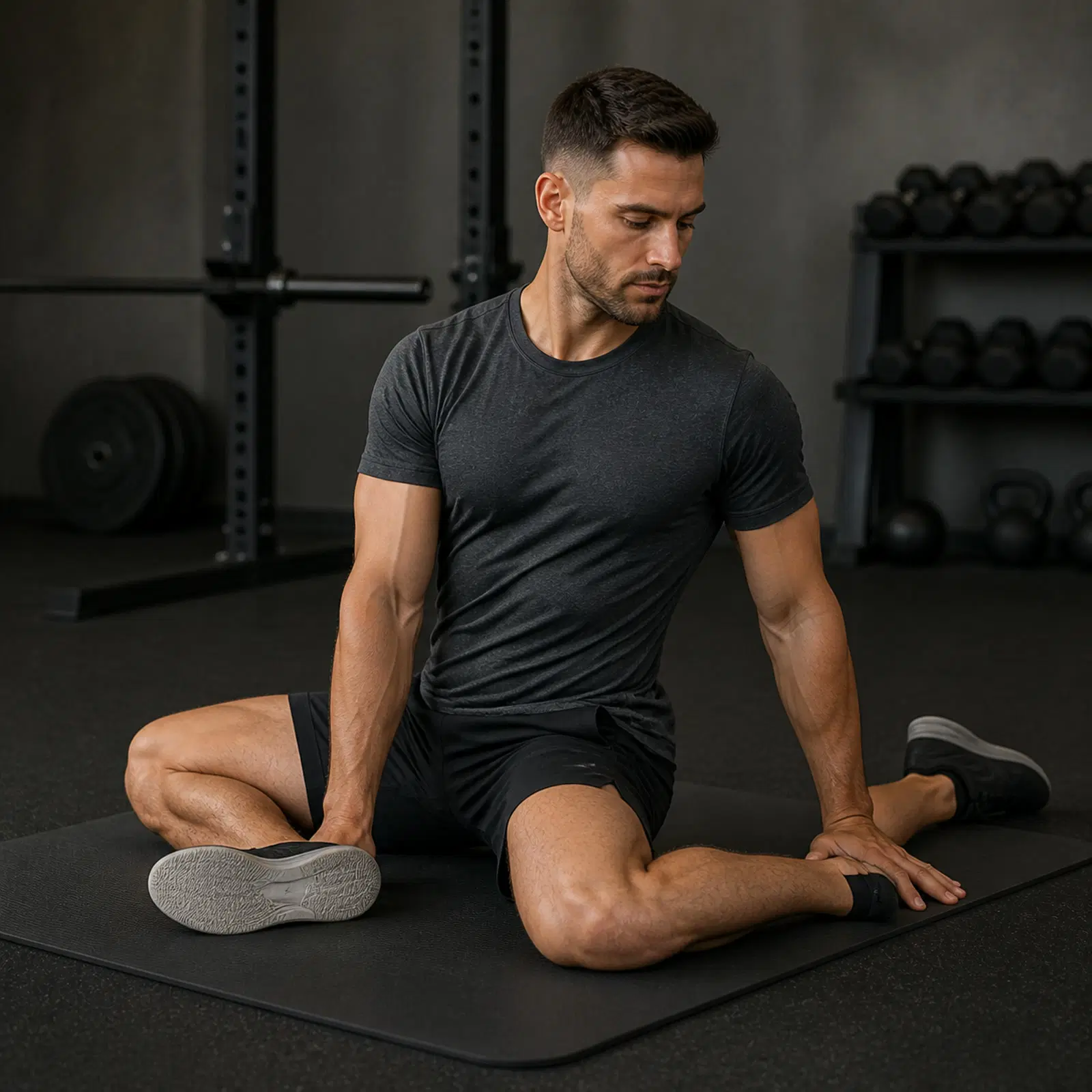
Hip Circles
Sources and review status
Review pending — this text hasn’t been signed off by a reviewer yet.
See this lesson’s sources0% read · 1 min left
Circle the knee/thigh to draw circles with a lifted leg, or circle the pelvis itself — a dynamic warm-up drill that mobilizes the hip through all directions.
Detail
Two common forms:
- Standing leg circles — hold support, lift one knee to hip height, and trace circles with the knee/thigh (open the hip out and around), mobilizing the hip through circumduction (The Hip Complex); reverse direction and switch legs.
- Pelvic circles — feet planted, hands on hips, and circle the pelvis (like a slow hula-hoop) to mobilize the hips and lumbo-pelvic region.
Keep movements smooth, controlled, and progressively larger — dynamic mobility rather than forced end-range work (see Mobility vs Flexibility). This is a standard dynamic warm-up drill (see Dynamic Warm-Up (Mobility-as-Training)) that prepares the hips for squatting, hinging, and locomotion. For a slow, maximal-control end-range version of hip circling, see hip CARs (Hip CARs (Controlled Articular Rotations)); leg swings (Leg Swings) are the linear companion.
Coaching:
- Brace the trunk; keep the supporting knee soft.
- Typical dose: ~8–10 circles each direction per leg (standing) or ~10 each way (pelvic).
Key facts
- Standing knee circles (lifted leg) and/or pelvic circles to mobilize the hip in all directions.
- Dynamic hip-mobility warm-up drill; develops active mobility.
- Typical dose: ~8–10 circles each direction per leg.
- Controlled and progressively larger; not forced end-range.
Connections
- Dynamic Warm-Up (Mobility-as-Training) — part of the dynamic warm-up menu.
- The Hip Complex — joint mobilized.
- Hip CARs (Controlled Articular Rotations) — slow, maximal-control version.
- Leg Swings — linear hip-mobility companion.
Sources
Keep this lesson, or ask how it applies to you.
Educational content only — not medical advice. Always consult a qualified professional for individualized guidance, especially around injury, pregnancy, or medical conditions.