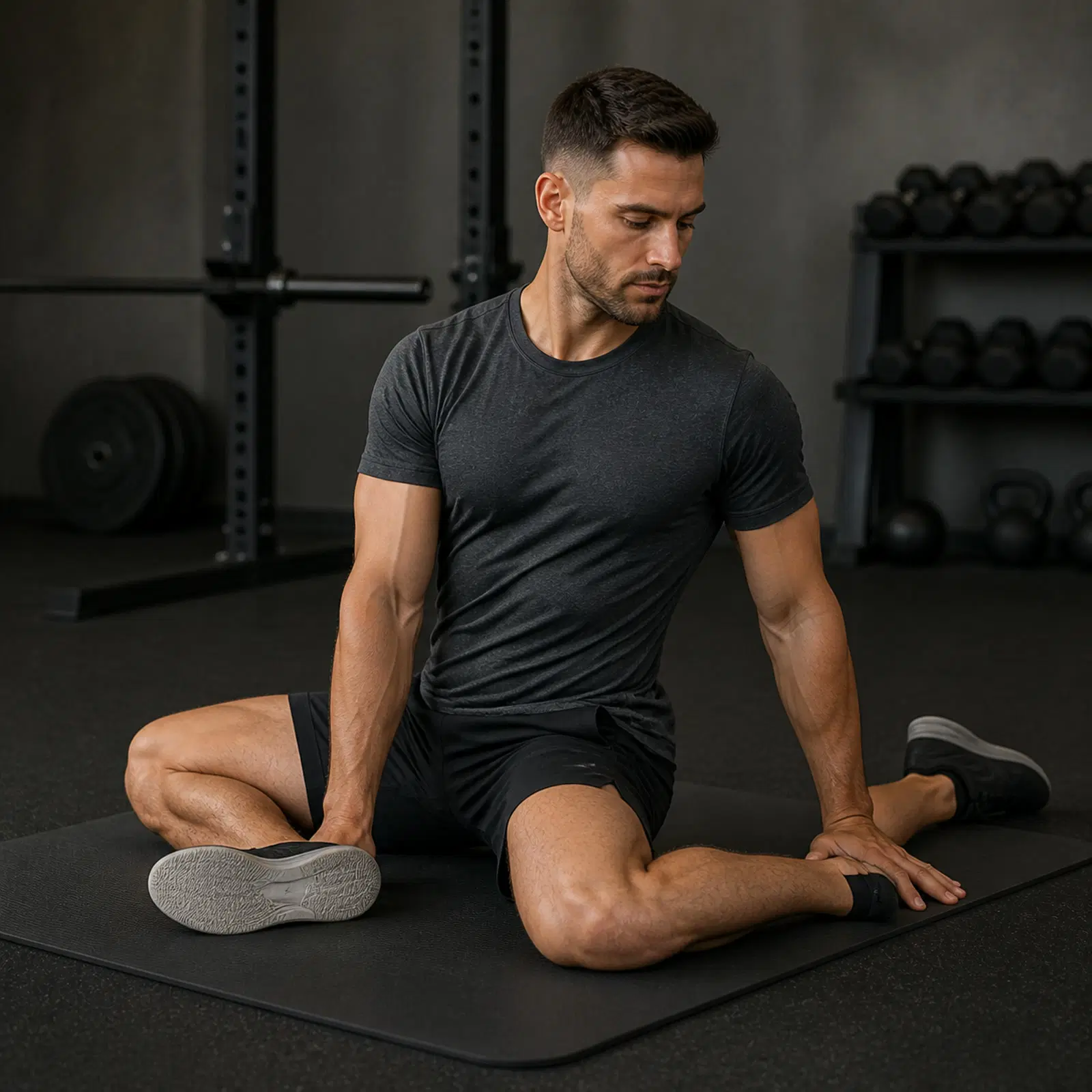
Shoulder CARs (Controlled Articular Rotations)
Sources and review status
Review pending — this text hasn’t been signed off by a reviewer yet.
See this lesson’s sources0% read · 2 min left
Slowly trace the largest circle your shoulder can actively make, body braced and the rest of you still — a daily joint-health and active-mobility drill.
Detail
A Controlled Articular Rotation for the shoulder (see the principle Controlled Articular Rotations (CARs)): brace the whole body, keep the spine and the other arm fixed, and move one shoulder through the biggest circle it can produce under its own muscular control (Shoulder / Arm Range of Motion).
A typical path: from the side, raise the straight arm forward and up overhead with the palm rotating; at the top, rotate the shoulder (turn the thumb back, internally rotating) and bring the arm down and behind; then reverse. Throughout, keep maximal tension in the working arm and the rest of the body still — the hallmark of a CAR versus a loose arm circle (Arm Circles).
This builds and assesses active, controllable end-range shoulder mobility (Mobility vs Flexibility) and is commonly done daily as a joint-health practice. The hip equivalent is hip CARs (Hip CARs (Controlled Articular Rotations)).
Coaching:
- Move slowly (several seconds per circle); control at the end ranges is the point, not speed.
- Keep the whole body braced; do not let the spine arch or the torso sway to "cheat" range.
- Stay within a pain-free range; this is also a way to find where active range is limited.
- Typical dose: ~1–3 reps per direction, per shoulder.
Key facts
- One shoulder traces its largest active circle, body braced and still, slow and controlled.
- Builds/assesses active end-range shoulder mobility (FRC principle); often daily.
- Slow, maximal-tension, pain-free — distinct from loose arm circles.
- Typical dose: ~1–3 reps per direction per shoulder.
Connections
- Controlled Articular Rotations (CARs) — the governing principle.
- Mobility vs Flexibility — develops active, controllable range.
- Shoulder / Arm Range of Motion — joint trained.
- Hip CARs (Controlled Articular Rotations) — hip equivalent.
- Arm Circles — the faster, less-controlled warm-up cousin.
Sources
Keep this lesson, or ask how it applies to you.
Educational content only — not medical advice. Always consult a qualified professional for individualized guidance, especially around injury, pregnancy, or medical conditions.