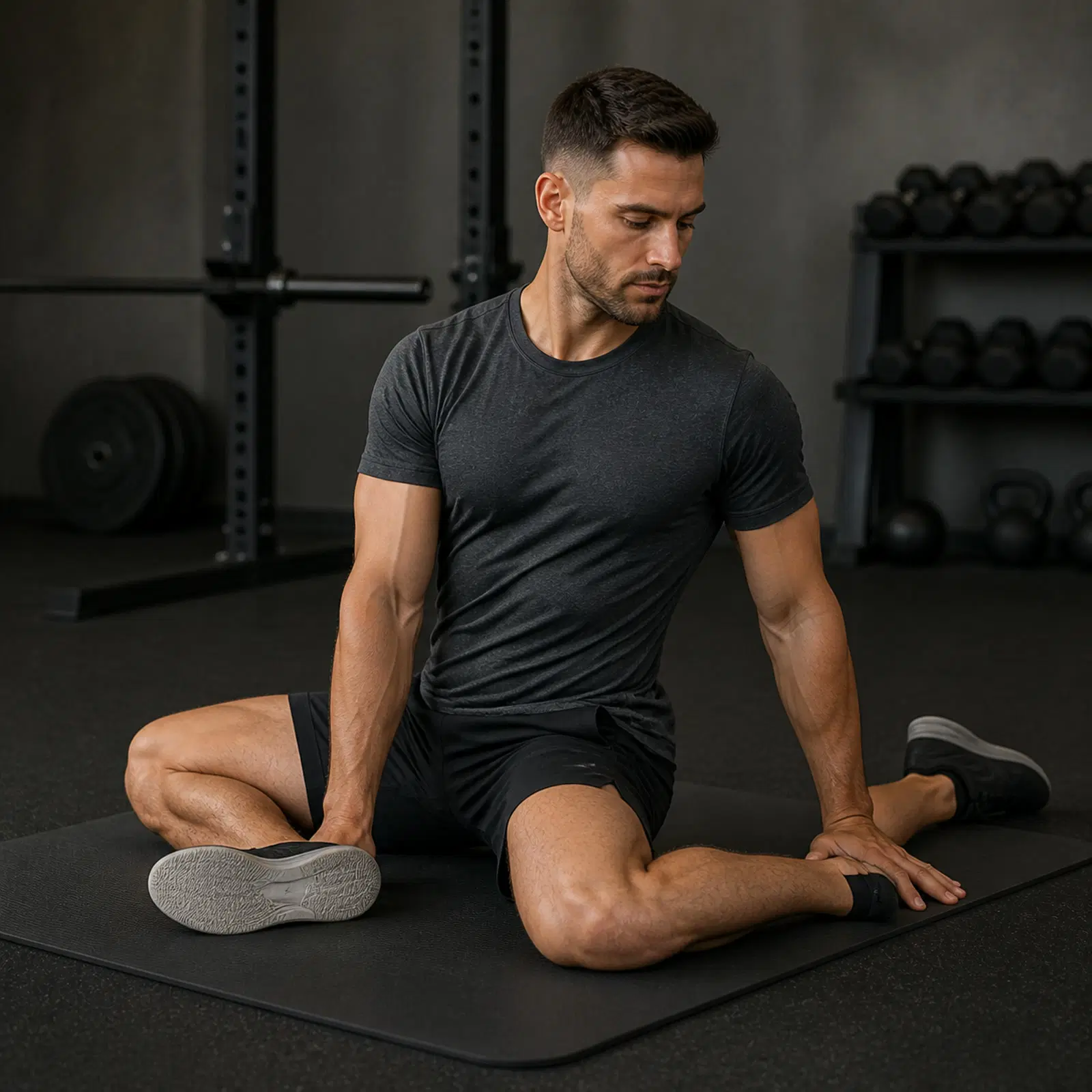
Thoracic Rotations (Open-Book / Quadruped)
Sources and review status
Review pending — this text hasn’t been signed off by a reviewer yet.
See this lesson’s sources0% read · 2 min left
Drills that isolate rotation to the mid-back (thoracic spine) — the joint-by-joint "mobility" segment — while keeping the lumbar spine stable.
Detail
The thoracic spine is a mobility joint in the joint-by-joint scheme (see Stability vs Mobility (Joint-by-Joint Approach)); restoring its rotation reduces compensatory twisting at the lumbar spine (which should be stable). Two common drills:
- Open-book (side-lying) — lie on one side, knees bent and stacked, arms together out front. Keeping the knees down, open the top arm across the body toward the floor on the other side, following the hand with the eyes, then return. The pinned hips keep rotation in the thoracic spine.
- Quadruped (hand-behind-head) rotation — on hands and knees, place one hand behind the head; rotate that elbow down toward the opposite arm, then up toward the ceiling, opening the chest. Keep the hips level so the motion stays thoracic.
Both develop active thoracic rotational mobility (Spine Range of Motion) and feature in dynamic warm-ups (see Dynamic Warm-Up (Mobility-as-Training)) and within the world's greatest stretch (World's Greatest Stretch).
Coaching:
- Keep the lumbar spine stable and hips/pelvis still — the rotation should come from the mid-back, not by twisting the low back.
- Move smoothly with the breath; reach a touch farther over successive reps.
- Typical dose: ~8–10 rotations per side.
Key facts
- Open-book (side-lying) and quadruped hand-behind-head rotations isolate thoracic rotation.
- Thoracic spine is a mobility joint; restoring rotation spares the lumbar spine.
- Keep hips/lumbar still — rotate from the mid-back.
- Typical dose: ~8–10 per side.
Connections
- Dynamic Warm-Up (Mobility-as-Training) — dynamic warm-up drill.
- Stability vs Mobility (Joint-by-Joint Approach) — thoracic = mobility joint rationale.
- Spine Range of Motion — spinal rotation ROM.
- World's Greatest Stretch — contains a thoracic rotation.
Sources
Keep this lesson, or ask how it applies to you.
Educational content only — not medical advice. Always consult a qualified professional for individualized guidance, especially around injury, pregnancy, or medical conditions.