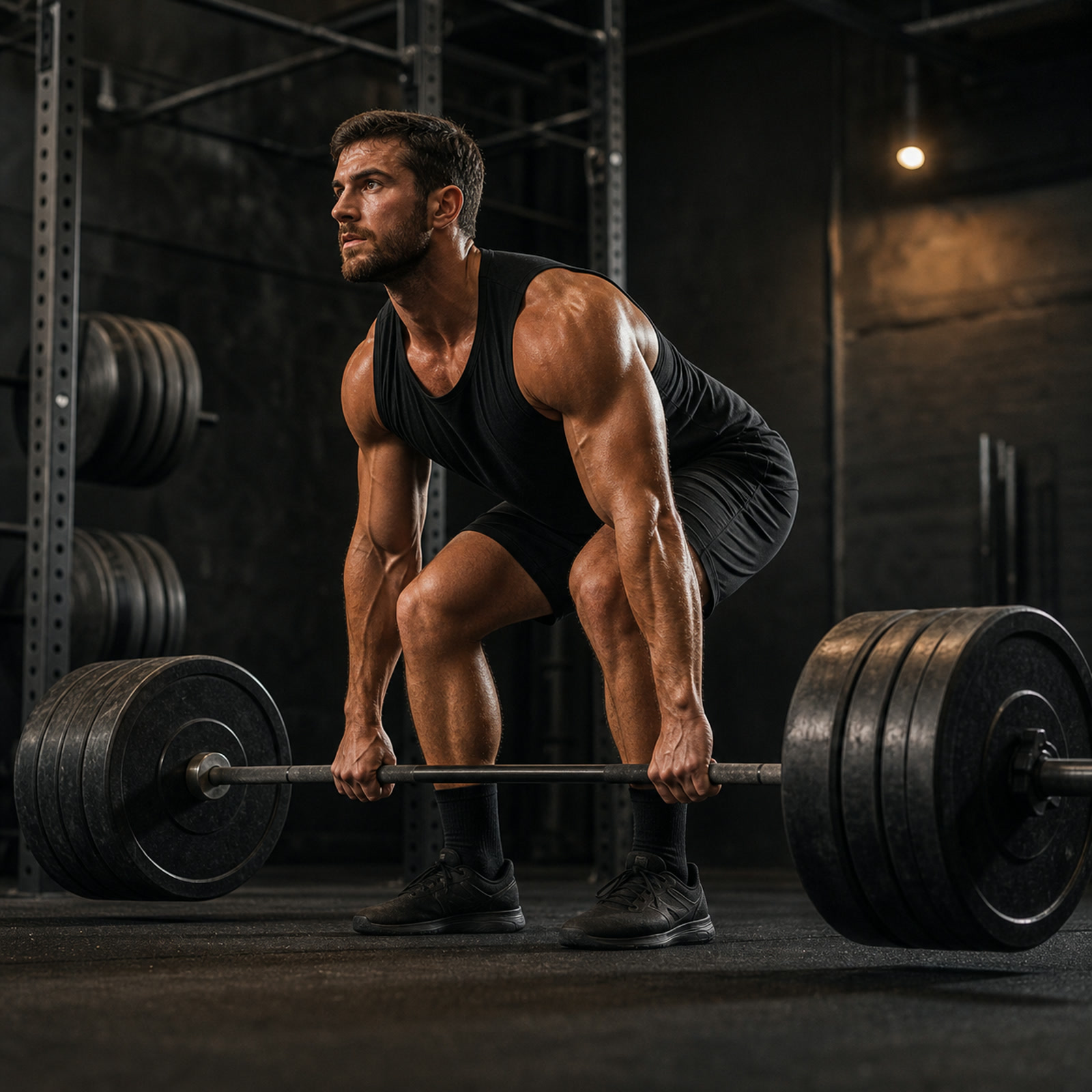
Standing Barbell Curls
0% read · 1 min left
Standing barbell curl working the short and long heads of the biceps; the classic exercise used to demonstrate the cheat system and biceps strength curve.
Detail
In the barbell curl the weakest position is when the arms are fully extended, and the strongest position is when the elbow joint is at approximately a 90-degree angle (force is optimized at about a 100-degree elbow angle). In strict form the maximal resistance that can be lifted is limited by the weakest, fully extended position, so the biceps are not maximally loaded through the stronger part of the range. The cheat system uses a slight body swing to start the bar moving, allowing 10 to 20 more pounds of resistance — but a swinging movement of the hips and lower back places additional stress on the lower back. For heavy standing barbell curls a weightlifting belt may be necessary. The source places this in the "midrange" position of the Positions-of-Flexion biceps chart (machine curls).
Key facts
- Primary Emphasis: Short Head, Long Head.
- Secondary Emphasis: Brachialis, Brachioradialis.
- Strength curve: weakest fully extended; strongest near 90-100 degrees of elbow flexion.
- Cheating allows ~10-20 lb more but stresses the lower back.
Connections
- biceps-brachii — short and long heads.
- brachialis / brachioradialis — secondary movers.
- cheat-system — the canonical cheat-system example.
- weightlifting-belt-safety-concerns — recommended for heavy standing curls.
- momentum-injury-risk — swing increases lower-back stress.
Educational content only — not medical advice. Always consult a qualified professional for individualized guidance, especially around injury, pregnancy, or medical conditions.