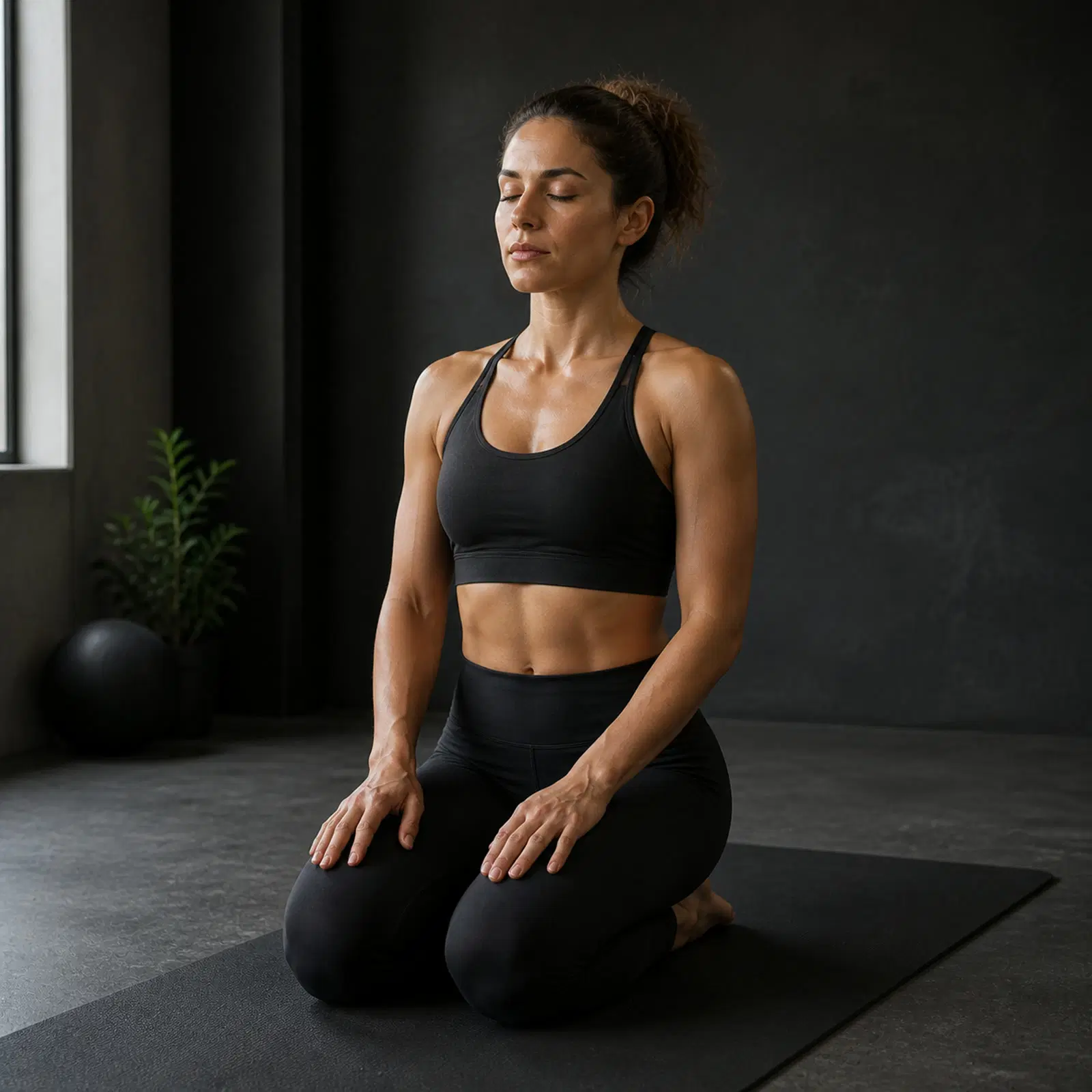
Mobility Flows & Movement Practice (Overview)
Sources and review status
Review pending — this text hasn’t been signed off by a reviewer yet.
See this lesson’s sources0% read · 1 min left
Continuous, low-load sequences that move joints actively through their range — combining mobility, active flexibility, and control — used to warm up, restore range, and practice movement.
Detail
A mobility flow links active joint movements and transitions into a continuous sequence performed with control through full available range. Unlike static stretching (passive, held), flows are dynamic and active (Active Stretching), training mobility — usable range plus the strength/control to own it (Dynamic Warm-Up (Mobility-as-Training)) — rather than passive flexibility alone.
Common ingredients: spinal articulation (cat-cow), hip openers (lunges with rotation, 90/90 transitions), shoulder circles/CARs (controlled articular rotations), thoracic rotations, deep squats, and quadrupedal transitions (Animal Flow & Ground-Based Movement (Overview)). Yoga's sun salutation (Sun Salutation (Surya Namaskar)) is itself a mobility flow.
Primary uses:
- Warm-up. A dynamic warm-up that raises tissue temperature and rehearses ranges before training (Types of Warm-Up (Passive, General, Specific)).
- Mobility development / "movement snacks." Short standalone sessions to maintain or restore joint range.
- Active recovery. Low-intensity flowing movement on rest days.
Move within pain-free range, keep loads light, and prioritize control over depth.
Key facts
- Continuous, active sequences moving joints through full range (mobility, not just passive flexibility).
- Ingredients: spinal articulation, hip openers, shoulder/thoracic CARs, deep squats, quadruped transitions.
- Uses: dynamic warm-up, mobility development, active recovery.
- Control over depth; pain-free range; light load.
Connections
- Full-Body Mobility Flow (Sequence) — a worked example flow.
- Dynamic Warm-Up (Mobility-as-Training) — mobility as trainable capacity.
- Active Stretching — active vs passive flexibility.
- Types of Warm-Up (Passive, General, Specific) — dynamic warm-up use.
Sources
Keep this lesson, or ask how it applies to you.
Educational content only — not medical advice. Always consult a qualified professional for individualized guidance, especially around injury, pregnancy, or medical conditions.