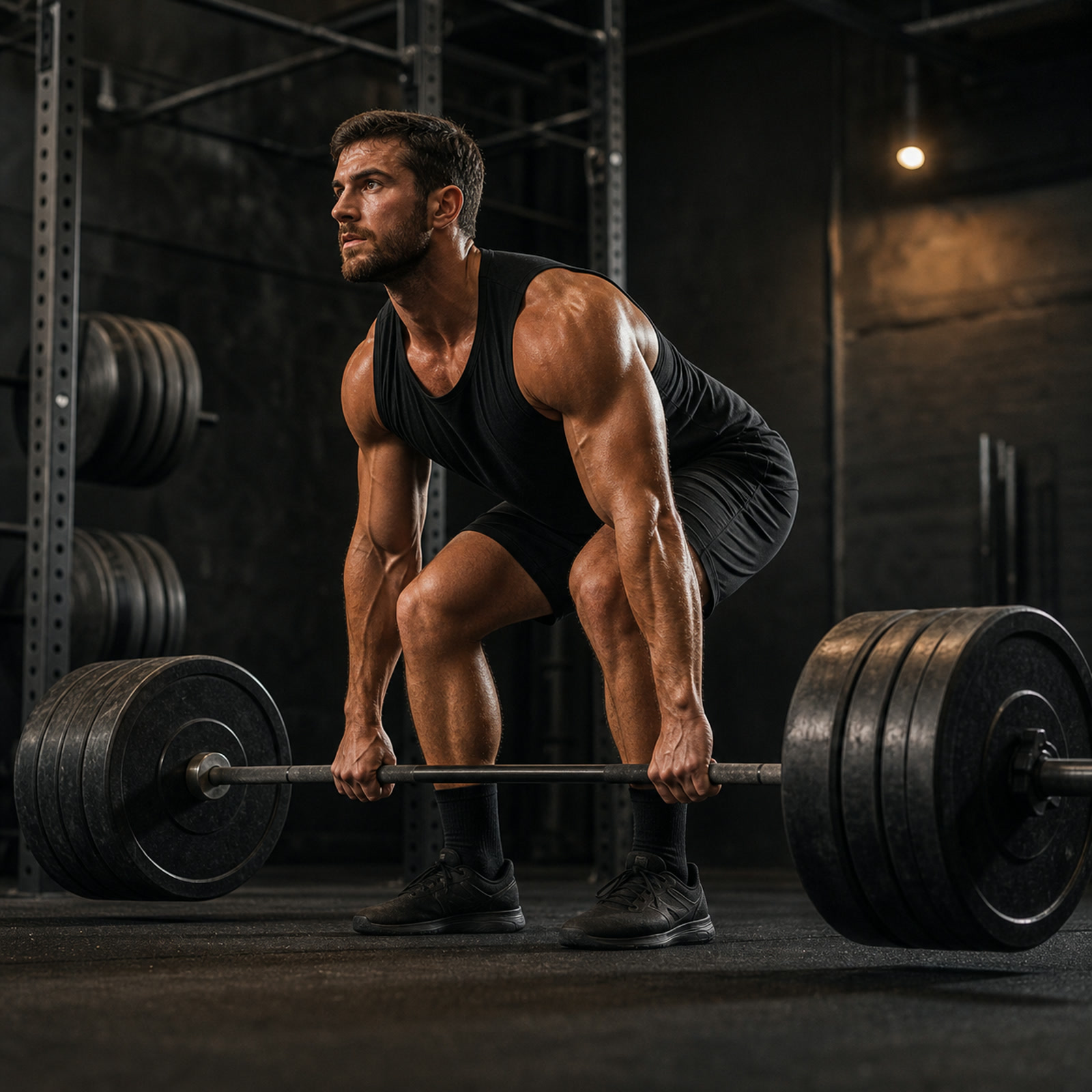
Olympic-Lift Derivatives for Power
0% read · 2 min left
Partial or simplified versions of the snatch and clean & jerk (power clean, hang clean, high pull, push press) used to train explosive triple extension and high power output.
Detail
The competition Olympic lifts — the snatch and the clean & jerk — produce some of the highest power outputs and rates of force development measured in any resistance exercise, because the load must be accelerated explosively through triple extension of the ankles, knees, and hips. To capture this training stimulus without the long technical learning curve of the full lifts, coaches use derivatives:
- Power clean / power snatch — catch the bar in a quarter-squat rather than a full squat.
- Hang clean / hang snatch — start from the hang (mid-thigh or knee) rather than the floor, isolating the explosive second pull.
- Mid-thigh / clean pull, snatch pull, high pull — pulling derivatives without the catch.
- Push press / push jerk — explosive overhead drive using leg drive.
These movements train the posterior chain (glutes, hamstrings, erector spinae) and triple extension that transfer to jumping, sprinting acceleration, and changes of direction. They are technically demanding and require coaching; loads are typically moderate-to-heavy (~70-90% of the derivative's 1RM) for strength-speed, lighter for speed-speed, with low reps (1-5), maximal intent, and full recovery (2-5 min). Place early in the session when fresh and neurologically rested.
Key facts
- Derivatives = partial/simplified snatch & clean (power clean, hang clean, pulls, push press).
- Train explosive triple extension (ankle-knee-hip) — high power and RFD.
- Loads ~70-90% 1RM for strength-speed; lower for speed-strength; reps 1-5.
- Technically demanding — require qualified coaching and a strength base.
- Strong transfer to jumping, sprint acceleration, and COD.
Connections
- rate-of-force-development — among the highest-RFD trainable lifts.
- ballistic-training — both are explosive whole-body methods.
- complex-contrast-training — heavy lift + Olympic derivative pairings.
- deadlift — shares the pull-from-floor posterior-chain pattern.
- gluteus-maximus / hamstrings — prime movers in triple extension.
Educational content only — not medical advice. Always consult a qualified professional for individualized guidance, especially around injury, pregnancy, or medical conditions.