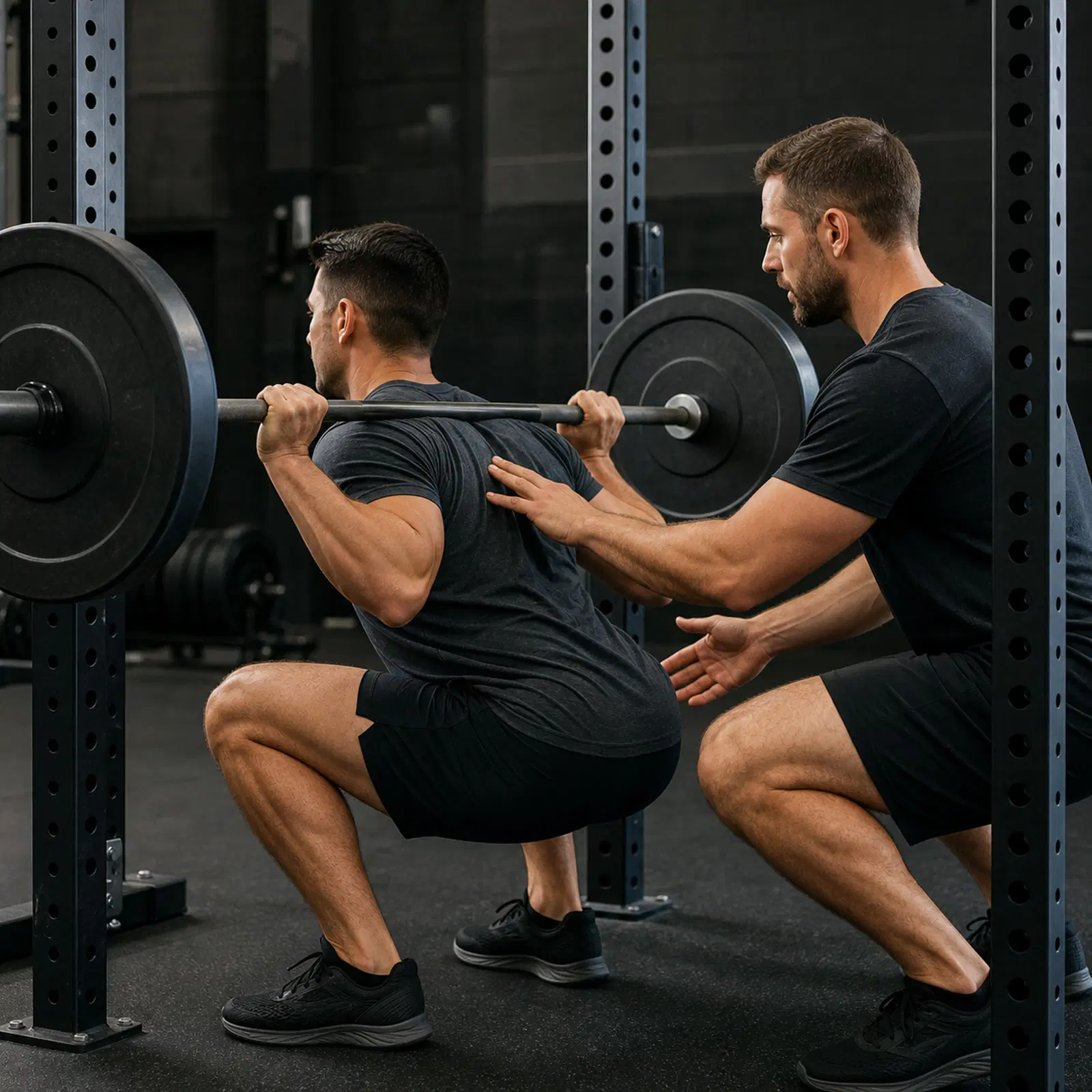
Knee–Toe Relationship Rule
Sources and review status
Review pending — this text hasn’t been signed off by a reviewer yet.
Historical reference: its only source is the original reference manual, and some of it may be out of date. Not used for AI answers until re-sourced.
See this lesson’s sources0% read · 1 min left
In the squat, manage where the knees travel relative to the toes — keeping the knees from passing the toes versus keeping the spine vertical — and find the "happy medium."
Detail
The Knee–Toe Relationship is a flagged safety concept for the squat (emphasized with "KNEE - TOE RELATIONSHIP!" in the source). The hand-drawn diagrams show three squat positions, each with a center-of-gravity (CG) line:
- To keep the knees from passing the toes, the buttocks are pushed outward (hips back).
- To keep the spine in a vertical plane requires compression of the knees and heel elevation.
- The best position is the "Happy Medium" between these two extremes.
This is one of several relationships to understand for safe squatting, alongside femur-length vs. torso-length, hip–knee, knee–foot placement, and stance width.
Key facts
- Pushing the buttocks outward (hips back) keeps the knees from passing the toes.
- Keeping the spine vertical requires knee compression forward and heel elevation.
- The recommended squat position is the "happy medium" between these.
Connections
- Knee Safety in the Squat — broader squat-technique safety guidance.
- Squat Depth and Knee Safety (Deep Squats Are Not Inherently Dangerous) — squat depth and knee safety (depth set by individual mobility, not a parallel ceiling).
- Bar Placement in the Squat (High / Low / Front) — bar position interacts with squat mechanics.
- Knee-Toe Relationship — anatomy-domain treatment of the same concept.
- Femur Length vs. Torso Length (Squat Mechanics) — femur-vs-torso length relationship in squats.
- Spine Positioning — "S" Shape, Never "C" — maintaining the spine's "S" shape.
Sources
Topics like this depend on your health and history. A qualified coach or clinician can apply it to you safely.
Educational content only — not medical advice. Always consult a qualified professional for individualized guidance, especially around injury, pregnancy, or medical conditions.