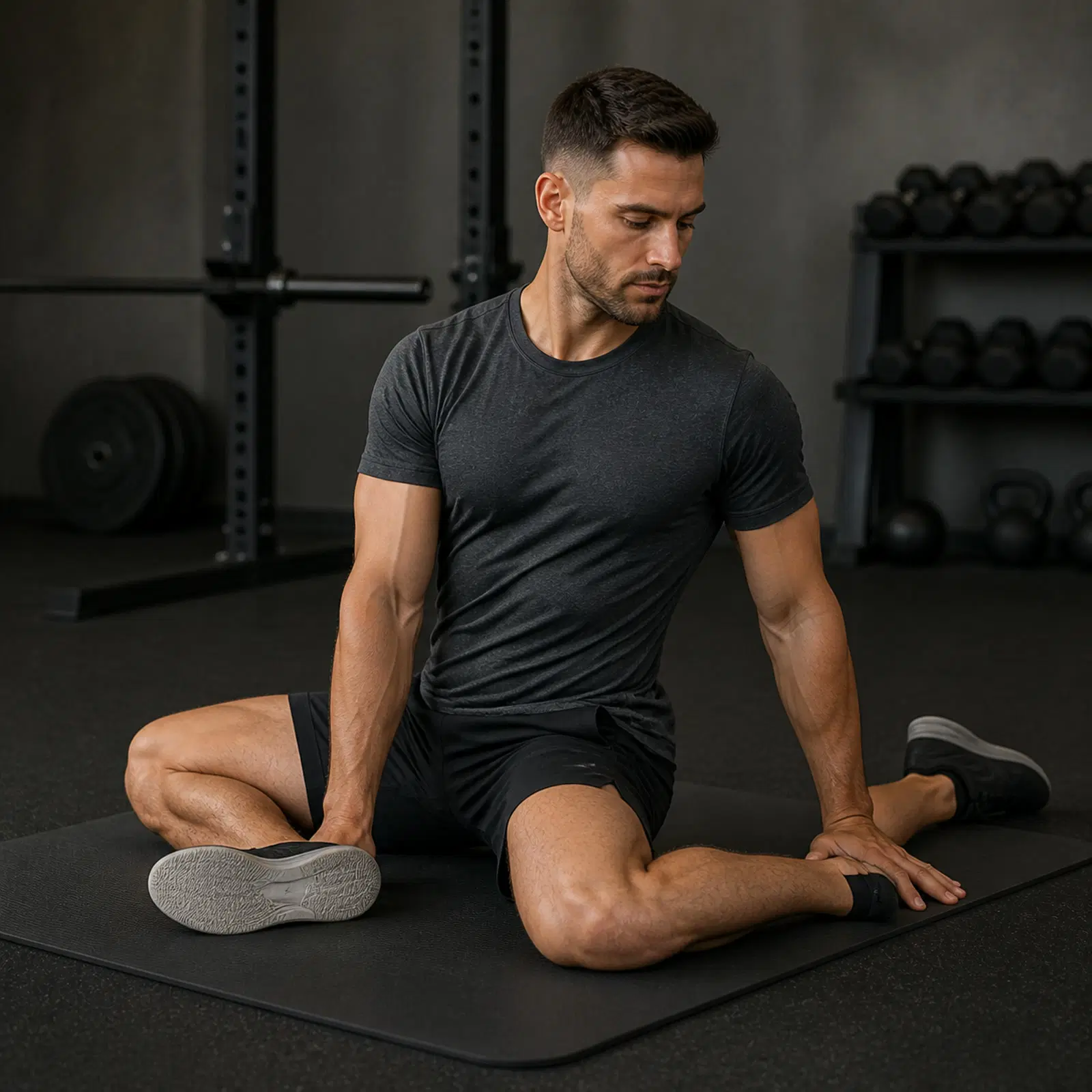
Mobility vs Flexibility
Sources and review status
Review pending — this text hasn’t been signed off by a reviewer yet.
See this lesson’s sources0% read · 5 min left
Flexibility is how far a joint can be moved, often with outside help. Mobility is how much of that range you can reach and control with your own muscles. Build both by stretching and by strengthening through full range.
The explanation
Flexibility is the range of motion available at a joint. You usually test and train it passively: gravity, a partner, a strap or your other hand takes the joint toward end range while the target muscles relax (see Passive Stretching, Range of Motion (ROM)).
Mobility, as Fysiqal uses the word, is active, controlled range. It is the part of that range you can reach and hold with your own muscle force and coordination (see Motor Control and Motor Learning). Active range is usually smaller than passive range. Someone can be pushed into a deep hamstring stretch yet be unable to lift that leg as high on their own. The gap between the two is what mobility work targets.
What the evidence says about building range:
- Stretching works, but acute gains are short. In Behm et al.'s 2016 review, static, dynamic and PNF stretching all increased range of motion. The immediate gain typically lasted under 30 minutes. Lasting change comes from doing it regularly. The authors attribute much of the change to reduced stiffness and greater stretch tolerance, not only longer tissue.
- Strength training through full range builds range too. Afonso et al. (2021) pooled 11 randomised trials (452 people) and found no difference in range-of-motion gains between strength training and stretching. That held for active and passive range.
- ACSM's dose for flexibility: flexibility exercises for each major muscle–tendon group, about 60 seconds total per exercise, on at least 2 days a week. ACSM also recommends neuromotor training (balance, agility, coordination) 2–3 days a week (Garber et al. 2011).
What that means in practice. Use stretching (see Static Stretching) when passive range is the limit. Use controlled, loaded work through range when control is the limit: controlled articular rotations (Controlled Articular Rotations (CARs)), end-range holds, and full-range lifts. Most people benefit from a mix.
Who it’s for
- Lifters who can get into a position with help but not on their own: a deep squat, an overhead lockout, a hip hinge with a flat back.
- Anyone choosing between "more stretching" and "more strength work" to improve range.
- People who want a simple weekly dose rather than an open-ended routine.
Limits
- The terms aren't standardised. Research mostly measures "range of motion" (active or passive). "Mobility" as active, controlled range is a useful coaching definition, not a formal scientific one.
- More range is not always better. Hypermobile people usually need control and strength, not more stretching.
- Pain is not a mobility problem to self-treat. Joint pain, a recent injury, numbness or a sudden loss of range needs a clinician.
- Afonso 2021 found the pooled studies very heterogeneous, so "strength = stretching for range" is a group-level result.
Show me
Jordan can't reach parallel in the squat without his heels lifting.
- Test passive vs active. In a half-kneeling knee-to-wall ankle test (shown in the Fysiqal media library as Ankle Mobility Drill (Knee-to-Wall Dorsiflexion)), his knee travels well past his toes when he leans his bodyweight in. So passive ankle range is fine. In the squat, he collapses forward at the bottom. The limit is control at depth, not tissue length.
- Plan (3 sessions a week, ~10 minutes):
- Goblet squat to a box, pausing 3 seconds at the bottom (a demo is in the Fysiqal media library under Goblet Squat and Box Squat). Lower the box 2–3 cm every week or two.
- Controlled ankle and hip rotations as part of the warm-up (Controlled Articular Rotations (CARs)).
- Keep a stretch where it helps. Static calf stretching after training, 60 seconds total per side, because tight calves are not his main issue but it's cheap to keep.
- Re-test after 4–6 weeks: depth with heels down, in a squat he controls.
Try it
Your turn. Pick one position you can't reach well (e.g. raising a straight leg, reaching overhead, the bottom of a squat).
- Passive test: how far can it go with help (a strap, a wall, a partner)?
- Active test: how far can you take it on your own and hold it for 3 seconds?
- Decide: a big gap means the limit is control, so add slow, loaded work at the end of your range. A small gap with both limited means the limit is range, so add regular stretching or full-range strength work.
Answer check: a large passive–active gap points to strength and control at end range. If both tests are limited and painful, don't push it; get it assessed.
What next
Next lesson: Dynamic Warm-Up (Mobility-as-Training). See how to turn mobility work into a 5–10 minute warm-up you'll actually do.
Key facts
- Flexibility = available range (often passive). Mobility = range you can actively reach and control.
- Stretching raises range, but acute gains usually fade within ~30 minutes (Behm 2016); consistency builds lasting range.
- Strength training through full range improved range as much as stretching across 11 RCTs (Afonso 2021).
- ACSM: flexibility work ~60 s total per exercise on ≥2 days/week; neuromotor training 2–3 days/week (Garber 2011).
- Diagnose the gap first: passive limit → stretch more; control limit → strengthen at end range.
Connections
- Benefits and Outcomes of Flexibility Exercise, Passive Stretching, Active Stretching: the flexibility side.
- Controlled Articular Rotations (CARs): a mobility-building method.
- Dynamic Warm-Up (Mobility-as-Training): putting mobility work into a warm-up.
- Motor Control and Motor Learning: the control component of mobility.
- Range of Motion (ROM): the underlying range-of-motion concept.
Sources
- Position standGarber CE et al. ACSM Position Stand: Quantity and quality of exercise for developing and maintaining cardiorespiratory, musculoskeletal, and neuromotor fitness in apparently healthy adults. Med Sci Sports Exerc 2011;43(7):1334–1359 Published 2011 · DOI 10.1249/MSS.0b013e318213fefb · Accessed 2026-10-13
- ReviewBehm DG, Blazevich AJ, Kay AD, McHugh M. Acute effects of muscle stretching on physical performance, range of motion, and injury incidence in healthy active individuals: a systematic review. Appl Physiol Nutr Metab 2016;41(1):1–11 Published 2016 · DOI 10.1139/apnm-2015-0235 · Accessed 2026-10-13
- Meta-analysisAfonso J et al. Strength training versus stretching for improving range of motion: a systematic review and meta-analysis. Healthcare 2021;9(4):427 Published 2021 · DOI 10.3390/healthcare9040427 · Accessed 2026-10-13
Corrections (1)
- 2026-10-13 — Upgraded to an applied lesson; replaced the '<!-- verify -->' consensus Source line with verified sources (ACSM 2011; Behm 2016; Afonso 2021). Softened the claim that active range is 'more functionally protective' (no direct evidence found) into a practical rationale. Added Afonso 2021: strength training through full range improved range of motion as much as stretching, for both active and passive range. Added Behm 2016: acute stretching gains usually fade within ~30 minutes.
Jordan can’t reach parallel in the squat without his heels lifting.
- Test passive vs active. In a half-kneeling knee-to-wall ankle test (shown in the Fysiqal media library as Ankle Mobility Drill (Knee-to-Wall Dorsiflexion) ),…
- Plan (3 sessions a week, ~10 minutes): Goblet squat to a box, pausing 3 seconds at the bottom (a demo is in the Fysiqal media library under Goblet Squat and …
- Controlled ankle and hip rotations as part of the warm-up ( Controlled Articular Rotations (CARs) ).
- Keep a stretch where it helps. Static calf stretching after training, 60 seconds total per side, because tight calves are not his main issue but it’s cheap t…
- Re-test after 4–6 weeks: depth with heels down, in a squat he controls.
Limits: 'Mobility' has no single agreed scientific definition; joint pain, recent injury or hypermobility needs individual assessment, not a generic routine.
Read the full worked example ↑Keep this lesson, or ask how it applies to you.
Educational content only — not medical advice. Always consult a qualified professional for individualized guidance, especially around injury, pregnancy, or medical conditions.