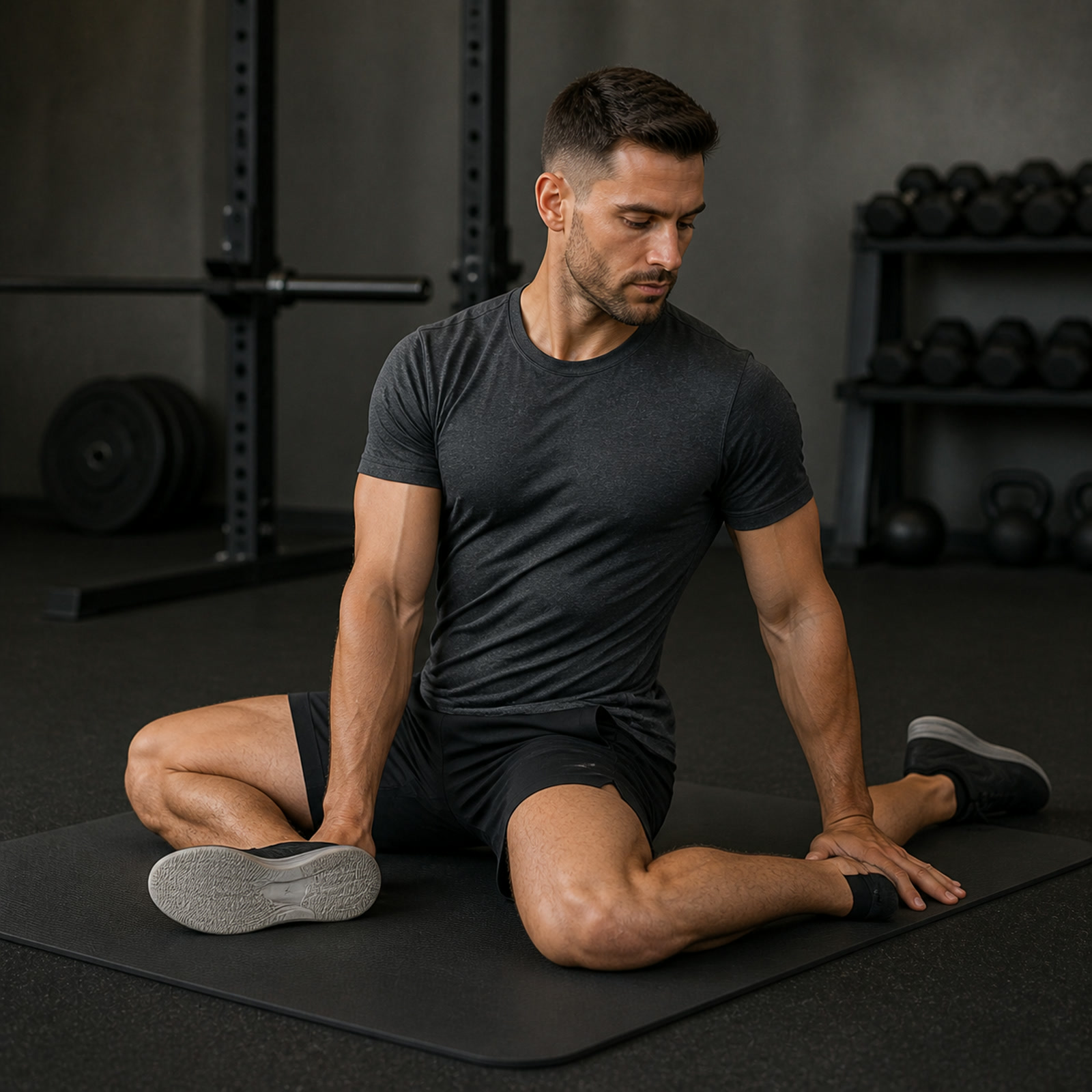
Bird-Dog
0% read · 2 min left
From hands-and-knees, extend the opposite arm and leg while keeping the spine perfectly still — a contralateral coordination and anti-rotation core-stability staple.
Detail
Start on hands and knees (quadruped): hands under shoulders, knees under hips, spine in neutral (see spine-positioning), and brace the core (bracing). Slowly extend one arm forward and the opposite leg backward until both reach roughly horizontal, without letting the lower back arch, sag, or rotate. Hold briefly, return under control, and alternate sides.
The drill demands that the trunk resist rotation and extension as the contralateral limbs load it asymmetrically (anti-rotation/anti-extension; see anti-movement-concepts), while training contralateral coordination (coordination) and the posterior chain (erector-spinae, multifidus, gluteus-maximus). A common cue: balance an imaginary cup of water on the low back so the pelvis stays level.
Coaching:
- Keep the hips square to the floor — the most common fault is the pelvis rotating up on the extending-leg side.
- Move slowly; the goal is control, not range or speed.
- McGill-style dosing favors short holds (e.g., ~7–8 s) for repeated quality reps rather than long single holds.
Progressions (see balance-training-progression): add a small "draw a square" with the extended limbs; add a band/resistance; perform from a plank/quadruped on an unstable surface. Regression: extend only the leg (or only the arm) first, keeping the other limbs grounded.
Key facts
- Quadruped; extend opposite arm + leg to horizontal with a still, neutral spine.
- Trains anti-rotation/anti-extension core stability + contralateral coordination + posterior chain.
- Keep hips square (don't let the pelvis rotate); move slowly.
- Common dosing: short ~7–8 s holds, multiple quality reps per side.
- Progress: add limb "squares," resistance, or instability; regress to single-limb.
Connections
- core-stability-vs-strength — a key stability drill.
- anti-movement-concepts — anti-rotation/anti-extension category.
- bracing — required to keep the spine still.
- exercise-dead-bug — complementary supine anti-extension drill.
- erector-spinae, gluteus-maximus — posterior-chain movers.
Educational content only — not medical advice. Always consult a qualified professional for individualized guidance, especially around injury, pregnancy, or medical conditions.