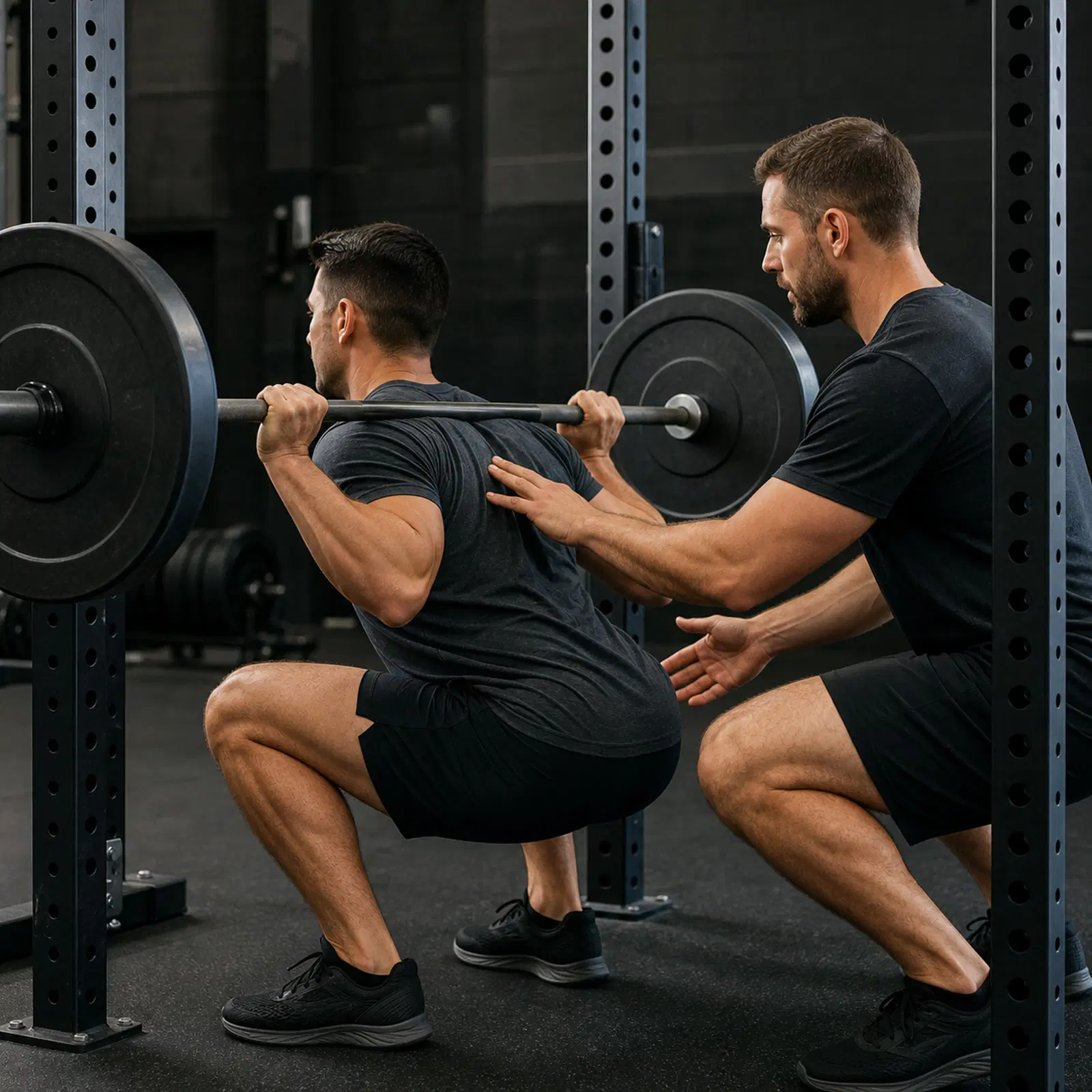
Training adapts to the person. These pages cover what changes for age, pregnancy and common conditions — and when to get clearance first.
What do you want to do?
Start here
4 lessons · ~9 min · in this order- 1Special Populations — OverviewA hub for tailoring exercise to people whose age, life stage, training experience, or health condition changes the recommendations — always starting from screening and, where needed, medical clearance.Begin →
- 2Medical Clearance & Pre-Participation ScreeningBefore progressing (especially to vigorous intensity), screen for known disease, signs/symptoms, and the desired exercise intensity to decide whether medical clearance is needed first.2 min
- 3Beginner / Novice TraineeBeginners progress fast on simple programs — full-body 2–3 days/week, learn technique, add a little each session — and should prioritize consistency and recovery over complexity.2 min
- 4Older Adults / SeniorsAdults 65+ should aim for the adult activity target (150–300 min/week moderate aerobic) PLUS muscle-strengthening on ≥2 days/week AND multicomponent balance/functional training on ≥3 days/week to preserve independence and prevent falls.3 min
Every Populations topic
41 topics
- Advanced Trainee1 minPopulation · Advanced trainees are near their genetic ceiling, so they progress over months using sophisticated periodization, high but carefully managed volume, specialization, and deliberate fatigue/recovery management.
- Arthritis / Osteoarthritis2 minPopulation · Exercise is a core, recommended treatment for osteoarthritis — it reduces pain and improves function; use low-impact aerobic, resistance, and range-of-motion work, progressing within a tolerable pain range.
- Asthma & Exercise-Induced Bronchoconstriction2 minPopulation · People with well-controlled asthma can and should exercise normally; manage exercise-induced bronchoconstriction with medication as prescribed, a proper warm-up, and environmental awareness.
- Beginner / Novice Trainee2 minPopulation · Beginners progress fast on simple programs — full-body 2–3 days/week, learn technique, add a little each session — and should prioritize consistency and recovery over complexity.
- Cardiovascular Disease (General)3 minPopulation · People with established cardiovascular disease benefit greatly from exercise but should begin within a medically supervised cardiac-rehabilitation framework; prescriptions are individualised, conservative, and symptom-/sign-guided.
- Children & Adolescents (Youth Training)3 minPopulation · Children and adolescents (WHO: ages 5–17; U.S.: 6–17) should accumulate ≥60 minutes/day of mostly moderate-to-vigorous activity, including muscle- and bone-strengthening on at least 3 days/week; supervised resistance training is safe and beneficial.
- Considerations by Sex (Where Evidence-Based)2 minGuideline · Training principles are largely the same across sexes; the well-supported, sex-specific considerations cluster around hormonal/reproductive physiology, energy availability, bone health, and (in males) prostate/older-age screening — always individualized.
- Diabetes Exercise (Redirect → Type 2 Diabetes)1 minGuideline · Exercise guidance for diabetes lives in the canonical type 2 diabetes module.
- Diastasis Recti Abdominis2 minPopulation · Diastasis recti is a widening/separation of the rectus abdominis along the linea alba (common in/after pregnancy) — managed with progressive deep-core and load-management work, not by avoiding all abdominal training.
- Dyslipidemia (Abnormal Blood Lipids)2 minPopulation · Higher-volume aerobic exercise modestly improves the lipid profile (notably triglycerides and HDL); a larger weekly dose (often toward the upper guideline range, ~150–300+ min/week) plus resistance training is recommended.
- Exercise Is Medicine (Framing for Chronic Conditions)3 minGuideline · For most chronic conditions, regular physical activity is a frontline therapy with large benefits — but it is prescribed and progressed individually, often after medical clearance, never as a substitute for medical care.
- Fall-Prevention Exercise (Older Adults)2 minGuideline · Exercise programs that combine challenging balance training with lower-body strength (≥3 sessions/week, sustained over months) measurably reduce the rate of falls in community-dwelling older adults.
- Generally Healthy Active Adults (Baseline)2 minGuideline · The baseline target for healthy adults (18–64) is 150–300 min/week of moderate (or 75–150 min vigorous) aerobic activity PLUS muscle-strengthening on ≥2 days/week, minimizing sedentary time.
- Hypertension (High Blood Pressure)3 minPopulation · Regular aerobic exercise lowers blood pressure (on average about 5–7 mmHg in people with hypertension) and a structured exercise programme of aerobic and/or resistance training is a first-line recommendation; avoid breath-holding/Valsalva and get readings in the severe range checked before training.
- Hypertension Exercise (Redirect → Hypertension)1 minGuideline · Exercise guidance for high blood pressure lives in the canonical hypertension module.
- Individuals with Obesity2 minPopulation · For weight management, build toward a higher aerobic dose (often ~200–300+ min/week) plus resistance training, favoring joint-friendly modalities — but exercise works best combined with dietary energy management.
- Intermediate Trainee2 minPopulation · Once simple session-to-session progress stalls, the intermediate trainee progresses over weeks using planned variation (e.g., undulating or split routines) and more total volume.
- Isometric Holds for Tendinopathy Pain Relief — What the Evidence Actually Shows5 minGuideline · A single bout of heavy isometric holds can produce a real, immediate
- Joint-Friendly / Low-Impact Exercise Options2 minGuideline · Low-impact modes deliver cardiovascular and strength benefits with reduced joint loading — ideal for obesity, osteoarthritis, older adults, low-back pain, and return-from-injury.
- Low-Back Pain2 minPopulation · For non-specific low-back pain, staying active and exercising (general activity plus core/motor-control and strengthening) is recommended over rest; avoid prolonged bed rest, and rule out red-flag symptoms.
- Medical Clearance & Pre-Participation Screening2 minGuideline · Before progressing (especially to vigorous intensity), screen for known disease, signs/symptoms, and the desired exercise intensity to decide whether medical clearance is needed first.
- Metabolic Syndrome2 minPopulation · Metabolic syndrome is a cluster of cardiometabolic risk factors; a higher-volume aerobic program plus resistance training and weight management reduces all of its components and overall cardiovascular/diabetes risk.
- Older Adults / Seniors3 minPopulation · Adults 65+ should aim for the adult activity target (150–300 min/week moderate aerobic) PLUS muscle-strengthening on ≥2 days/week AND multicomponent balance/functional training on ≥3 days/week to preserve independence and prevent falls.
- Osteoporosis & Osteopenia2 minPopulation · Weight-bearing aerobic, progressive resistance, and balance training help build/maintain bone and prevent falls — but avoid high-risk loaded spinal flexion and twisting where fracture risk is high.
- Pelvic-Floor Considerations in Exercise2 minPopulation · The pelvic-floor muscles work with the deep core to manage intraabdominal pressure; training them (and coordinating breathing/bracing) supports continence and safe loading, especially around pregnancy and for impact/heavy lifting.
- Postpartum Return to Exercise3 minPopulation · Exercise can resume gradually as soon as it is medically safe — some people within days of an uncomplicated birth — progressing from pelvic-floor and core re-education to fuller training while monitoring symptoms, and working back toward ≥150 min/week.
- Pregnancy (Prenatal Exercise)5 minPopulation · For uncomplicated pregnancies, U.S. and WHO guidelines recommend at least 150 minutes/week of moderate-intensity aerobic activity plus muscle-strengthening; ACOG encourages aerobic and strength exercise before, during and after pregnancy, with specific modifications and contraindications to respect.
- Pregnancy Exercise — Contraindications & Warning Signs2 minGuideline · ACOG lists absolute contraindications (do not do aerobic exercise) and relative contraindications (exercise only with clinician guidance), plus warning signs that mean stop and seek care.
- Prenatal (Redirect → Pregnancy)1 minGuideline · Prenatal exercise content lives in the canonical pregnancy module.
- Prenatal & Postpartum (Redirect)1 minGuideline · Split into pregnancy (prenatal) and postpartum, with diastasis recti and pelvic floor support modules.
- Recovery & Nutrition for Trainees 40+7 minPopulation · From roughly 40 onward — and more sharply past 50–60 — muscle becomes more resistant to a given protein dose ("anabolic resistance") and recovers more slowly from hard training, so trainees need a higher per-meal protein target and more spacing between hard sessions, not less training.
- Resistance Training After Menopause — Strength and Muscle Gains Hold Up4 minGuideline · Menopause does not meaningfully blunt the response to resistance training — the largest pooled analysis to date found postmenopausal women gain strength, lean mass, and lose fat at essentially the same rate as premenopausal women.
- Return From Injury / Rehab-to-Performance Continuum4 minGuideline · Returning from injury is a graded continuum from medical rehab to full performance — work with the treating clinician/physiotherapist, progress load and complexity gradually, and use pain/symptom and function criteria (not just calendar time) to advance.
- Sarcopenia & Age-Related Muscle Loss2 minPopulation · Sarcopenia is the progressive age-related loss of muscle mass, strength, and function — strongly counteracted by progressive resistance training plus adequate protein.
- Sedentary / Deconditioned Individuals2 minPopulation · For those starting from little or no activity, the priority is to start well below capacity, build the habit, and progress gradually — "some activity is better than none," and the largest relative health gains come from the first steps off the couch.
- Senior Training (Redirect → Older Adults)1 minGuideline · Senior strength/balance training is covered in older adults and fall prevention exercise.
- Seniors (Redirect → Older Adults)1 minGuideline · "Seniors" content lives in the canonical older adults module.
- Special Populations — Overview2 minGuideline · A hub for tailoring exercise to people whose age, life stage, training experience, or health condition changes the recommendations — always starting from screening and, where needed, medical clearance.
- Training Age & The Novice→Advanced Continuum2 minGuideline · "Training age" (how long and how effectively someone has trained) — not chronological age — determines how fast they can progress and how complex their programming needs to be.
- Type 2 Diabetes & Prediabetes2 minPopulation · Combined aerobic plus resistance training improves glycemic control and insulin sensitivity; aim for ≥150 min/week moderate aerobic, resistance 2–3 days/week, and don't let more than 2 consecutive days pass without activity.
- Youth Resistance Training — Myths vs. Evidence2 minGuideline · The fear that lifting "stunts growth" or routinely damages growth plates is not supported by evidence — supervised, technique-first resistance training is safe and beneficial for children and adolescents.
Explore connections
How Populations links to other categories — line thickness is link density in the graph, not an editorial rating.